The minimal RevOps tech stack for $3-10M ARR SaaS (under $10K/year)
Your $5.7K/year RevOps stack actually costs $19.2K when you add reconciliation hours. Here's the minimal 3-layer architecture that costs under $10K and eliminates 15-20 hrs/month of manual work.
It's the 5th business day of the month. You're on your third coffee. You've already spent six hours reconciling last month's revenue across Salesforce, Stripe, QuickBooks, and three different spreadsheets. Your NRR calculation shows 112%, but the CFO's version (using different logic) shows 107%. The Head of Sales is asking why her commission report doesn't match the billing system. And you still don't have a clean DSO number to present to the board tomorrow.
Sound familiar?
At $3-10M ARR, most SaaS companies use 4-7 tools to manage revenue operations. The sticker price might be $8K/year. But the actual cost. including 15-20 hours of manual reconciliation per month. is closer to $35K annually.
You don't need more tools. You need the right consolidation architecture that treats billing, revenue recognition, and commissions as one connected layer. Not scattered point solutions stitched together with spreadsheets and hope.
This guide gives you the specific stack, the math, and the 90-day roadmap to get there.
Why your current stack costs more than you think
Let's break down what a typical fragmented RevOps tech stack actually costs at $5M ARR:
Visible costs (what shows up on your credit card):
CRM (HubSpot or Salesforce): $3,600/year
Billing (Stripe Billing): $1,200/year
Accounting (QuickBooks or Xero): $900/year
Total visible: $5,700/year
Hidden costs (what shows up as wasted time):
Revenue recognition spreadsheets: 10 hrs/month at $75/hr = $9,000/year
Commission tracking and reconciliation: 5 hrs/month at $75/hr = $4,500/year
Total hidden: $13,500/year
True cost: $19,200/year. That's 3.4x what you think you're spending.
The billing stack tax isn't just about subscription fees. It's about the hours your finance team burns making disconnected systems agree with each other.
The five hidden costs of fragmentation
Data reconciliation time. Every month, someone on your team manually matches CRM deals to billing subscriptions to accounting entries. How many systems does it take to calculate last month's revenue? If the answer is more than one, you're paying this tax.
Forecast inaccuracy. When your revenue data lives in three places with three different definitions of "MRR," forecasts drift 30-40% from actuals. That erodes board confidence and leads to bad hiring decisions.
Commission disputes. Sales reps don't trust numbers they can't trace back to a single source of truth. Every dispute costs 3-5 hours across finance and sales leadership. Multiply that by 4-6 disputes per quarter.
Audit risk. Disconnected systems mean manual journal entries. Manual journal entries mean errors. Errors mean longer audit prep and higher risk during investor due diligence.
Hiring delay. You can't scale finance operations when your team spends 40% of their time on data plumbing instead of actual analysis. The infrastructure problem blocks the people problem.
The three-layer RevOps stack architecture
Most stack guides are CRM-first. That makes sense for sales leaders. But for finance and RevOps leaders at $3-10M ARR, your stack should be built around revenue data quality. Not sales activity tracking.
Here's the architecture that actually works.
Layer 1: Customer data and contracts (foundation)
Tool: HubSpot Sales Pro Cost: ~$300/month ($3,600/year for 10 users) Job: Single source of truth for customer relationships and contract terms.
Track customer records, contract start and end dates, and expansion opportunities here. But don't try to make your CRM do billing schedules, rev rec rules, or commission logic. That's where fragmentation starts.
Layer 2: Revenue operations core (the consolidation layer)
This is where 80% of your reconciliation work happens. And it's where consolidation matters most.
Job: Unified billing, revenue recognition, and commission calculation from one connected data source.
Calculate commissions from the same revenue data (zero reconciliation)
Generate audit-ready reports for NRR, ARR, DSO, and revenue waterfalls
Cost target: $400-600/month ($4,800-7,200/year) Avoided cost: Eliminates $10-15K/year in manual reconciliation time
What to avoid here: Trying to build this layer with Stripe Billing plus Excel plus manual journal entries. That's the $3-5M ARR trap that gets exponentially more painful as you grow. A separate rev rec tool plus a separate commissions tool plus manual reconciliation between them creates the exact problem you're trying to solve.
Also avoid over-buying. Enterprise tools like Zuora cost $50K+ per year when you need $7K/year of functionality.
Layer 3: Financial reporting and accounting (integration layer)
Tool: QuickBooks Online Plus or Xero Cost: ~$75/month ($900/year) Job: General ledger, AP/AR, payroll integration.
The critical requirement: this must sync automatically with Layer 2. If you're manually journaling revenue from your billing system into accounting, you've already lost. The journal entries should propagate from your revenue ops core into your GL without human intervention.
The tiered implementation framework
Not every tool deserves a budget line today. Here's what to deploy when.
Tier 1: Must-have from day one ($0-3M ARR onward)
CRM with clean data governance. HubSpot Pro at $300/month. Without this, you have no pipeline visibility and no structured customer data.
Accounting system. QuickBooks or Xero at $75/month. You need financial statements and tax compliance from day one.
Basic payment processing. Stripe standard at 2.9% + $0.30 per transaction. This works until you need subscription management, usage-based billing, or automated revenue recognition.
Tier 2: Critical for $3-10M scale (deploy by $5M ARR)
Consolidated billing, rev rec, and commissions platform. Budget $400-600/month. This is where spreadsheets stop working and the reconciliation tax becomes unsustainable.
Deploy trigger: When you spend more than 10 hours per month reconciling revenue data. Or when commission disputes become weekly. This replaces Stripe Billing's subscription management, your rev rec spreadsheets, and your manual commission tracking in one move.
ROI: 15-20 hours per month saved equals $13,500-$18,000 per year in recovered finance team capacity.
Basic BI and reporting. Budget $0-200/month. Metabase (self-hosted) or HubSpot native dashboards. Your executive dashboard should take 5 minutes to pull up. Not a 2-hour SQL session.
Tier 3: Defer until $10M+ ARR
Advanced forecasting (Clari, ORM): $1,000-2,000/month. Defer until you have 15+ reps and predictable sales velocity.
Sales engagement (Outreach, Salesloft): $100-150/user/month. Defer until you have 5+ SDRs doing high-volume outbound.
Data enrichment (ZoomInfo, Clay): $500-1,000/month. Defer until inbound leads are insufficient.
Complex CPQ: $500-1,500/month. Defer until deal complexity requires proposal generation for multi-product, multi-year deals with custom pricing logic.
The decision framework is simple. Ask three questions: Is this problem costing me more than 10 hours per month? Is it blocking revenue or creating audit risk? Can the problem be solved with better process instead of new software? If the first two are yes and the third is no, buy the tool.
The real-world stack: two validated examples
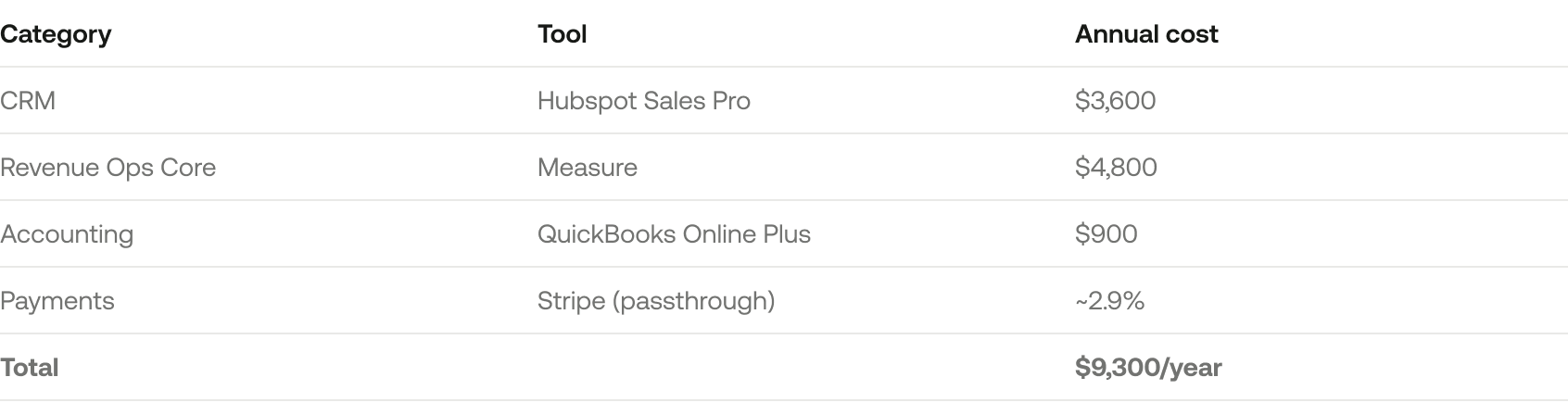
Example 1: The minimal stack ($9,300/year)
Profile: $3.5M ARR, 12 employees, simple subscription model
Why this works: NRR updates automatically from the revenue ops core. DSO is visible in real-time without manual AR aging. Commission calculations match billing data. No disputes. Month-end close drops from 8 days to 3.
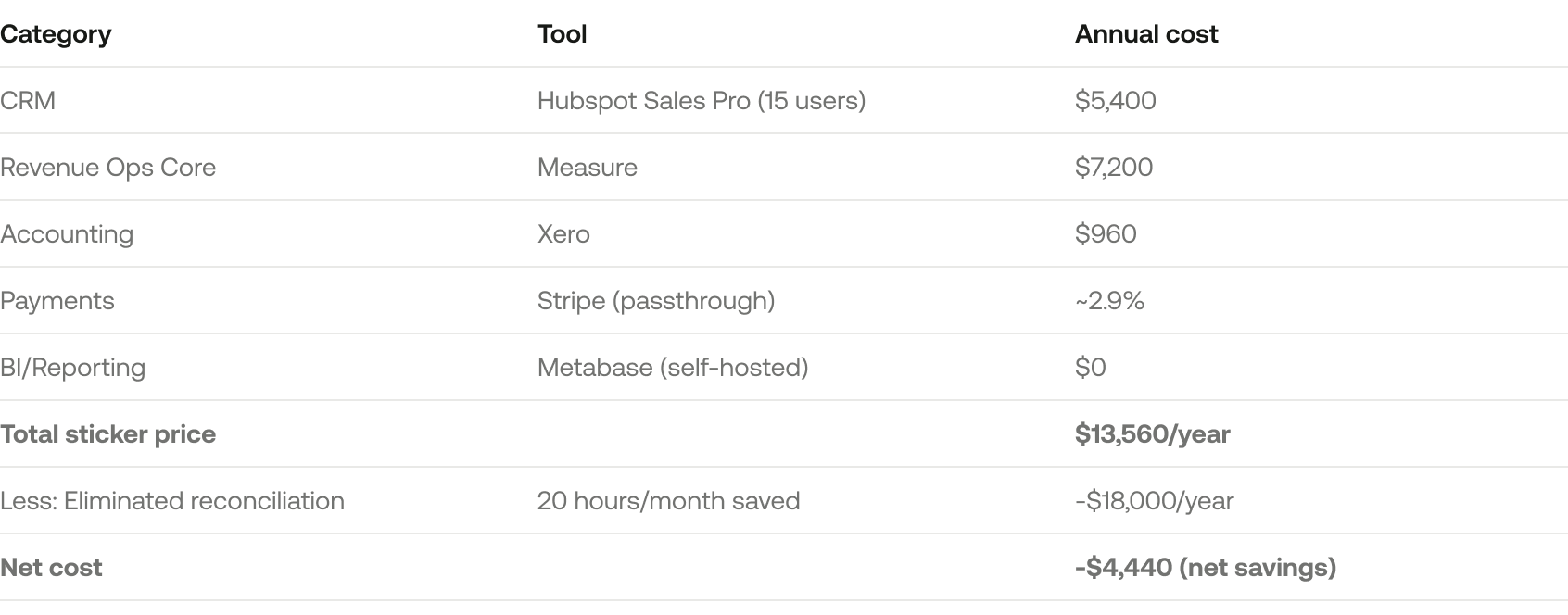
Example 2: The growth stack ($6,960/year net)
Profile: $8M ARR, 35 employees, usage-based plus subscription hybrid model
The growth stack actually saves money compared to the fragmented alternative. It handles consumption-based billing without engineering support. Revenue recognition follows ASC 606 automatically. Board-ready metrics (NRR, NDR, CAC payback) generate without manual calculations.
What you should NOT buy yet
Being explicit about what to skip is more valuable than another list of recommendations.
Salesforce CRM
At $150+ per user per month, Salesforce costs $21,600/year for 12 users versus $3,600 for HubSpot. The feature gap doesn't justify 6x cost when you have fewer than 100 employees.
The trap: "We'll need it eventually, so let's buy it now." That adds $18K/year with zero ROI at this stage.
Reconsider at: 100+ employees, complex enterprise sales cycles lasting 9+ months, or very specific industry requirements.
Enterprise rev rec platforms
Zuora, Sage Intacct, NetSuite. These cost $30K-100K/year. They're built for public companies with armies of accountants.
The trap: Over-buying on "future needs" when a $7K/year solution handles 95% of your requirements today.
Reconsider at: $30M+ ARR or when preparing for IPO audit requirements.
Separate commission tracking tools
If your revenue ops platform handles commissions natively, a standalone tool creates another reconciliation problem instead of solving one.
Reconsider at: 50+ sales reps with complex, multi-tier commission plans.
Advanced analytics platforms
Tableau, Looker, Mode. $3K-10K/year when HubSpot dashboards or Metabase cover 80% of your needs.
The trap: Buying "data infrastructure" before you've cleaned up your data sources. Analytics tools don't fix dirty data. They just visualize it faster.
How data should flow through your stack
The integration architecture matters more than individual tool features. Here's the correct flow:
Contract signed in CRM
Billing schedule created automatically in revenue ops core
Invoice generated and sent from revenue ops core
Payment received via Stripe
Revenue recognized in revenue ops core (applying ASC 606 rules)
Commission calculated in revenue ops core (using the same recognized revenue)
Journal entries synced to accounting system
Metrics updated. NRR, ARR, DSO visible in dashboards.
There are three critical handoffs in this flow. CRM to revenue ops core (contract terms and customer data). Payment processor to revenue ops core (payment confirmation). Revenue ops core to accounting (journal entries).
With a fragmented stack, each handoff is manual. Someone copies data, reformats it, uploads it, and prays it matches. With a connected revenue ops core, steps 2 through 7 happen automatically. That's where your 15-20 hours per month come back.
Measuring stack ROI: the metrics that matter
Don't just buy tools. Prove they're working.
Operational efficiency metrics
Time to close. Target: under 5 business days. If your month-end close takes longer, your stack has gaps.
Reconciliation hours per month. Target: under 5 hours. If you're above 10, the consolidation layer is your highest-ROI investment.
Commission dispute incidents. Target: fewer than 1 per quarter. Disputes signal that revenue data isn't flowing from one source of truth.
Data errors requiring correction. Target: fewer than 2% of transactions. Higher rates mean manual handoffs are introducing mistakes.
Financial data quality metrics
NRR calculation confidence. Can you defend your number in a board meeting without caveats or footnotes? If not, your data sources are fragmented.
DSO accuracy. The gap between your real-time number and a manual calculation should be zero. If it's not, you're tracking AR across disconnected systems.
Revenue waterfall completeness. New, expansion, contraction, churn. Can you generate this breakdown without manual work? That's the bar.
Common implementation mistakes
Mistake 1: Buying tools in the wrong order
Sales engagement before CRM data quality. Advanced analytics before clean revenue data. The result is always the same: garbage in, garbage out. Always start with the data foundation (CRM plus revenue ops core), then add outreach and reporting tools on top.
Mistake 2: Choosing "best of breed" over "good enough integrated"
The "best" tool in each category costs you 20 hours per month making them talk to each other. Integration complexity negates individual tool benefits. Prioritize native integrations and data consolidation over feature depth in any single tool.
Using Stripe Billing plus a separate rev rec tool plus Excel commissions is technically "best of breed." It's also three reconciliation points that compound errors monthly.
Mistake 3: Over-indexing on sticker price, ignoring TCO
The $50/month tool that requires 15 hours of manual work actually costs $1,175/month. The $500/month tool that eliminates that work is 57% cheaper. Always calculate true cost including reconciliation time. Your finance team's hours are the most expensive line item in your stack.
Mistake 4: Deferring the revenue ops consolidation layer
"We'll just use spreadsheets for rev rec until we're bigger." By the time you hit $10M, you have 3 years of bad data and broken processes to unwind. The migration gets harder every quarter you wait. Consolidate by $5M ARR, not $15M.
Mistake 5: No data governance from day one
If different team members use different logic to calculate MRR, define discounts, or recognize revenue, your metrics are unreliable regardless of tooling. Create a simple Revenue Data Playbook (2-3 pages) defining how to calculate MRR/ARR, when to recognize revenue, how to handle credits and refunds, and commission calculation rules.
When to replace vs. when to add
Not every problem requires a new tool. Sometimes it requires replacing an existing one.
Replace when you're using Stripe plus Excel for rev rec. The reconciliation tax is too high. One integrated platform eliminates the problem entirely.
Keep and extend when you have HubSpot Free and need sales engagement. Use HubSpot's native Sequences. No new vendor needed.
Replace when you have Salesforce but fewer than 20 employees. That's a 70% cost reduction waiting to happen.
Replace when you're tracking commissions in spreadsheets. Commission disputes signal a broken data flow, not a people problem.
Add when you have QuickBooks but need better reporting. QB covers the GL. Just add a visualization layer like Metabase.
The consolidation trigger points are clear. Spending more than 10 hours per month reconciling data between systems. Commission disputes more than once per month. Can't calculate NRR without a 2-hour manual process. Month-end close takes more than 5 business days. Any of these means the consolidation layer pays for itself immediately.
Your 90-day implementation roadmap
Days 1-30: Foundation
Audit your current stack. Map every tool, user, cost, and integration. Calculate true TCO including reconciliation hours. Clean CRM data (dedupe, standardize fields, document entry rules). Select your revenue ops consolidation platform. Use the billing system evaluation checklist to compare options. Document current processes for billing workflow, rev rec rules, and commission logic.
Days 31-60: Migration and setup
Migrate customer and contract data to your new revenue ops platform. Set up automated integrations (CRM to revenue ops to accounting). Configure ASC 606 rev rec rules. Set up commission calculation logic. Build initial dashboards for NRR, ARR, DSO, and revenue waterfall. Run parallel (old stack plus new stack) for one month to validate accuracy.
A good implementation shouldn't take longer than this. If a vendor quotes you 6 months, they're not built for your stage.
Days 61-90: Optimization and training
Turn off old tools. Train your finance team on new workflows. Document the new month-end close process (should be 3-5 days). Create your RevOps Stack Playbook for the team. Set up a monthly metric review cadence to track time savings.
Success criteria:
Month-end close reduced by 40%+ (8 days to 5 days or less)
NRR calculable in under 5 minutes
Commission reports match revenue system (zero disputes)
DSO visible in real-time
Board metrics automated (no manual spreadsheet prep)
Build the stack that actually reduces work
The $3-10M ARR stage is where RevOps debt compounds or gets resolved. Every quarter you spend reconciling fragmented systems is a quarter you're not analyzing expansion opportunities, improving pricing, or preparing for your next raise.
The minimal stack isn't about spending less. It's about spending correctly. One connected revenue infrastructure layer that handles billing, rev rec, and commissions together. A CRM that owns customer data. An accounting system that receives clean journal entries automatically.
That's it. Three layers. Under $10K/year. Fifteen to twenty hours per month back in your team's calendar.
Measure is the revenue ops core built for this exact stage. It connects contracts, billing, revenue recognition, and commissions in one system. No reconciliation between tools. No month-end fire drills.
Book a demo to see how Measure replaces 3-4 point solutions and gives you clean NRR, DSO, and commission data from a single source of truth. Or don't. But if you're still reconciling Stripe to QuickBooks to spreadsheets next month, you'll know exactly what it's costing you.
See it in action.
Billing and revenue automation that handles contracts, invoicing, revenue recognition, and commissions in one connected system. Book a demo to see how Measure works.


.jpg)