

Jul 6, 2026
How to speed up month end close: a SaaS finance playbook
SaaS month-end close averaging 10-15 days? Here's the exact pre-close strategy, 10-day calendar, and automation priorities to cut it to 3-5 days.

Evelyn Ly
Head of Marketing

SaaS month-end close averaging 10-15 days? Here's the exact pre-close strategy, 10-day calendar, and automation priorities to cut it to 3-5 days.
Evelyn Ly
Head of Marketing
The average B2B SaaS company under $20M ARR closes books in 10 to 15 days. The fastest teams do it in 3 to 5. The gap isn't talent or headcount. It's late data inputs, manual reconciliations, and reactive processes that force finance teams into a monthly sprint they never fully recover from before the next one starts.
Here's what actually works: move 60% of close activities before month-end through continuous accounting. The highest-ROI improvements are pre-close data staging, automated revenue recognition synced to billing, daily reconciliations instead of monthly ones, and a clear ownership calendar that every department actually follows.
This guide covers exactly how to do each of those things. With timelines, owner matrices, and a 30-day implementation plan you can start Monday.
Traditional close advice assumes you're running a manufacturing business or a services company. It doesn't account for the specific complexity of subscription revenue.
SaaS companies deal with problems that other businesses don't. Revenue recognition under ASC 606 requires allocating performance obligations across multi-element arrangements. Deferred revenue rollforwards involve tracking hundreds or thousands of individual subscription schedules. Usage-based billing calculations depend on data from engineering teams. Contract modifications happen mid-period and cascade into billing, rev rec, and commissions simultaneously.
Then there's the three-way match problem: billing system says one number, CRM says another, general ledger says a third. Finance becomes the department that reconciles everyone else's data.
Here's what a typical close timeline looks like compared to where you should be:
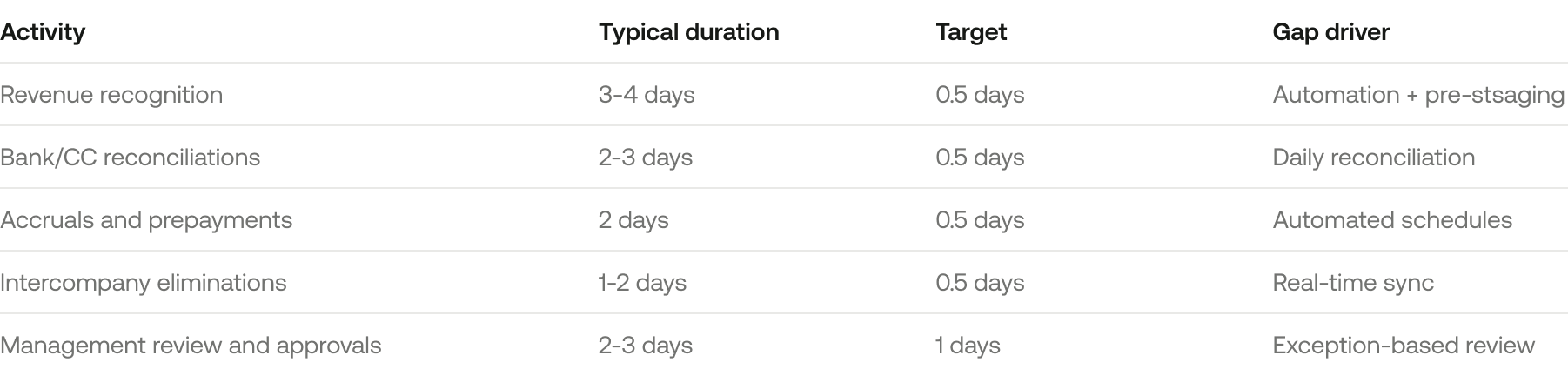
Based on conversations with hundreds of SaaS finance leaders, 60% of close delays come from data dependencies outside of finance. Your team isn't slow. They're stuck waiting.
The good news: most delays aren't inevitable. They're symptoms of process gaps and disconnected systems you can fix systematically.
Before prescribing solutions, you need to diagnose which specific bottlenecks are hurting you most. Here are the five we see repeatedly in $3-10M ARR companies.
Usage data arrives on day 3. Sales ops sends contract amendments on day 5. Customer success flags churn after close has already started. Billing system and CRM don't match.
This happens because there's no pre-close cutoff calendar, revenue operations and finance use different systems, and manual contract-to-billing handoffs create gaps that only surface during close.
Ask yourself: Do you know which contracts closed in the last 3 days of the month? Is usage data available on day 1? Do you wait for sales ops to "finish up" invoice corrections?
If you answered yes to any of those, your quick win is a day -3 cutoff for all revenue-impacting transactions with a formal exception escalation process.
Manual allocation of performance obligations. Spreadsheet-based deferred revenue calculations. SSP determination for each deal. Contract modification waterfalls. Multi-period revenue schedules managed in Excel.
This bottleneck exists because your billing system, rev rec system, and general ledger are three separate things. Finance re-creates revenue schedules from scratch every month. There's no systematic way to handle contract changes mid-period.
Usage-based and hybrid pricing models compound this further. When revenue depends on consumption, usage data delays cascade into rev rec delays cascade into close delays. One late input propagates through the entire chain.
Bank reconciliations. Credit card reconciliations. Stripe reconciliations. AR aging reviews. Deferred revenue tie-outs. Prepaid expense schedules. Commission accruals. Payroll reconciliations. Intercompany balances.
All happening simultaneously in the first 3-5 days of the new month. All in spreadsheets.
The core problem: reconciliations get saved for month-end instead of happening continuously. Multiple tools mean multiple data sources mean multiple spreadsheets. "The truth is in Excel" is the most expensive sentence in SaaS finance.
Quick win: Move your top 5 highest-volume reconciliations (usually bank, AR, Stripe, deferred revenue, and prepaid expenses) to weekly or daily frequency.
Journal entries sit in "pending approval" for 2-3 days. The CFO only reviews after everything is "done." Department heads don't review on deadline. Adjustments trigger another review cycle. "One more change" syndrome hits on day 8.
This happens because there are no approval SLAs, exception-based review isn't implemented (everything gets reviewed equally), and feedback arrives informally through Slack or email instead of a structured workflow.
Quick win: Implement materiality thresholds. Only entries above a defined dollar amount or flagged as unusual go to executive review. Everything else gets auto-approved by the Controller.
Finance is stuck waiting for sales ops (deal data), customer success (churn notifications), billing team (invoice corrections), rev ops (usage data), payroll (headcount and commissions), and procurement (vendor accruals).
No formal close calendar exists across departments. Finance is the only team that "cares" about close. Dependencies aren't documented. There's no escalation path when data arrives late.
Quick win: Create a cross-functional close calendar with explicit owner names, deadlines, and escalation rules. Share it in Slack 5 days before month-end. Make it specific: "Sarah in Sales Ops confirms all Q1 contract amendments by March 28."
The fastest-closing SaaS companies don't work harder during close. They've already done most of the work. Teams that close in 3-5 days complete 60-70% of close activities before the last day of the month.
This isn't about being faster during the sprint. It's about eliminating the sprint entirely.
Not: doing month-end work faster. Actually: staging, validating, and reconciling data in real-time so month-end is just a final lock.
Three tiers of pre-close work:
Tier 1: Real-time (every day). Revenue recognition schedules calculate automatically as contracts are signed. Bank reconciliations happen daily. Stripe and payment processor reconciliations happen daily. Subscription metrics dashboards update automatically.
Tier 2: Weekly (every Friday). AR aging review. Unbilled revenue validation. Deferred revenue balance verification. Prepaid expense schedules. Accrual reasonableness checks.
Tier 3: Pre-close window (day -5 to day -1). Usage data pull and validation. Contract modification review. Sales ops handoff of closed deals. Customer success handoff of churn and expansion. Department-level accrual estimates. Payroll and commission accrual prep.
Here's how the timelines compare:
Traditional approach: Day 0 you close the month and hope for clean data. Days 1-10 you scramble to gather data, reconcile, and adjust. Days 11-15 you handle reviews, approvals, and finalization.
Continuous accounting approach: Days -5 to -1 you stage 60% of work and validate data. Day 0 you lock the period. Days 1-3 you run final reconciliations and review. Days 4-5 you get executive approval and close.
Day -5:
Day -3:
Day -1:
Day 0 (last day of month):
Teams that pre-stage revenue recognition before month-end reduce close time by 1-2 days immediately. If rev rec is your bottleneck, this is your highest-ROI change.
You don't need a three-month transformation project. Here's a 4-week rollout:
Week 1: Diagnose. Time each close task. Identify dependencies. Survey other departments on their constraints. You need actual data before making changes.
Week 2: Prioritize. Pick the top 3 bottlenecks. Determine which can be moved to pre-close. Document current vs. desired timing for each task.
Week 3: Pilot. Move one high-volume reconciliation to daily (usually bank or Stripe). Test pre-staging revenue recognition. Share the close calendar with one department. Start with sales ops because they own the most revenue-impacting data.
Week 4: Expand. Add 2 more daily/weekly tasks. Formalize cutoff dates. Hold a cross-functional close kickoff meeting. Measure what changed.
Automation is the right answer for some problems. For others, fixing the process matters more. Here's how to tell the difference.
Priority 1: Revenue recognition. Highest complexity, most time-consuming, most error-prone in SaaS. Auto-calculate rev rec schedules from contract terms. Saves 2-4 days. Medium risk because it requires careful setup and validation.
Priority 2: Billing-to-GL sync. Manual export/import is error-prone and repetitive. Real-time sync from billing system to general ledger. Saves 1-2 days. Low risk because it's transactional data that's easy to validate.
Priority 3: Daily reconciliations. Prevents month-end reconciliation pile-up. Automated bank, credit card, and Stripe reconciliation workflows. Saves 1-2 days. Low risk because it's rule-based matching.
Priority 4: Close workflow and task management. Eliminates email and Slack chaos. Automated checklist, reminders, approvals. Saves 0.5-1 day. Very low risk because it's a process layer.
Priority 5: Reporting automation. Speeds final review and board prep. Auto-generated financial statements and KPI dashboards. Saves 0.5-1 day. Low risk because it doesn't change underlying data.
Complex judgments should stay manual: unusual transaction classification, materiality assessments, revenue recognition for non-standard deals, contract modification accounting decisions.
Low-volume, high-variance tasks should stay manual too: one-off accruals, manual journal entries below a threshold, department-specific adjustments that change every month.
And never automate a process you've only run manually for a month or two. You need to understand the edge cases first. Automate only after 3+ months of consistent manual execution.
Red flags that you need automation: revenue recognition takes 3+ days, you have 5+ spreadsheets for deferred revenue, billing and GL don't sync automatically, reconciliations are entirely manual, and your team works weekends every month.
When process improvement is enough: you close in 7-10 days, most delays are late inputs from other teams, you have clear bottlenecks but no systematic process, and close timing varies wildly month-to-month.
The honest answer: Fix the process first, then automate the process. Automating a broken process just makes you fail faster.
This calendar assumes you've implemented pre-close staging and continuous accounting. If you haven't, use this as your target state and work backward to identify gaps.
.png)
A few notes: Multi-entity operations add 1-2 days. Usage-based billing adds 1 day if data isn't pre-staged. Your first month implementing this calendar, add 2-3 buffer days.
Cross-functional clarity prevents the "I thought someone else was doing that" problem:
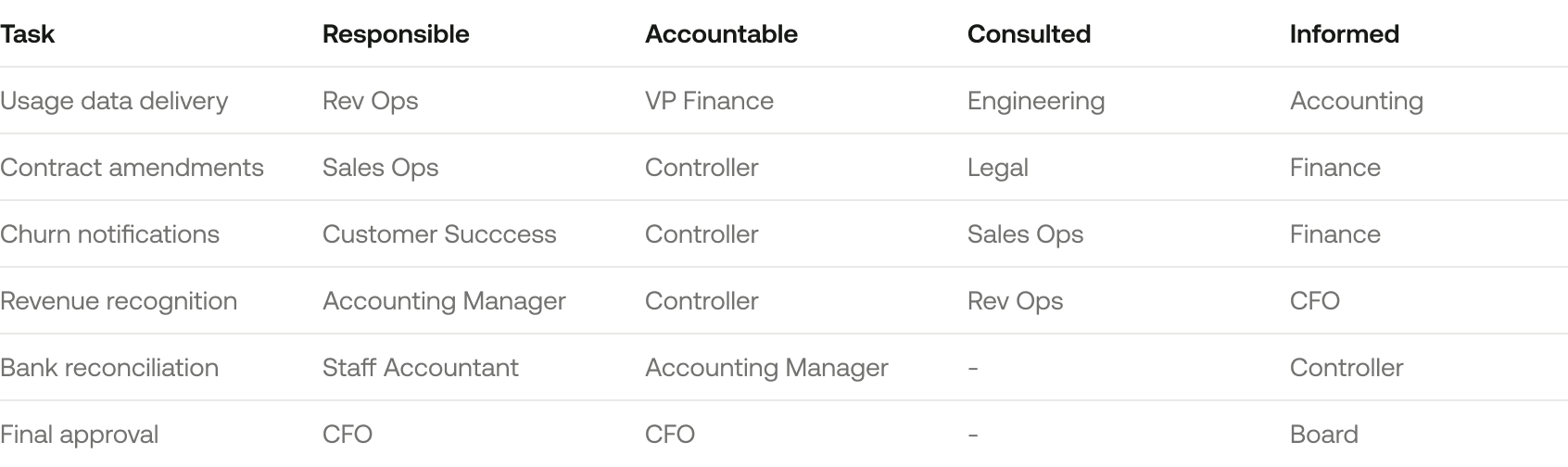
Every person on this matrix should see it before close starts. No surprises.
Generic advice breaks down when you hit the messy reality of subscription businesses. Here's how to handle the situations that actually slow you down.
The challenge: usage data arrives late, calculations are manual, and usage vs. committed minimums requires judgment calls.
How to speed it up: automate usage data pulls via API integration. Pre-calculate usage throughout the month with weekly snapshots. Implement usage dashboards so customers can self-serve (reducing disputes that delay close). Auto-calculate overage vs. committed minimums.
What good looks like: usage data is available on day 0, pre-validated weekly, and automatically flows to invoicing and rev rec without anyone touching a spreadsheet. Here's how teams handle this in practice.
The challenge: a customer upgrades on day 15. Now you have to recalculate deferred revenue, pro-rate invoices, and adjust revenue schedules.
How to speed it up: implement a day -3 cutoff for modifications. Push non-material changes to the next month. Use automated revenue waterfall calculations for changes that can't wait. Pre-stage amendment workflows in your CRM.
What good looks like: contract amendments are either handled in real-time via automation or batched to the next period unless they meet a materiality threshold. No one is manually rebuilding revenue schedules during close.
The challenge: multiple legal entities, intercompany eliminations, currency translations, and different close timings across subsidiaries.
How to speed it up: consolidate on a unified GL (not separate instances). Automate intercompany eliminations. Close subsidiaries 1 day before the parent entity. Use automated FX rate tables.
What good looks like: all entities close simultaneously, intercompany reconciliations happen automatically, and consolidation takes minutes instead of days.
The challenge: your billing system says one thing, your deferred revenue schedule says another, and your GL says a third.
This is the core problem that connected revenue infrastructure solves. When contracts, billing, rev rec, and your GL all draw from the same source of truth, the sync problem disappears. You don't reconcile because there's nothing to reconcile. The same contract data that drives billing also drives rev rec also posts to the GL.
If you're spending hours reconciling billing to deferred revenue every month, the answer isn't more reconciliation. It's fewer systems.
You can't improve what you don't measure. Track these five metrics every month.
1. Days to close. Business days from month-end to final approval. Target: 5 days or fewer. Track the trend over 6 months.
2. Tasks completed on time (%). Percentage of checklist tasks completed by deadline. Target: 90%+. This identifies dependency issues before they become bottlenecks.
3. Manual journal entries (#). Count of non-recurring JEs posted during close. Target: decreasing trend. A rising number indicates process immaturity.
4. Late data incidents (#). Count of times data arrived after its deadline. Target: 0-2 per month. This drives cross-functional accountability.
5. Unresolved exceptions at day 3 (#). Open reconciliation items on day 3 of close. Target: 0. This indicates whether your pre-close work is actually working.
Run a 30-minute retro after every close. Four questions:
Document results in a close log: bottleneck, root cause, action item, owner. After three months, you'll have a clear pattern showing exactly where your process breaks down.
There's a ceiling to what process improvement alone can achieve. Here are the signs you've hit it.
Revenue recognition takes 2+ days. Deferred revenue lives in 3+ separate files. Only one person understands how the spreadsheets work. You're copy-pasting between systems. Your close breaks when that person is on vacation. Contract modifications require rebuilding revenue schedules from scratch. You can't confidently trace from invoice to GL to rev rec.
If three or more of those are true, you have a systems problem, not a process problem.
The disconnected stack most SaaS companies run: Salesforce (contracts), then a manual handoff to the billing tool (invoices), then a spreadsheet export to revenue recognition spreadsheets, then a manual journal entry to your GL, then another spreadsheet for commissions.
Every arrow between those systems is a delay, a risk, and manual work that lands on finance during close.
The connected approach: contracts automatically sync to billing. Billing automatically calculates rev rec. Rev rec automatically posts to the GL. Commissions calculate from the same contract data. One source of truth. No spreadsheets. No re-keying. No wondering which number is right.
Non-negotiables: single source of truth for contract-to-cash, automated ASC 606 rev rec, real-time billing-to-GL sync, built-in reconciliation workflows, and audit trail with change tracking.
Nice-to-haves: built-in close checklist management, approval workflows, usage billing support, and multi-entity consolidation.
Here's exactly what to do, starting this week.
Week 1: Diagnose. Time every close task using a simple log. Identify your top 3 bottlenecks. Survey your finance team on what slows them down most. Ask other departments what's hard about close for them.
Week 2: Build the plan. Create a close calendar with owners and deadlines. Identify 3 tasks to move to pre-close. Pick one reconciliation to move to weekly. Draft a cross-functional close communication for Slack or email.
Week 3: Pilot one improvement. Test pre-close staging on one high-impact task (probably rev rec). Share the close calendar with one department. Run one reconciliation weekly instead of monthly. Measure time saved.
Week 4: Expand and systematize. Run your first post-close retrospective. Add one more pre-close task. Formalize cutoff dates with cross-functional teams. Document what worked and what didn't.
Next quarter: Automate your number one bottleneck. Target a 2-day improvement. Track metrics monthly.
The fastest-closing SaaS companies don't just have better processes. They have systems that eliminate the root causes of slow close.
When contracts, billing, revenue recognition, and commissions all live in one connected platform, revenue recognition happens automatically as contracts are signed. Billing and your GL sync in real-time. Deferred revenue is always accurate because it's calculated from the same contract data that drives everything else. Usage data flows automatically. Commissions calculate from the same source of truth.
Measure connects your entire revenue workflow in one system, eliminating the manual handoffs that make close take 10+ days. If you're spending 3+ days on revenue recognition, or your deferred revenue lives in spreadsheets, it's worth a conversation.
Book a demo to see how Measure reduces close time by 40-60%.
Billing and revenue automation that handles contracts, invoicing, revenue recognition, and commissions in one connected system. Book a demo to see how Measure works.