How to implement usage based billing: a complete operational playbook for B2B SaaS
Your top 10 accounts use 8x more than your bottom 100. Here's the complete 90-day operational playbook to implement usage-based billing without breaking revenue, churn, or your finance team.
Here's a scenario we see constantly. A $6M ARR SaaS company runs the numbers and discovers their top 10 accounts consume 8x more than their bottom 100. Everyone's on the same plan. The top accounts are getting a steal. The bottom accounts are subsidizing them without knowing it. The fix isn't a price increase email. It's restructuring how you bill entirely.
Usage-based billing (UBB) in B2B SaaS means billing customers proportionally to what they actually consume. Not seats. Not tiers. Actual metered consumption of your product's value. API calls, compute hours, records processed, documents generated, tokens consumed.
This guide isn't a strategy overview. It's an implementation playbook built for Finance leaders, RevOps teams, and technical co-founders at $3-10M ARR B2B SaaS companies. You'll get a phased roadmap, tooling guidance, customer communication frameworks, revenue recognition specifics, and financial controls. Everything you need to hand your team on Monday and execute within a quarter.
What "implementation" actually means for B2B SaaS (and what most guides get wrong)
UBB is not just a billing change. It's a revenue operations change.
Most implementation guides treat usage-based billing as an engineering problem. Build the metering pipeline, connect it to Stripe, ship it. Done.
In B2B SaaS, that approach fails. UBB touches pricing strategy, contract structure, CRM data models, revenue recognition methodology, customer success workflows, sales compensation plans, and investor reporting. If your Finance team isn't in the room from day one, you will build the wrong thing. You'll meter perfectly and invoice incorrectly.
The actual implementation problem isn't "can we count events?" It's "can we connect those events to signed contract terms, generate accurate invoices, recognize revenue correctly under ASC 606, and pay commissions on the right numbers?" That's four systems working together, not one.
The B2B UBB difference: why consumer SaaS playbooks don't apply
Enterprise procurement teams require cost predictability. Pure consumption billing terrifies them. That's why hybrid models (minimum commitments plus overages) are almost always required for B2B.
Multi-tenant complexity adds another layer. Are you billing by organization, by user, by workspace, or by usage unit? In B2B, usage events must map to signed contract terms. Unlike PLG motions where customers self-serve upgrades, your usage data needs to reconcile against negotiated rates in a specific contract.
Longer billing cycles (net-30 or net-60 invoicing vs. card-on-file) amplify disputes and tracking errors. A metering mistake caught on a credit card statement gets disputed in minutes. A metering mistake on a $47K quarterly invoice turns into a two-week finance reconciliation project.
Here's the framework. Four layers of UBB implementation:
Pricing design (choosing the right metric and model)
Usage tracking infrastructure (metering architecture and tooling)
Billing and invoicing execution (connecting usage to contracts to cash)
Every section that follows addresses one of these layers.
Phase 1. Pricing design: choosing the right usage metric
The B2B value metric framework
Your usage metric is the single most consequential decision in this entire implementation. Get it wrong and you'll rebuild everything in six months.
A strong B2B usage metric meets four criteria. First, it correlates with customer value delivered. Customers should feel like they're paying more because they're getting more. Second, it's measurable without disputes. If a customer can argue about the count, you've chosen wrong. Third, it scales with customer growth. As they grow, their usage grows, and your revenue grows. Fourth, it's explainable to a procurement team in one sentence.
Examples by vertical: API calls (data platforms, AI companies), compute hours (infrastructure, ML training), active records processed (fintech, data enrichment), documents generated (legal tech, proposal tools), messages sent (communication platforms), tokens consumed (LLM/AI products).
Anti-patterns to avoid: metrics customers can game (e.g., "active users" where customers consolidate logins), metrics that create perverse incentives (e.g., penalizing efficient usage), and metrics that require complex auditing to validate.
Hybrid pricing architecture for B2B (minimum commitments plus overages)
Pure consumption billing fails enterprise sales cycles for one specific reason: procurement can't budget for it. A CFO who can't forecast next quarter's software spend won't sign your contract.
The proven B2B model is a committed-use baseline plus an overage rate. The customer signs an annual minimum commitment (say, $60K/year for 500,000 API calls). Usage above that threshold bills at an overage rate ($0.15 per additional 1,000 calls). This gives the customer cost predictability and gives you a revenue floor.
How to model tier thresholds: analyze your existing customer base. Find the 50th percentile usage level. That's your entry commitment. The 75th percentile is your mid-tier. The 90th percentile is your enterprise tier. Overages kick in above each tier's included allocation.
Credit-based models (like Snowflake's compute credits or AWS committed-use discounts) work well when your product has multiple usage dimensions. A customer buys credits upfront and draws them down across different features. The tradeoff: credits add abstraction. Direct metered billing is simpler to understand but harder to sell at enterprise scale.
For a deeper look at structuring complex pricing models, this pricing playbook covers the B2B specifics.
The pricing design checklist (pre-build)
Before writing a single line of code or changing a contract template, validate these:
Have you validated the metric with at least 5 existing customers? (Not hypothetically. Actually asked them.)
Can your data pipeline currently measure this event per account?
What's the measurement lag? Real-time? Daily? Weekly?
Does your CRM capture usage data by account today?
Can your finance team model revenue under the new pricing with historical data?
Have you modeled the impact on your bottom 20% of accounts? (Will they churn?)
Have you modeled the expansion opportunity on your top 20%?
Does your legal team have contract language for overages and minimum commitments?
Can your sales team explain the pricing in under 60 seconds?
Have you identified the billing system changes required?
If you can't answer "yes" to at least 7 of these, you're not ready to build. You're still in design.
Phase 2. Usage tracking infrastructure
The metering architecture decision
You have three options, and the right one depends on your stage, event volume, and metric complexity.
Option 1: Build on Stripe Billing/Meter. Best for simple metrics (one usage dimension), single product, fewer than 50K events per day. Stripe handles aggregation and invoicing natively. Limitation: no custom aggregation logic, limited B2B contract support, manual rev rec. If you're evaluating this path, our Stripe comparison breaks down where it works and where it doesn't.
Option 2: Dedicated metering platform (Lago, Orb, Amberflo). Best for complex metrics, multi-tenant architectures, high event volumes (1M+ events/day). These tools sit between your product and your billing system. Tradeoff: another tool in the stack, another integration to maintain, another vendor to evaluate.
Option 3: Full custom build. Rarely justified at $3-10M ARR. The real cost isn't the initial build (which teams underestimate at 2-3 sprints). It's ongoing maintenance: schema migrations, edge case handling, accuracy audits. Budget $150-300K+ in engineering time over 18 months. That's time not spent on your product.
The raw event architecture (what "real-time tracking" actually requires)
The pipeline looks like this: Event emission at the product layer. Message queue (Kafka, SQS, or equivalent) for reliability. Aggregation service that windows and counts events. Metering database that stores aggregated totals per account per billing period. Billing system sync that converts usage counts into invoice line items.
Key engineering decisions your team needs to make:
Idempotency. Every event needs a unique key. Without it, network retries create double-counts. A single duplicate event on a high-volume account can mean a $3K invoice discrepancy.
Late event handling. What happens when an event arrives after the billing period closes? You need a policy: include in next period, back-date and re-invoice, or absorb.
Timezone normalization. If your billing period resets at midnight UTC but your customer operates in PST, an event at 11pm their time lands in a different billing period than they expect.
Multi-tenant tagging. Every event must carry an org_id (or equivalent) that maps cleanly to a billing account. In complex setups with workspaces, sub-orgs, or reseller hierarchies, this becomes the hardest data modeling problem.
Infrastructure cost range for a $5M ARR company: $5K-$25K/month depending on tooling choice, event volume, and whether you're self-hosting or using managed services.
The 5 metering errors that cause customer disputes
These are the errors that actually generate support tickets and threaten renewals:
Double-counted events. Missing idempotency keys on retry logic. Prevention: enforce unique event IDs at the emission layer. Deduplicate at the aggregation layer.
Clock drift and timezone misalignment. Events timestamped in local time instead of UTC. Prevention: standardize all event timestamps to UTC at emission. Convert to customer timezone only at the display layer.
Events attributed to wrong account. Multi-tenant routing errors, especially during account merges or org restructuring. Prevention: validate org_id against a canonical account registry before aggregation.
Missing events during outages. Your product stays up but your metering pipeline drops events during a 20-minute queue failure. Prevention: implement dead-letter queues with automated backfill. Target: zero event loss even during pipeline degradation.
Aggregation window mismatch. Engineering aggregates daily but billing runs on calendar-monthly cycles. A customer who starts mid-month gets a partial-period invoice that doesn't match their dashboard. Prevention: align aggregation windows to billing period boundaries from day one.
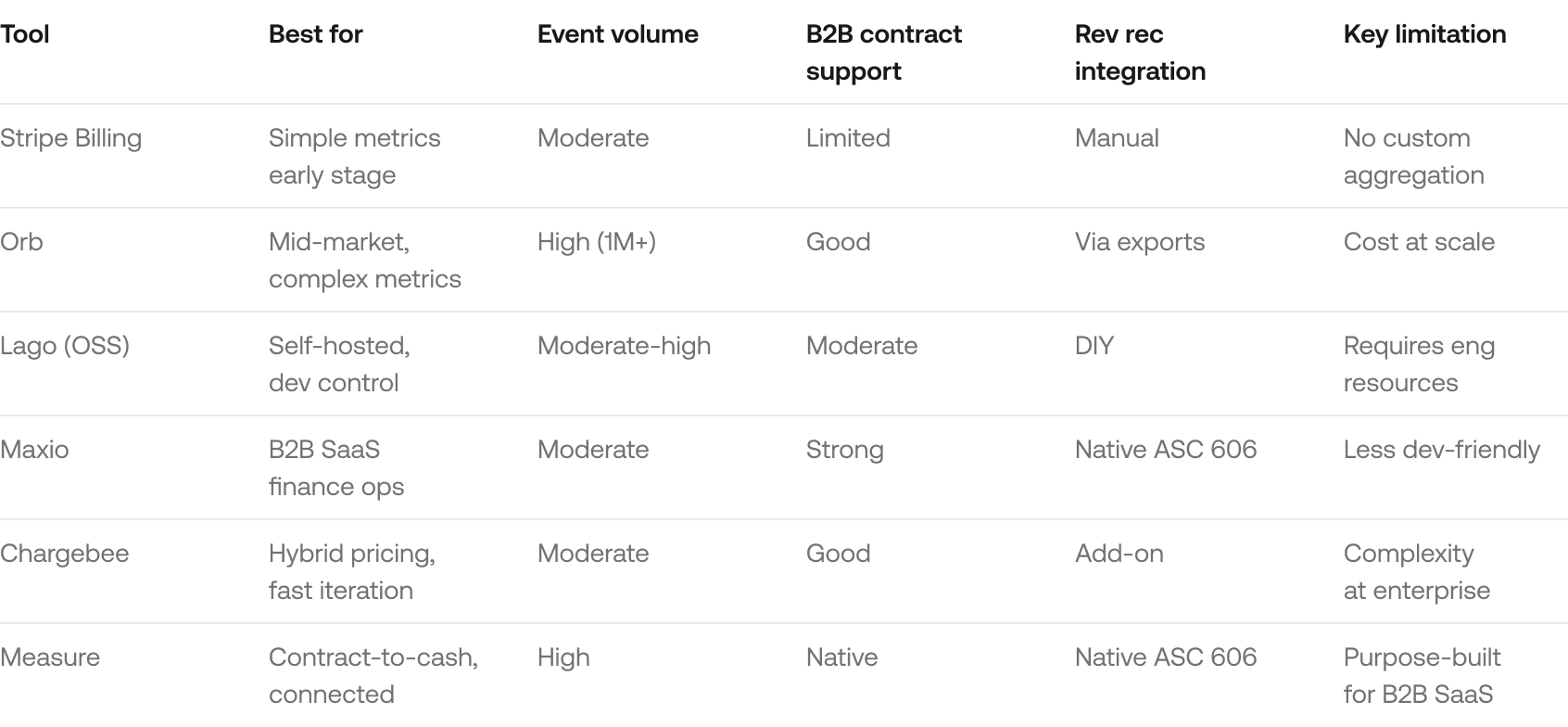
Tooling comparison
The honest reality: no tool does everything perfectly. The question isn't "which tool is best?" It's "which tool creates the fewest integration gaps between my contracts, my usage data, and my revenue recognition?"
Don't migrate everyone at once. Segment your customer base across four dimensions: current ARR, usage intensity relative to peers, contract renewal date, and relationship health score (NPS or CS health metric).
Four migration cohorts, in this order:
Cohort 1: New customers. All new deals close on the new pricing model immediately. Zero risk. This also gives your team live reps before touching existing revenue.
Cohort 2: Low-usage legacy customers. These accounts typically pay less under usage-based pricing. Migration is a retention play for them. Lead with "your bill is going down."
Cohort 3: High-usage, high-ARR accounts. These accounts will pay more. They know it. You know it. This requires a conversation, not an email.
Cohort 4: Enterprise/custom contract accounts. Migrate last. Only at renewal. With a custom transition plan negotiated by your account team.
The rule: never migrate a $100K+ ARR account without a synchronous conversation and a custom transition proposal. An email won't cut it.
Grandfathering vs. sunsetting legacy plans
Grandfather when: a customer is within 90 days of renewal, has a high churn risk score, or is a strategic logo you can't afford to lose right now. Offer them their current pricing through the next renewal cycle.
Sunset timeline: 12-18 months from announcement to full deprecation. 90-day written notice minimum. Structure the sunset so that legacy pricing expires at each account's next renewal date, not on a single cutover day.
The mistake to avoid: creating permanent pricing exceptions. Every grandfathered account should have an expiration date in your system. Otherwise, you're maintaining two pricing models indefinitely.
Watch for MFN (most favored nation) clauses in enterprise contracts. If Account A has an MFN clause and you offer Account B better overage rates during migration, you may trigger a contractual renegotiation. Have legal review your top 20 contracts before announcing any new pricing.
The customer communication playbook
Bill shock kills retention. The antidote is aggressive transparency before, during, and after rollout.
Pre-migration (90 days out): Run individual usage audits. Show every customer their projected bill under the new model. In our experience, 60-70% of customers pay the same or less. Lead with that data. "Based on your last 6 months of usage, your bill under the new model would have been $4,200/month vs. your current $4,500/month."
Email sequence:
90 days: Announcement + projected impact + FAQ link
60 days: Detailed FAQ + office hours calendar link
30 days: Final notice + confirm opt-in/transition date
Go-live: Welcome to new plan + dashboard access + support contact
For customers who will pay more: Acknowledge it directly. "Based on your usage, your bill will increase approximately 15%. Here's why: you're using the product 3x more than when you signed. That means it's working. Here's how to optimize if you'd like to reduce consumption."
Non-negotiable requirement: Customers must have self-service access to their real-time usage data before you send the first invoice. A surprise bill without a dashboard equals churn. Every time.
Measuring migration success
Track these KPIs weekly during migration:
Migration completion rate (% of target cohort moved)
NPS delta: pre-migration vs. 30 days post
Churn rate in migrated cohort vs. non-migrated control group
Net revenue change: expansion (accounts paying more) vs. contraction (accounts paying less)
Billing-related support ticket volume (should spike then decline within 30 days)
If churn in the migrated cohort exceeds your baseline by more than 2x, pause and investigate before moving to the next cohort.
Phase 4. Billing execution, invoicing, and rev rec
Connecting usage events to contracts and invoices
Here's the core B2B billing challenge: usage data lives in product infrastructure. Contract terms live in CRM and legal systems. Invoicing lives in billing or ERP. These three systems need to produce one accurate invoice.
What needs to sync: contract committed amounts, overage rates per unit, billing period start/end dates, invoice delivery cadence, payment terms (net-30, net-60), and any credits or prepaid balances.
The common failure mode: your billing team manually exports usage reports from engineering, cross-references contract terms in Salesforce, and builds invoices in a spreadsheet or disconnected tool. This produces a 3-5% error rate and adds 1-2 weeks of delay per billing cycle. That's not a billing process. That's a monthly fire drill.
The fix is infrastructure that connects contracts to usage to invoices natively. Not a spreadsheet bridge. Not an integration duct-taped between three tools. One connected system where a contract's overage rate automatically applies to metered usage and generates the correct invoice line item.
Revenue recognition under ASC 606 for usage-based models
UBB creates variable consideration under ASC 606. This is the section your Controller needs to read.
Minimum commitments: Recognize ratably over the commitment period. A $120K annual minimum recognizes as $10K/month regardless of actual usage (assuming usage doesn't exceed the commitment).
Overages: Recognize at the point of delivery/consumption. When a customer uses 10,000 API calls above their commitment in March, that revenue belongs in March. Not when you invoice it. Not when they pay.
True-ups: If a customer commits to an annual minimum but pays monthly, and their actual usage is below the commitment, you may need to accrue the shortfall. This creates a deferred revenue vs. accrued revenue accounting question that your auditor will ask about.
The recommendation: Establish your rev rec policy for usage-based revenue before go-live. Not after your first audit question. Document how you handle: variable consideration estimation, constraint application, true-up timing, and credit memo treatment.
Overage notifications: Alert customers at 80% of their committed usage. Email plus in-app notification. Give them time to either optimize usage or prepare for the overage charge.
Dispute resolution: Define the window in your contracts. We recommend 30 days from invoice date to dispute a usage charge. After that, the invoice stands. Require disputes to reference specific event IDs or date ranges. Vague "this seems high" disputes consume disproportionate CS and Finance time.
Audit trail: Maintain an immutable event log accessible to customers on request. If a customer disputes a charge and you can't produce the underlying events, you lose. Every time.
Credit issuance: Define who can approve credits (CS lead for under $500, Finance for over $500, VP for over $5K). Define what triggers credits: metering error (always), service outage during metered period (proportional), customer complaint without evidence (never).
Sales compensation model adjustments
This is where RevOps teams feel the most pain. Traditional quota structures break under UBB.
A rep closes a $100K annual commitment. But the customer only uses $60K worth in year one. Is that a $100K deal or a $60K deal for commission purposes? If you pay on committed ARR, reps sandbagged on low commitments and rely on overages they don't get paid on. If you pay on actual usage, reps can't forecast their own compensation.
The most common model for B2B SaaS at this stage: pay commission on committed ARR at booking. Pay a smaller accelerator on overages recognized in the first 12 months. This gives reps incentive to right-size commitments (not lowball them) while maintaining comp predictability.
Your CRM must reflect committed ARR distinctly from invoiced ARR and recognized revenue. These are three different numbers in a usage-based model. If your CRM can't track this, your pipeline reporting breaks.
Week 1: Usage metric workshop. Cross-functional. Product, Finance, Sales, and CS in the same room. Output: one chosen metric, documented rationale, list of open questions.
Week 2: Data audit. Can you currently measure the chosen metric? At what granularity (per-event, daily aggregate, monthly)? What's the measurement lag? What's missing?
Week 3: Pricing model design. Build three financial scenarios: conservative (bottom 30% of customers pay less), base case (revenue-neutral at portfolio level), aggressive (5-10% net expansion). Model each against your existing customer base's actual usage data.
Week 4: Contract template updates plus legal review. Tooling decision finalized. If buying a metering platform, contracts signed and implementation kickoff scheduled.
Weeks 5-10: Infrastructure build
Weeks 5-6: Metering infrastructure setup. Integration with chosen tooling or internal build. Event emission code deployed to staging.
Week 7: Internal billing dry run. No customer impact. Run the metering pipeline against real usage data. Compare metered counts against known benchmarks. Target: less than 1% variance.
Week 8: Customer-facing usage dashboard build or integration. Customers must see their data before they see their invoice.
Week 10: Soft launch with 3-5 volunteer accounts. Friendly customers who've agreed to test. Dual-bill them (old model and new model in parallel) for one billing cycle.
Weeks 11-14: Staged rollout
Week 11: All new customers close on new pricing. Sales team fully trained. Contract templates live.
Week 12: Customer communication begins for migration Cohort 1 (low-usage accounts). 90-day notice sent.
Quarterly: Pricing tier calibration. Are commitments set at the right levels? Is the overage rate generating expansion or generating disputes?
Annually: Full pricing model review with customer cohort analysis. Compare year-one vs. year-two usage curves by customer segment.
Common implementation failures (and how to avoid them)
Choosing the wrong metric and rebuilding 6 months in. A fintech company picked "transactions processed" as their metric, then realized enterprise customers batch transactions. Monthly counts varied wildly. They switched to "active accounts under management" after 5 months of customer complaints. Prevention: validate with 5+ customers and run 3 months of historical data through the model before building anything.
Engineering builds metering without Finance input. The pipeline works perfectly. It counts events accurately. But the aggregation windows don't match billing periods. The tenant IDs don't map to CRM accounts. The data format doesn't integrate with the invoicing tool. Prevention: Finance and Engineering co-own the implementation from week 1.
Launching without customer dashboards. You send the first usage-based invoice. The customer has no way to verify the number. They dispute it on principle. Prevention: dashboard access is a launch blocker, not a fast-follow.
Migrating high-value accounts too early. Enthusiasm pushes the team to move their biggest accounts first ("that's where the revenue upside is"). One miscommunication on a $200K account creates an executive escalation that freezes the entire project. Prevention: sequence by risk, not by opportunity size.
Ignoring rev rec implications until audit. You've been invoicing usage-based charges for 8 months. Your auditor asks how you're recognizing variable consideration. You don't have a policy. Now you're restating revenue. Prevention: rev rec policy documented and approved before the first usage-based invoice ships.
Underestimating sales team resistance. Reps with $400K quotas hear "variable revenue" and panic. They sandbag commitments or avoid the new pricing entirely. Prevention: redesign comp plans before rolling out new pricing. Train the team. Show them the math on how overages increase their total deal value over time.
Is your current billing infrastructure ready? (Self-assessment)
Answer yes or no to each:
Can you currently measure your chosen usage metric per account in real-time (or near real-time)?
Do your contract templates support overages and minimum commitments today?
Is your billing system connected to your CRM at the contract level?
Can your revenue recognition process handle variable consideration?
Do customers have self-service visibility into their current usage?
Can your billing system generate invoices with variable line items automatically?
Does your sales comp model account for committed vs. actual revenue?
Can your finance team produce a usage-by-account report in under 30 minutes?
Do you have an immutable audit trail for all usage events?
Can your billing system handle mid-period upgrades, downgrades, and plan changes?
Score 0-4: Foundational work needed. Your current infrastructure will break under UBB. Start with tooling evaluation.
Score 5-7: Ready for phased rollout. You have building blocks in place but need to fill specific gaps before migration.
Score 8-10: Optimize your existing model. You likely already have usage elements. Focus on pricing calibration and expansion.
If you scored below 7, the gap is almost always between your contracts, your usage data, and your revenue recognition. Three separate systems that need to work as one.
Frequently asked questions
How long does it take to implement usage-based billing? For a $3-10M ARR B2B SaaS company, expect 90 days from kickoff to first cohort migration. The timeline extends to 6-9 months for full customer base migration. Engineering infrastructure takes 4-6 weeks. The longer tail is customer communication and phased rollout.
What's the best usage metric for a B2B SaaS company? The best metric correlates with customer value, is measurable without disputes, and is explainable to procurement in one sentence. Common strong metrics include API calls, records processed, documents generated, and compute hours. The worst metrics are ones customers can game or that create perverse usage incentives.
How do you prevent bill shock with usage-based pricing? Three mechanisms: minimum commitments that create a predictable baseline, real-time usage dashboards so customers always know where they stand, and proactive alerts at 80% of committed usage. Never send a surprising invoice. The customer should know their approximate bill before they receive it.
Does usage-based billing hurt revenue predictability? Hybrid models (minimum commitments plus overages) maintain a revenue floor while capturing expansion. Your committed ARR provides the predictable base. Overages add upside. Most B2B companies implementing UBB report increased net revenue retention because expansion happens automatically as customers grow, without requiring a sales-led upsell motion.
How does usage-based billing affect revenue recognition? Under ASC 606, minimum commitments are recognized ratably over the commitment period. Overages are recognized at the point of consumption. True-ups between committed and actual usage create variable consideration that requires estimation and constraint analysis. Establish your rev rec policy before go-live, not after.
How do you handle enterprise customers who want price predictability? Offer committed-use plans with a guaranteed rate. The customer commits to an annual minimum (e.g., $120K/year for 1M API calls). They get rate predictability and volume discounts. You get a revenue floor. Overages above the commitment bill at a pre-agreed rate. This satisfies procurement while preserving your usage-based upside.
What comes next
If you're mid-implementation and hitting walls between your contracts, your usage data, and your revenue numbers, that's the exact problem Measure solves. Contracts, billing, revenue recognition, and commissions. Connected in one system. Not stitched together across five tools with spreadsheet reconciliation in between.
Your usage events automatically flow to the correct contract terms, generate accurate invoices, recognize revenue correctly under ASC 606, and calculate commissions on the right numbers. No manual sync. No month-end fire drill.
If you're planning a usage-based billing rollout (or stuck in the middle of one), book a 20-minute walkthrough and we'll show you how it actually works with your specific pricing model.
See it in action.
Billing and revenue automation that handles contracts, invoicing, revenue recognition, and commissions in one connected system. Book a demo to see how Measure works.