Consumption based billing: the B2B SaaS finance leader's guide
Revenue unpredictability kills consumption billing rollouts. The complete guide for B2B SaaS finance teams covering pricing models, rev rec, implementation, and avoiding common pitfalls.
Your board wants predictable revenue. Your customers want to pay for what they use. Your VP of Sales says consumption pricing will accelerate deal velocity. Your CFO says it'll destroy your ability to forecast.
They're all partially right. Consumption based billing isn't a pricing decision. It's a revenue infrastructure decision. And at the $3–10M ARR stage, getting it wrong doesn't just create billing headaches. It creates forecasting chaos, commission disputes, audit risk, and customer churn that takes quarters to diagnose.
This guide covers what consumption based billing actually is, when it makes sense for B2B SaaS, and how to implement it without breaking your revenue operations. Written for the finance and RevOps leader who must evaluate, defend, and run this model. Not the engineering team building the product.
What is consumption based billing?
Definition and core mechanics
Consumption based billing means customers pay based on what they actually use. Not what they might use. Not what a sales rep estimated during the deal cycle. What they actually consume.
The unit of consumption varies by product: API calls, active seats, data processed, events triggered, tokens consumed, records enriched, reports generated. The billing system tracks usage over a defined period and generates an invoice reflecting actual consumption.
This is distinct from pure subscription billing (fixed recurring fee regardless of usage) and pure transactional billing (one-time payments). You'll see it called "usage-based billing" and "metered billing" interchangeably. The terms are functionally identical, though "consumption based billing" tends to appear in enterprise B2B contexts where the emphasis is on value consumption rather than raw usage volume.
How it differs from subscription billing
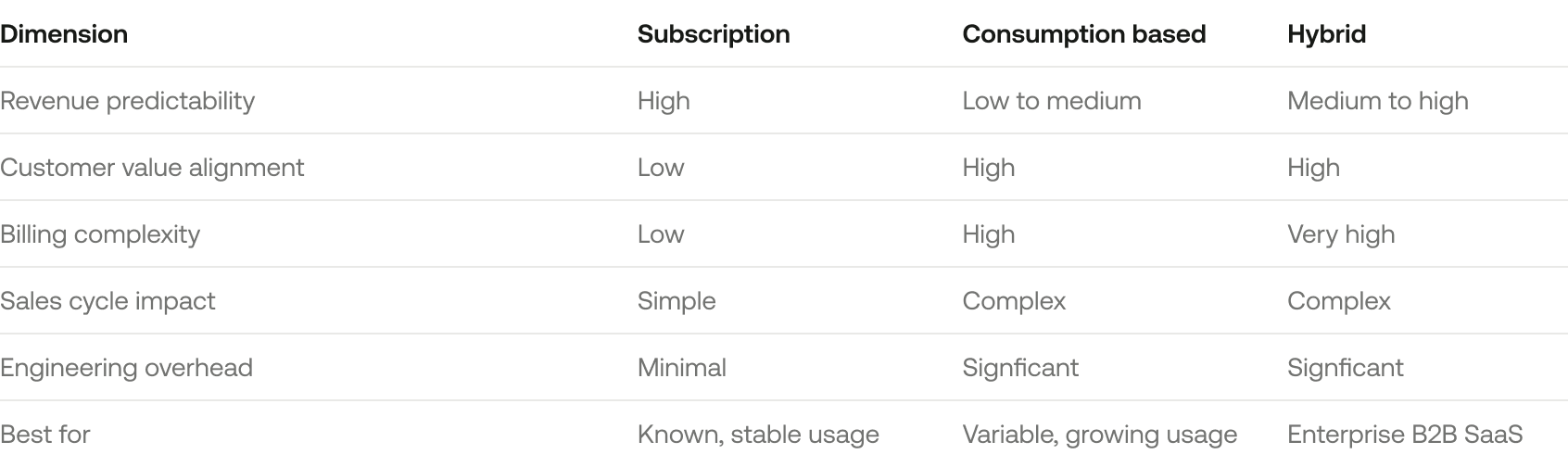
The differences go far beyond how the invoice looks.
The critical difference: subscription billing requires you to get the packaging right upfront. Consumption based billing requires you to get the infrastructure right permanently. Every invoice depends on accurate, real-time metering. Every forecast depends on usage pattern analysis. Every commission depends on variable deal recognition.
Common consumption metrics in B2B SaaS
Choosing the right metric is a strategic decision, not a technical one. The wrong metric misaligns incentives between you and your customer.
Common metrics include:
Active seats (users who actually logged in, not provisioned licenses)
Event or transaction volume (API calls, emails sent, records processed, webhooks triggered)
The best consumption metrics share four qualities: they're measurable without ambiguity, correlated with customer value, visible to the customer in real time, and hard to game. If your customer can't tell why their bill changed from last month, you've picked the wrong metric.
Why B2B SaaS companies adopt consumption based billing
The revenue expansion argument
The core promise is straightforward. When customers pay based on usage, revenue grows as they grow. Built-in net revenue retention without upsell conversations or contract renegotiations.
The initial purchase barrier drops too. Instead of committing to an annual contract at a price point sized for full deployment, customers start small. They test with one team. Usage grows. Revenue follows.
This alignment works both ways. You only charge when customers get value. They only pay when they're using the product. In theory, this creates a natural retention mechanism. Customers who use more pay more. Customers who use less pay less. And customers who stop using churn visibly, early, before the annual renewal surprise.
The market reality in 2025
AI-native products have forced consumption based billing into mainstream B2B SaaS. When your cost structure is driven by LLM tokens and inference calls, flat per-seat pricing creates margin risk that grows with every customer interaction.
Enterprise procurement teams are requesting usage-based structures to reduce commitment risk. After the budget corrections of 2023, buyers want flexibility. They want to start with lower commitments and scale spending with demonstrated value.
OpenView's research found that approximately 39% of SaaS companies now use some form of usage-based pricing, with acceleration concentrated in AI, infrastructure, and data categories. Your competitors may already offer consumption options. Customer expectations are shifting faster than most B2B SaaS finance teams realize.
What the upside actually looks like (and when it doesn't)
Real NRR expansion from consumption billing requires two things working together: usage growth and correct metric selection. Missing either one and the model underperforms subscription pricing.
Pure consumption can actually lower ACV if customers optimize usage downward. A data enrichment platform that charges per record lookup might see sophisticated customers batch and cache results, reducing their bill while maintaining the same business outcomes.
Revenue growth only follows when the consumption metric maps to genuine value delivery. If customers can get more value while consuming fewer units, your pricing model has a structural flaw that compounds over time.
The hidden costs and real risks (what other guides skip)
Revenue unpredictability and the CFO objection
Your CFO is right to be nervous. This isn't resistance to change. It's a legitimate operational concern that most consumption billing advocates dismiss too quickly.
Monthly revenue variance of 20–40% is common in early consumption-model rollouts. That variance cascades into investor reporting, cash flow management, hiring decisions, and board conversations. When your board asks "what's next quarter's revenue?" and you answer with a probability distribution instead of a number, trust erodes.
The solution isn't to dismiss the concern. It's to build predictability into the model itself. Commitment floors, prepaid credits, hybrid contracts with minimums, and annual agreements with usage-based overages all create a revenue forecasting floor while preserving the expansion upside.
The honest take: If your revenue infrastructure can't model P10/P50/P90 scenarios using historical usage distributions, you aren't ready for consumption based billing. Linear projections don't work here.
Bill shock and customer churn
The number one operational failure mode in consumption billing: a customer receives a bill three to five times higher than they expected.
This happens faster than you'd think. A product launch drives a usage spike. An integration misconfiguration triggers duplicate events. A team scales faster than their budget owner anticipated. The invoice arrives. The customer is furious. They churn within 90 days.
The myth that consumption based billing reduces churn deserves direct challenge. Without the right guardrails, it often increases churn. Customers who feel out of control of their spending leave. Customers who get surprised by invoices lose trust instantly.
Prevention requires: usage alerts at 50%, 75%, and 90% of expected spend. Configurable spend caps. Real-time usage dashboards inside the product. Pre-invoice summaries sent three to five days before billing. These aren't nice-to-have features. They're structural requirements. When a customer blows past their token limit, your system's response determines whether you keep or lose that account.
The metering infrastructure problem
Every guide on consumption based billing says "track usage." Almost none explain what that actually requires.
Accurate usage tracking isn't a billing configuration toggle. It's an engineering workstream. Instrumentation across microservices, multi-tenant environments, and async processes is genuinely complex. You need event deduplication, idempotency guarantees, and audit trails. You need sub-second latency for usage dashboards but batch processing for invoice accuracy.
Data pipeline latency creates billing disputes. When a customer's dashboard shows 9,800 events but their invoice says 10,200, you have a support ticket, a trust problem, and a potential churn event. High-frequency event environments (API platforms, data pipelines, messaging tools) amplify this challenge.
Building metering in-house is often a three to six month engineering project before billing even begins. That's three to six months of engineering time not spent on product. For a $3–10M ARR company with 20–200 employees, that's a meaningful resource commitment that competes directly with feature development.
Sales friction and GTM complexity
Consumption models create real problems for your go-to-market motion that RevOps teams rarely anticipate until they're already live.
Sales reps struggle to quote variable deals. When a prospect asks "what will this cost us?" and the honest answer is "it depends on how much you use it," the sales cycle extends. Enterprise procurement teams want caps, commitments, and worst-case scenarios. They want to know the maximum they'll spend before signing.
Commission calculation on variable deals gets murky fast. When is a consumption deal "closed"? How do reps earn on usage growth that happens six months after the initial contract? Do you pay on committed minimums, actual usage, or a blend? Without clear answers, you'll have rep disputes, delayed payments, and misaligned incentives.
You'll need separate playbooks for SMB versus mid-market versus enterprise. The self-serve customer paying per API call operates in a completely different reality than the enterprise customer with an annual commitment and quarterly true-ups.
Consumption based billing models: choosing the right structure
Pure consumption (pay-as-you-go)
The simplest model conceptually, the hardest operationally. Customers pay only for what they use. No commitments. No minimums. No predictability.
Best for developer-facing tools, AI/ML APIs, and infrastructure products where usage is inherently variable and customers expect granular control. Think cloud compute, SMS APIs, data enrichment services.
The risk profile is clear: low revenue predictability, customers who optimize aggressively on cost, and forecasting that requires sophisticated cohort modeling rather than simple MRR tracking.
Committed consumption (the credits model)
The customer buys a block of usage upfront. They draw down credits over the contract term. If they exceed the commitment, overage pricing applies. If they don't use it all, you navigate expiration and rollover rules.
This model gives your CFO recognized revenue on the commitment while giving customers budget certainty. Enterprise buyers prefer this because procurement can approve a known number. Your finance team prefers it because you have a contractual floor.
The mechanics matter: overage pricing per unit, whether unused credits roll over or expire, expiration timing, and how mid-term amendments work. Each of these creates complex pricing scenarios that your billing system and contract management process must handle natively.
Hybrid subscription plus consumption (recommended for $3–10M ARR B2B SaaS)
This is the model we recommend for most B2B SaaS companies in the $3–10M ARR range. A base platform fee (subscription) provides the revenue floor. A variable usage layer captures expansion.
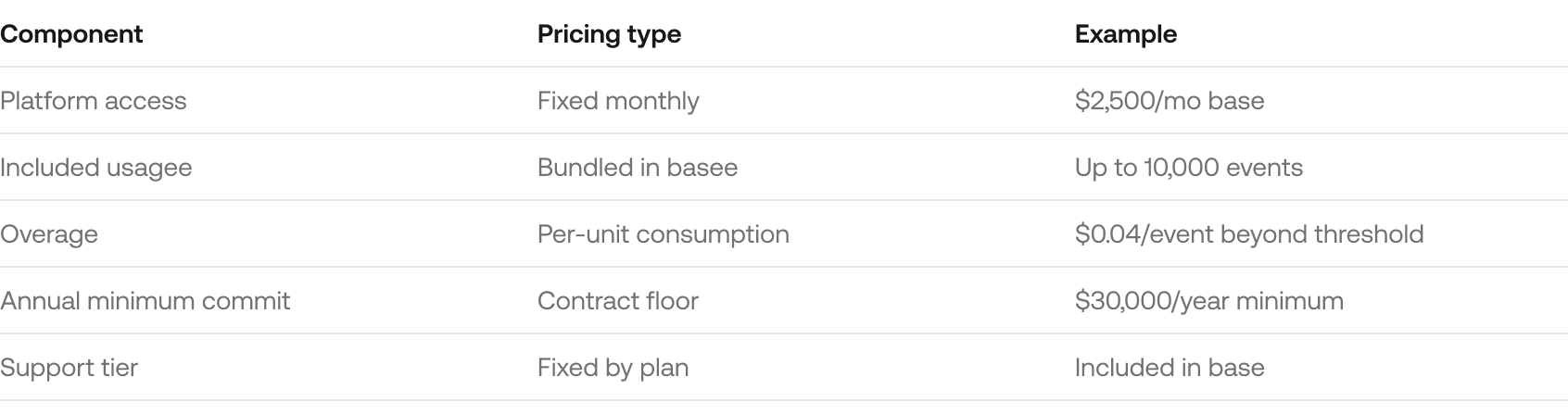
Here's what a hybrid structure actually looks like:
The subscription covers access, support, base features, and a usage threshold that serves most customers in their early months. Consumption charges apply to usage beyond that threshold. The committed minimum and contract structure gives your CFO the forecasting floor. The usage layer gives your customer expansion-aligned pricing.
Why this works at your stage: you get revenue predictability for planning, customers get pricing that grows with their success, and your sales team can quote a concrete number while preserving upside.
Tiered consumption
Usage tiers with volume discounts. Not the same as subscription tiers. The customer still pays based on actual consumption, but the per-unit price decreases at higher volumes.
This encourages usage growth (more usage means a lower effective rate) while protecting your margins at scale. The complexity lives in tier breakpoints, rounding rules, what happens when usage crosses a tier boundary mid-cycle, and how you notify customers approaching the next threshold.
How to implement consumption based billing: a practical roadmap
Step 1: Choose your consumption metric
Start here, not with the technology decision. The metric you choose determines everything downstream: billing accuracy, customer perception, revenue behavior, and operational complexity.
Your consumption metric must be measurable without ambiguity, correlated with the value your customer receives, visible to the customer in real time, and resistant to gaming. Map each candidate metric against a single question: "Is this what makes our customers successful?"
Red flags to watch for: metrics customers can't self-monitor, metrics that fluctuate for reasons outside the customer's control, and metrics that punish efficiency (charging for operations that could be batched or cached).
Step 2: Design your pricing architecture
Set unit pricing before engineering begins. Decide whether you're pricing cost-plus (your infrastructure cost plus margin), value-based (what the customer outcome is worth), or competitive anchoring (what alternatives charge).
Define tiers and thresholds. Build the hybrid floor: what's the minimum committed contract value that makes this customer profitable? Create the overage ladder: how should per-unit price change at scale? Does it decrease (volume discount), stay flat (simple), or increase (scarcity pricing)?
Document every pricing rule in a single source of truth. Not a spreadsheet. Not a sales deck. A system that your billing infrastructure can execute against automatically.
Step 3: Build or buy metering infrastructure
The build-versus-buy decision here is more consequential than most teams realize.
Build path: Event streaming (Kafka, Kinesis), custom aggregation layer, deduplication logic, billing API integration, and ongoing maintenance. Timeline: three to six months minimum. Ongoing cost: dedicated engineering resources.
Buy path: Evaluate whether your billing platform treats metering as a native, first-class feature or a configuration afterthought. A billing platform that can ingest raw usage events, aggregate them accurately, and connect them directly to invoicing eliminates the custom data pipeline build entirely.
Decision criteria: your engineering capacity, event volume, latency requirements, audit needs, and how many months you can afford to delay going live. For most $3–10M ARR teams without a dedicated billing engineer, building a billing implementation from scratch shouldn't take a year. Your billing platform should handle metering natively.
Step 4: Connect revenue infrastructure together
Billing alone is not enough. Consumption data must flow into every downstream system without manual reconciliation.
Revenue recognition: ASC 606 treatment of variable consideration requires your billing system to communicate usage data to your rev rec process in real time. Not monthly. Not via export.
Commissions: When is a consumption deal "closed"? How do reps earn on usage growth? Your commission system needs to pull actual usage data, not estimated deal values, to calculate payouts correctly.
Contract management: Committed minimums, amendment tracking, overage terms, and mid-term changes all need to live in one connected system where changes propagate automatically.
Reporting: NRR, expansion MRR, and usage-based cohort analysis all depend on consumption data flowing cleanly into your reporting layer.
This is the operational gap that breaks $3–10M ARR teams. Disconnected point solutions create reconciliation nightmares. When your billing tool doesn't talk to your rev rec process, and neither talks to your commission system, the billing stack tax compounds with every consumption contract you add. How many systems does it take to calculate one rep's commission on a usage-based deal?
Step 5: Build customer-facing usage transparency
In-product usage dashboards aren't a nice-to-have. They're non-negotiable for consumption based billing.
Configure alerts at 50%, 75%, and 90% of committed usage or expected spend. Send pre-invoice summaries three to five days before billing. Give customers the ability to set their own spend caps and notification thresholds.
The outcome: fewer billing disputes, lower churn from bill shock, increased trust, and customers who actively monitor their own usage patterns. When customers can see their consumption in real time, they feel in control. When they feel in control, they stay.
Step 6: Align GTM and finance operations
Train sales reps on TCO conversations and hybrid deal structuring. Give them a calculator that shows prospects their expected monthly cost at different usage levels. Make the commitment floor and overage structure crystal clear in the proposal.
Update commission plans to account for variable deal recognition. Define when reps get paid: on the committed minimum at signing, on actual usage quarterly, or on annual true-up. Pick one approach and document it clearly.
Forecast revenue using P10/P50/P90 probabilistic models. Build a monthly usage review cadence across finance and CS: identify expansion signals early, flag churn risks before they show up in next month's invoice.
Consumption based billing and revenue recognition
ASC 606 treatment of variable consideration
This is where consumption based billing creates real complexity for your Controller. Under ASC 606, variable usage revenue requires estimation using either the "expected value" method (probability-weighted scenarios) or the "most likely amount" method.
The constraint on variable consideration says you can only recognize revenue when it's highly probable of not reversing. For consumption billing, this means you can't recognize projected usage revenue upfront. You recognize actual usage in the period it occurs.
Prepaid credits follow a different path: recognize as deferred revenue at purchase, release as the customer consumes credits. Overages are straightforward: recognize in the period incurred.
Common rev rec pitfalls in consumption models
The mistakes we see most often at the $3–10M ARR stage:
Mis-timing revenue on prepaid blocks. Recognizing prepaid credit revenue upfront rather than as consumed. This inflates current-period revenue and creates a liability problem your auditor will catch.
Handling expired credits incorrectly. Breakage revenue (unused credits that expire) has specific recognition rules. When to recognize it and how much to estimate requires historical usage data and a defensible methodology.
Standalone selling price allocation in bundled deals. When you sell a hybrid subscription plus consumption package, ASC 606 requires allocating revenue to each performance obligation based on standalone selling prices. If your billing system doesn't track these components separately, your revenue numbers are wrong.
The operational reality: If you're running consumption billing on spreadsheets or a billing tool without native rev rec capabilities, you're creating audit risk that grows with every contract. Variable consideration requires your billing and rev rec systems to share data natively, not through monthly reconciliation exports.
Choosing a billing platform for consumption based models
What to look for in a billing platform
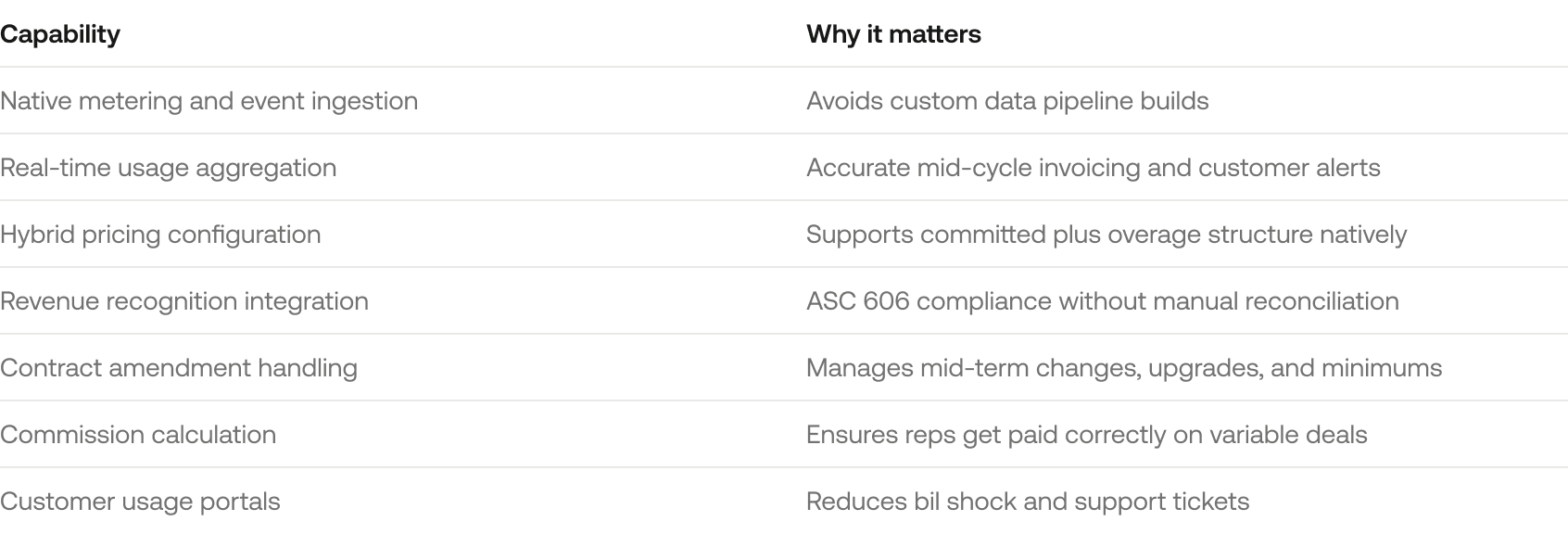
Not every billing system handles consumption based billing with the same depth. Here's what actually matters for a $3–10M ARR B2B SaaS team running hybrid consumption contracts:
When evaluating billing systems, the key question isn't "does it support usage-based billing?" Almost every platform claims to. The question is: does it connect usage data to rev rec, commissions, and contract management natively? Or does it create another integration point you'll need to maintain?
The integration question
Standalone billing tools may handle metering adequately in isolation. But consumption billing doesn't exist in isolation. The usage data that generates invoices must also inform revenue recognition schedules, commission calculations, contract utilization tracking, and financial reporting.
Stripe Billing handles metering but doesn't connect to rev rec or commissions. Chargebee offers usage tracking but contract amendments and variable deal commissions require separate systems. Orb focuses on metering depth for engineering teams but misses the finance workflow entirely.
Revenue infrastructure that connects contracts, billing, rev rec, and commissions in one system reduces the reconciliation work that compounds as consumption revenue scales. The inflection point is clear: when you have more than 50 active consumption contracts, manual reconciliation between billing, rev rec, and commissions becomes a monthly fire drill. Your billing platform isn't too complex to fix. It's too complex for where you're going.
Get consumption billing right the first time
Consumption based billing works when the infrastructure behind it works. Not just the metering. Not just the invoicing. The entire connected system: contracts, billing, revenue recognition, and commissions operating from one source of truth.
Measure connects consumption billing to rev rec, commissions, and contract management natively. No spreadsheet reconciliation. No monthly fire drills. Usage data flows through your entire revenue infrastructure automatically, so your finance team closes books confidently and your reps get paid correctly on variable deals.
Book a 30-minute demo to see how consumption based billing works in Measure. From metering to revenue recognition to commissions. One connected system.
See it in action.
Billing and revenue automation that handles contracts, invoicing, revenue recognition, and commissions in one connected system. Book a demo to see how Measure works.