

Jul 23, 2026
Stripe Billing is costing you more than you think
Stripe Billing's 0.5% fee hits $100K/year at $20M ARR. Here's the full cost breakdown for B2B SaaS companies and what to do when it stops making sense.

Evelyn Ly
Head of Marketing

Stripe Billing's 0.5% fee hits $100K/year at $20M ARR. Here's the full cost breakdown for B2B SaaS companies and what to do when it stops making sense.
Evelyn Ly
Head of Marketing
The 0.5% fee is just the beginning. Here's what B2B SaaS companies actually pay Stripe for billing. And what they do when it stops making sense.
You opened your Stripe dashboard, looked at last month's billing fees, and did some quick math. The number was bigger than you expected. Maybe your CFO flagged it. Maybe you just noticed it's been climbing every quarter, in lockstep with your revenue, without delivering anything new in return.
You're not miscalculating. Stripe Billing gets expensive fast. And the sticker price is only part of what you're actually paying.
This page is for finance leaders, RevOps leads, and CTOs at B2B SaaS companies who've been on Stripe Billing for a year or more and are starting to feel the squeeze. We'll break down the real numbers, explain when the economics stop working, and show you what the alternative looks like.
Stripe Billing's pricing looks simple on the surface. It isn't. The cost stacks in layers, and each layer compounds as you grow.
Stripe Billing Essentials charges 0.5% of billing volume. The Scale tier charges 0.8%. That's a percentage of your revenue, charged every month, on top of payment processing.
At $1M ARR, 0.5% is $5,000 per year. Noticeable, but not painful. At $5M ARR, it's $25,000. At $10M, it's $50,000. At $20M, it's $100,000 per year. Just for the billing layer.
Here's the critical thing: your billing infrastructure doesn't get 10x more complex when your revenue grows 10x. But you pay 10x more anyway. That's how percentage-based pricing works. Your growth becomes the penalty.
Stripe Billing fees don't replace payment processing fees. They stack on top. You're still paying 2.9% + $0.30 per card transaction, or 0.8% (capped at $5) for ACH.
For a B2B SaaS company running $10M through Stripe on a mix of cards and ACH, total Stripe costs (processing plus billing) can easily exceed $300,000 per year. That's real money. That's headcount. That's product investment.
Stripe Billing handles straightforward subscription logic well. But B2B SaaS pricing isn't straightforward for long.
The moment you need hybrid pricing (seats plus usage), ramp schedules, committed-spend contracts, or mid-cycle amendments, your engineering team starts building workarounds. Custom webhook handlers. Proration logic. Overage calculations. Trial-to-paid conversion flows that Stripe's native objects don't support.
That engineering time has a cost. It shows up on your payroll, not your Stripe invoice. But it's a billing cost all the same.
Stripe doesn't include revenue recognition. You'll need a separate tool for ASC 606 compliance. Stripe doesn't include CPQ. Your sales team works around that with spreadsheets or yet another vendor. Stripe Tax, Stripe Invoicing, Stripe Revenue Recognition. each comes with its own fee layer.
The total cost of ownership isn't what's on your Stripe invoice. It's the Stripe invoice plus the engineering hours plus the additional tools you've stitched together to fill the gaps.
Let's make this concrete. Not theoretical. Not "it depends." Here's what two common scenarios look like.
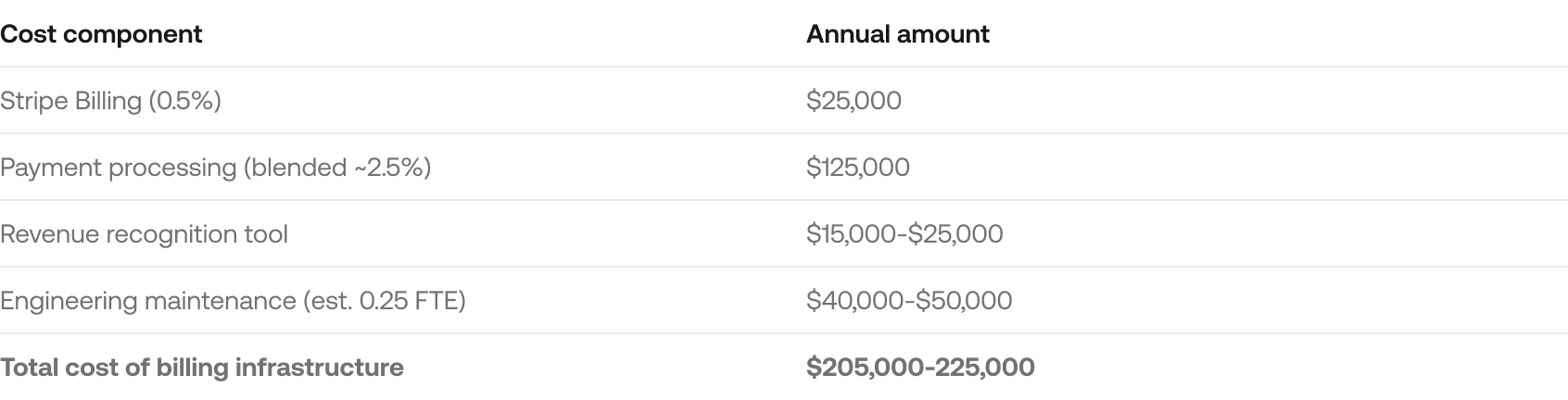
That's roughly 4-4.5% of revenue going to billing infrastructure. For something that should be a back-office function.
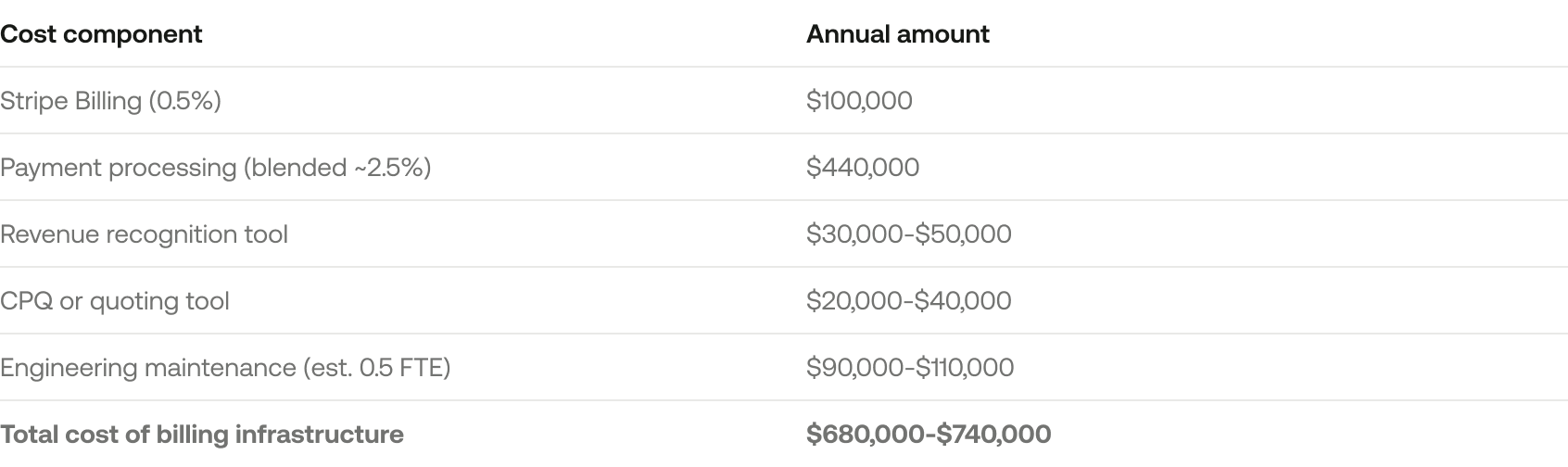
At this scale, Stripe Billing alone costs as much as a senior engineer. The full billing stack costs as much as a small team.
Here's the question worth asking: what would you get if you spent that money on a billing platform that actually handled your pricing models natively? One that didn't charge you more just because you grew?
We'll come back to that.
Let's be honest. Stripe Billing was probably the right choice when you picked it.
If you launched with a product-led motion, self-serve signups, and card payments, Stripe was the obvious answer. Fast to implement. Great developer docs. Payments and billing in one place. It works.
Nobody made a mistake by choosing Stripe at $500K ARR with simple per-seat pricing. That's exactly the use case it was built for.
The convenience of having your payment processor and billing engine in the same system is genuine. One vendor. One integration. One dashboard.
The problem is that convenience creates lock-in. And lock-in lets Stripe charge a revenue percentage because switching feels expensive. As your billing needs grow more complex, that simplicity becomes a constraint. But you've already built around it.
There's a pattern to when companies outgrow Stripe Billing. It usually happens between $3M and $10M ARR, and it shows up in one of four ways.
Hybrid pricing. Usage-based billing with commitments. Ramp deals that increase over the contract term. Stripe Billing's subscription objects weren't designed for these structures. You can force it, but forcing it means custom code, fragile logic, and invoices that don't match what your sales team actually sold.
If your team has ever said "Stripe can't do that natively," you've already hit this wall.
Enterprise deals have custom terms. Multi-year contracts. Payment schedules that don't align with billing periods. Amendment clauses. Net-60 payment terms.
Stripe Invoicing works for self-serve. It wasn't built for contract-driven, negotiated B2B deals. When your AEs start routing around your billing system, that's a signal.
ASC 606 compliance isn't optional once you reach a certain stage. Stripe doesn't handle rev rec natively. You add a separate tool, which means a separate integration, a separate data model, and a separate reconciliation process every month.
That's not just cost. It's time. And it's risk.
This is the one that sneaks up on you. Your billing system should work automatically. But when you've built custom logic on top of Stripe to handle edge cases, someone has to maintain it. Every pricing change, every new plan, every contract amendment touches code.
How many engineering sprints last quarter went to billing maintenance instead of product? That's the billing stack tax nobody talks about.
When the math stops working, companies typically go one of two directions.
The instinct is to keep Stripe for payments and add tools for everything else. A CPQ here. A rev rec tool there. A billing middleware in between.
This creates what we call the patchwork problem. You now have three or four systems that need to stay in sync. Data propagates between them. Or it doesn't. And when an invoice doesn't match a contract, someone spends hours figuring out where the chain broke.
More tools, more integrations, more failure points. The total cost often exceeds what a single connected system would cost.
The other path is replacing Stripe Billing with a purpose-built revenue infrastructure that handles contracts, billing, rev rec, and commissions in one system. You keep Stripe as your payment processor (it's genuinely good at that) and move the billing logic to a platform designed for how B2B SaaS actually sells.
Not every alternative is actually better. Some just move the same problems to a different vendor. Here's what matters:
Pricing model. Does it charge a percentage of your revenue? If so, you're just trading one revenue tax for another.
Native support for your pricing models. Can it handle hybrid, usage-based, and ramp pricing without custom code? Test this with your actual deal structures, not a demo scenario.
Connected data. Does billing data automatically flow into rev rec, reporting, and commissions? Or are you building another patchwork?
Implementation timeline. If it takes six months to go live, the switching cost might outweigh the savings for another year. That matters.
Stripe does payments very well. It's a world-class payment processor. But Stripe Billing is a billing layer that charges you more as you grow, without growing its capabilities to match.
Measure is revenue infrastructure built for B2B SaaS companies between $3M and $10M ARR. It connects contracts, billing, rev rec, and commissions in one system.
Stripe Billing charges 0.5% to 0.8% of your revenue. Every month. Forever. The more you grow, the more you pay.
Measure doesn't charge a percentage of your revenue. Your billing costs don't automatically scale with your ARR. When you double your revenue, you keep more of it.
Measure handles the pricing models B2B SaaS companies actually use. Hybrid pricing, usage-based billing, ramp deals, mid-term amendments. Natively. Without custom engineering work.
Revenue recognition posts automatically from the same data source as your invoices. No separate tool. No reconciliation spreadsheets. One source of truth that updates when contracts change.
When a customer blows past their token limit, Measure handles it. When a deal includes a ramp schedule, Measure handles it. When finance needs ASC 606 reports, the data is already there.
Switching billing systems has a cost. We won't pretend otherwise.
There's an implementation period. There's data migration. There's a learning curve. If you're at $1M ARR with simple per-seat pricing and no immediate plans to change, Stripe Billing might still be the right fit for now.
But if you're at $3M or above, running complex pricing, and feeling the cost pinch, every month you wait is another month of revenue-percentage fees. At $5M ARR, that's roughly $2,000 per month in Stripe Billing fees alone. At $10M, it's over $4,000.
Here's how to think about it.
Add up your Stripe Billing fees for the last 12 months. Add the cost of any supplementary tools (rev rec, CPQ, billing middleware). Estimate the engineering hours spent on billing maintenance.
That's your actual cost of billing today.
Now project it forward 12 months at your growth rate. If you're growing 50% year-over-year, your Stripe Billing fees grow 50% too. Your billing system gets more expensive precisely because you're succeeding.
For most B2B SaaS companies between $3M and $10M ARR, the math works out clearly. The switching cost pays for itself within two to three quarters. After that, the savings compound every month.
If you've read this far, you've probably already done some version of this math yourself. The question isn't whether Stripe Billing costs too much. You already know the answer. The question is what you do about it.
See what you'd actually pay with Measure. We'll walk through your specific pricing models, show you how the numbers compare, and give you an honest answer about whether switching makes sense for your stage. Book a demo framed around your cost math, not a generic product tour.
Billing and revenue automation that handles contracts, invoicing, revenue recognition, and commissions in one connected system. Book a demo to see how Measure works.