

May 19, 2026
Measure vs. Zuora: Which one is actually built for your stage?
Zuora costs $75K+/year and takes 6-9 months to implement. Here's why finance teams at $3-10M ARR SaaS choose Measure instead.

Evelyn Ly
Head of Marketing
Zuora costs $75K+/year and takes 6-9 months to implement. Here's why finance teams at $3-10M ARR SaaS choose Measure instead.
Evelyn Ly
Head of Marketing
Zuora handles billing for Zoom and Box. If you're a $0-20M ARR B2B company, here's what that means for your implementation timeline, your budget, and your finance team.
You're evaluating billing infrastructure because spreadsheets stopped working. Maybe a Zuora rep reached out. Maybe someone on your board mentioned them. And now you're wondering whether a system built for companies processing 400,000 invoices per hour is actually right for a finance team of two.
It probably isn't.
This isn't a hit piece on Zuora. They've built a legitimate enterprise platform that powers some of the largest subscription businesses in the world. The question isn't whether Zuora is good. It's whether Zuora is good for you, right now, at your stage.
If you're comparing these two systems, here's the summary:
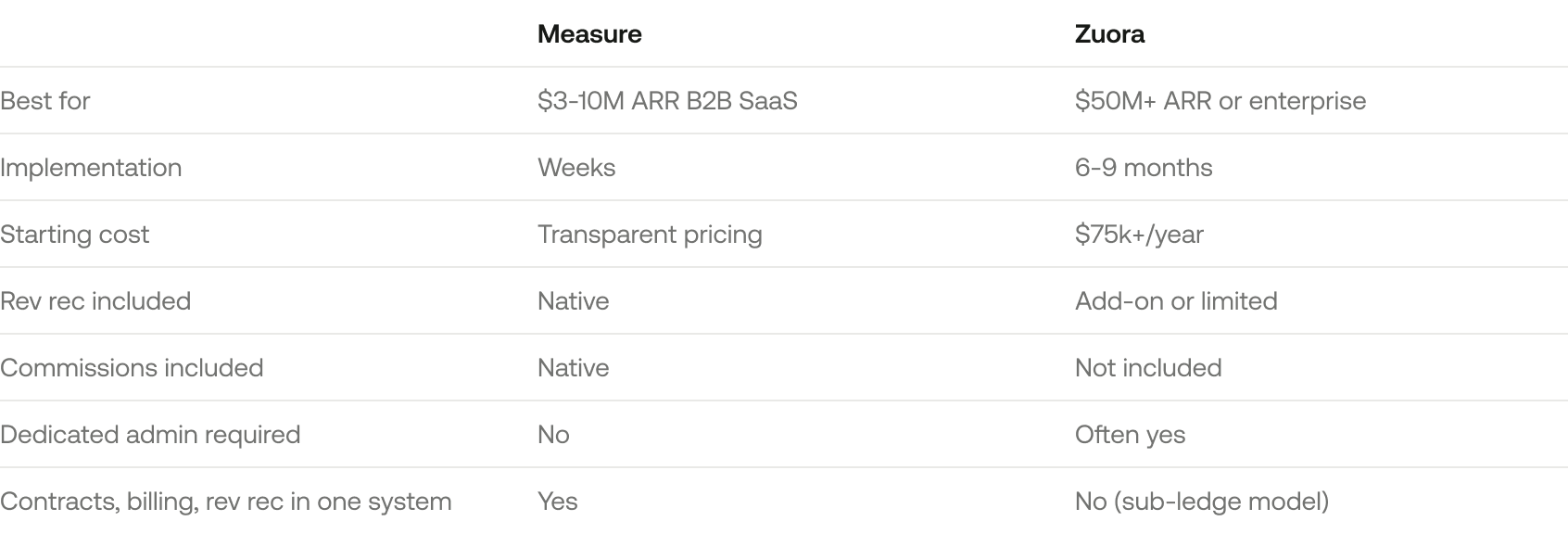
Zuora isn't a bad product. It's the wrong product for most companies under $20M ARR. If you're closing books with a small team and need to be live before next quarter, keep reading.
Let's give credit where it's due. Zuora built the category. They've been doing subscription billing since 2007, and they've earned their enterprise reputation.
Zuora's architecture handles volume that most SaaS companies will never reach. We're talking 400,000 invoices per hour. Billions of usage events per day. Real-time rating engines that can price complex entitlements across dozens of dimensions.
This is the infrastructure that powered Zoom's growth from 10 million to 300 million users in six months. It's what Box uses to manage enterprise contracts across global subsidiaries. When you need to bill in 15 currencies across 8 legal entities with audit trails that satisfy public-company requirements, Zuora delivers.
That enterprise capability comes with enterprise implementation timelines. The average Zuora deployment takes 6-9 months. This isn't a knock on their team. It's the reality of configuring a system built for maximum flexibility.
You'll need an internal project owner. Most companies end up hiring or dedicating a Zuora admin post-launch. Professional services engagements are standard, and they're additive to your license cost. We've seen PS quotes range from $30,000 to $100,000+ depending on complexity.
Zuora also operates as a sub-ledger. That means your billing data lives in Zuora, but it needs to reconcile to your ERP. NetSuite, Sage, QuickBooks. Wherever your books actually live. That reconciliation layer creates monthly close work that compounds over time.
If you check most of these boxes, Zuora might be the right call:
If that sounds like your company, Measure probably isn't right for you either. But if you're a $5M ARR SaaS company with a two-person finance team who needs to stop managing revenue in spreadsheets before your next board meeting, let's talk about what you actually need.
Measure exists because most B2B companies don't need a billing system built for Zoom. They need infrastructure that connects contracts, billing, rev rec, and commissions in one place. Without a 9-month project. Without a dedicated admin.
Measure connects the pieces that most billing systems leave disconnected. A contract closes in your CRM. Billing schedules generate automatically. Revenue recognition posts to your books. Commissions calculate and update as the contract evolves.
One system. One source of truth. No sub-ledger reconciliation at month-end.
This matters because your finance team isn't 15 people with specialized roles. It's a Controller who owns the entire workflow from signed contract to recognized revenue. They don't have time to reconcile three systems. They need the data to propagate automatically.
Most Measure customers go live in weeks. Not because we've built something less capable, but because we've built something more focused.
You don't need professional services. You don't need to staff a dedicated admin. Your finance team owns the implementation directly, which means they understand the system from day one.
This isn't just about speed. It's about risk. A 9-month implementation is a 9-month bet that requirements won't change, that the vendor won't pivot, that your business model will stay static. At your stage, that's not a bet you should be making.
Every Measure account includes:
You're not buying four products and stitching them together. You're buying infrastructure that works as one connected system.
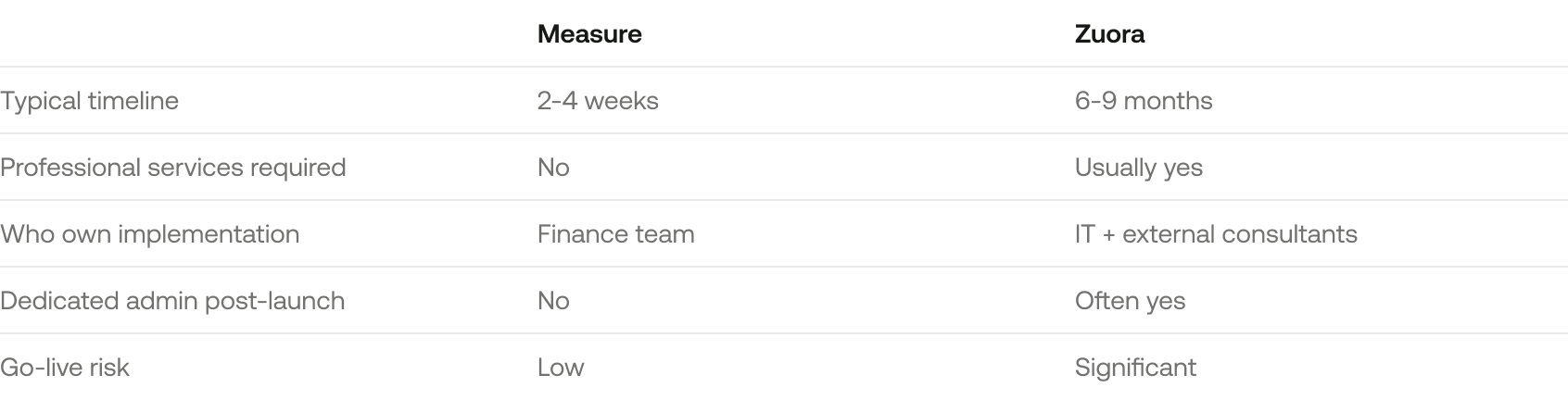
The gap here isn't marginal. It's the difference between being live before your next board meeting and being live before your next fiscal year.
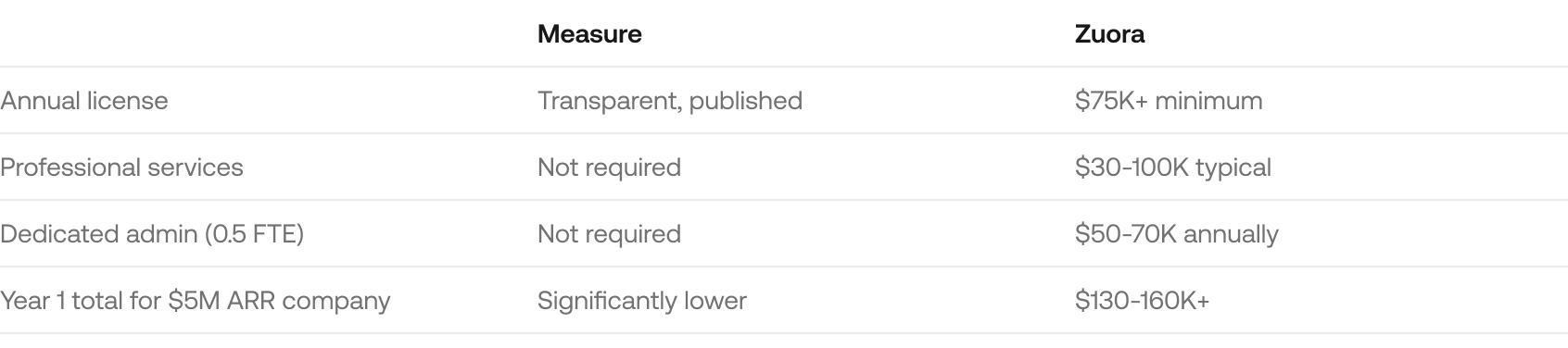
Zuora's minimum spend represents roughly 1.5% of a $5M ARR company's revenue. Before you've recouped anything. Before you've improved a single workflow. That's the billing stack tax nobody talks about.
For a deeper look at how these costs compound across your finance stack, see The Billing Stack Tax Nobody Talks About.
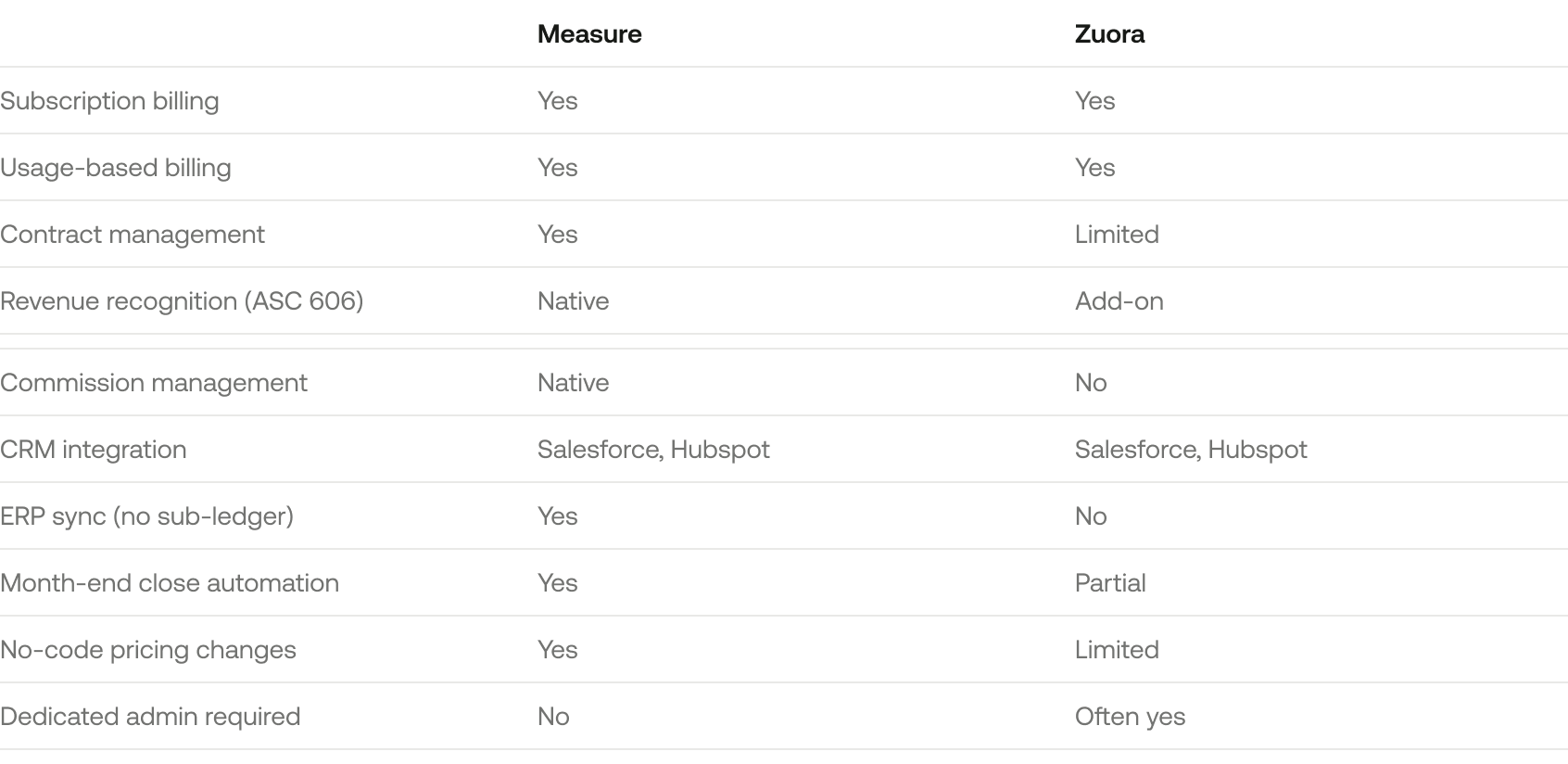
The functionality difference isn't about what each system can do. It's about how the pieces connect. Zuora handles billing exceptionally well. But billing is one step in a workflow that includes contracts, revenue recognition, and commissions. In Zuora, those are separate systems or add-ons. In Measure, they're native.
Zuora offers rev rec as a separate module called Zuora Revenue (formerly RevPro). It's a capable product. It's also another license, another implementation, and another reconciliation layer.
In Measure, revenue recognition is native. When a contract closes, rev rec schedules generate automatically based on the contract terms. When a contract amends, rev rec updates. No separate module. No reconciliation to billing data.
For finance teams closing books in 4-5 days, that reconciliation step is the difference between finishing Wednesday and finishing Friday.
What that looks like in practice. A customer upgrades their plan on the 15th of the month. In Zuora, that amendment creates a proration event in the billing sub-ledger. Your rev rec module needs to pick up that change and recalculate the performance obligation schedule. Then both need to reconcile to your ERP — usually NetSuite or QuickBooks — before the journal entry is correct. If any step doesn't sync cleanly (and mid-month amendments are exactly where sync issues surface), someone on your team is manually tracing the discrepancy across three systems at 9pm on the last day of the month.
In Measure, the same amendment triggers one cascade: the invoice updates, the rev rec schedule recalculates, and the journal entry posts — all from the same contract record. There's no sub-ledger to reconcile because there's no sub-ledger. The contract is the source of truth.
Measure wins. Zuora's implementation timeline would outlast your urgency. You need to be live before your next board cycle, not three board cycles from now.
Measure wins. Hybrid billing without engineering resources. Zuora handles this, but requires significant configuration and often custom work.
Measure wins. Native rev rec tied directly to contract terms. No separate module, no reconciliation, no additional implementation project.
Zuora may be right. At that scale and complexity, Zuora's enterprise architecture makes sense. The implementation timeline and cost are justified by the requirements. If this is you, you're probably not the target reader for this page.
Measure wins. Zuora doesn't touch commissions. You'd need a third system like CaptivateIQ or Spiff. In Measure, commissions calculate natively as contracts close and renew.
Is Measure a Zuora alternative or a replacement?
Neither, exactly. Measure is built for a different stage. If you're under $20M ARR with a small finance team, Measure handles your entire revenue workflow in one system. If you're $50M+ with enterprise complexity, Zuora is built for that. We're not Zuora lite. We're purpose-built for the stage where Zuora is overkill.
Can Measure handle usage-based billing like Zuora?
Yes. Measure supports usage-based, flat-rate, and hybrid billing models natively. You can meter usage, set pricing tiers, and invoice automatically. For companies dealing with consumption-based models, see Your Customer Just Blew Past Their Token Limit. Now What?
Does Measure integrate with Salesforce, HubSpot, and NetSuite?
Yes. CRM integrations pull closed deals directly into Measure. Contract terms sync automatically. ERP integrations push journal entries to your books without a sub-ledger reconciliation layer.
How long does it actually take to implement Measure?
Most teams are live within 2-4 weeks. Not quarters. Weeks. And you don't need professional services or a dedicated admin to get there.
What happens when we outgrow Measure?
Honest answer: at some point, you might. If you reach $50M+ ARR with multi-entity, multi-currency complexity across dozens of subsidiaries, you may need Zuora's architecture. But that's years away for most companies reading this. And you'll have closed hundreds of books on Measure by then.
Is Measure ASC 606 compliant?
Yes. Revenue recognition in Measure follows ASC 606 guidelines and posts directly to your ERP. Rev rec schedules generate automatically from contract terms, so you're not manually calculating deferred revenue.
How does Measure pricing compare to Zuora's?
Zuora's minimum spend is approximately $75K per year, before professional services. Measure pricing is transparent and significantly lower for companies at the $3-10M ARR stage. See Measure pricing for specifics.
If you're evaluating Zuora because someone told you it's the industry standard, they're not wrong. It is the standard for enterprise SaaS at $50M+ ARR. But that's not where you are. And buying infrastructure for where you might be in five years means overpaying for where you are today.
Measure gets finance teams live in weeks. Contracts, billing, rev rec, and commissions in one system. No professional services. No dedicated admin. No sub-ledger reconciliation at month-end.
Book a 30-Minute Demo and see how it works for companies at your stage.
See how Measure compares: vs. Stripe · vs. Chargebee · vs. Maxio · vs. Orb · vs. Sequence
Billing and revenue automation that handles contracts, invoicing, revenue recognition, and commissions in one connected system. Book a demo to see how Measure works.