RevOps org structure for 20-200 employee SaaS: who actually owns billing, commissions, and contracts?
At 75 employees, a simple seat expansion shouldn't require 4 people, 3 Slack threads, and manual data entry. Stage-specific org charts, RACIs, and automation triggers for SaaS RevOps.
Here's the question nobody answers honestly: when a customer asks for a mid-cycle seat expansion at your 75-person SaaS company, how many people and systems does it take to get the invoice right, the commission credited, and the revenue recognized?
If the answer is "four people, three Slack threads, and someone manually re-keying data from a signed PDF into your billing system," you don't have a people problem. You have a structural problem. And hiring another $120K ops generalist won't fix it.
Most RevOps org chart guides assume you're either a scrappy founder doing everything in spreadsheets or a 500-person enterprise with dedicated systems architects. The 20-200 employee SaaS company lives in neither world. You have too much complexity for one generalist but not enough budget for eight specialists.
This guide maps the four workflows that actually define your RevOps structure, shows what the team looks like at each stage, and tells you exactly when to add headcount versus when to invest in infrastructure that eliminates manual handoffs entirely.
Why most RevOps org charts fail in the 20-200 employee range
The typical RevOps content gives you a clean org chart with boxes and dotted lines. Then you try to apply it to your reality: Sales blaming Finance for wrong commission calcs, Finance discovering contract amendments three weeks after signature, and your one RevOps hire spending 60% of their time on manual data entry instead of strategic work.
The problem isn't the boxes on the chart. It's the handoffs between them.
At 40 employees, deal exceptions start taking 4+ days to resolve. At 80, commission disputes consume 20+ hours per month. At 120, month-end close extends from 5 days to 12 days because nobody owns the gap between your CRM and your billing system.
These breakdowns aren't caused by bad people. They're caused by workflow ownership ambiguity that creates four predictable failures:
Revenue leakage. Unapplied payments, missed escalations, incorrect pricing that nobody catches until quarter-end.
Close delays. Contracts stuck in legal review, billing changes requiring three approvals across teams who don't share a system.
Compensation disputes. Sales questioning every commission statement because the calculation logic lives in a Finance spreadsheet they've never seen.
Audit risk. No single owner for rev rec schedules or contract modifications. Your Controller rebuilds everything in Excel every quarter.
The fix isn't another hire. It's clarity about who owns what, at which stage, and which handoffs should be managed by infrastructure rather than headcount.
The four workflows that define your RevOps structure (not your org chart)
Most guides start with roles and reporting lines. That's backwards. Start with the workflows that actually generate revenue. Then map who owns each step.
Workflow 1: Contract execution (signature to system of record)
The process looks simple on paper: Sales closes deal, contract gets signed, data enters your billing system, Finance creates a rev rec schedule, commission gets credited to the rep.
In practice at a 50-person SaaS company, here's what actually happens:
Sales Ops thinks the contract is "done" after signature. Finance doesn't see non-standard payment terms until month-end. RevOps manually re-keys data from DocuSign into the billing system. The result: an 18-48 hour lag between signature and invoice generation, custom payment terms missed, and commission disputes that take days to resolve.
If your team is manually entering contract data from signed PDFs into two or more systems, this handoff should be automated by infrastructure. Not managed by adding another person to the chain.
Workflow 2: Billing changes (amendment request to invoice adjustment)
A customer wants to add seats. Simple, right?
Not when Sales assumes changes happen automatically after updating the CRM. Not when CS sends billing changes via Slack that never reach Finance. Not when Finance makes billing adjustments without notifying Sales about the commission impact.
The typical billing change at a 60-person SaaS company touches four people, three systems, and takes three business days. If you're spending 20+ hours per month reconciling your CRM to your billing system, you don't need more hands. You need the systems to talk to each other.
RevOps owns the CRM data but doesn't understand rev rec rules. Finance owns rev rec but doesn't see contract amendments until month-end. Accounting manually rebuilds schedules in Excel every quarter.
The result: close delays, restatement risk, and audit findings that make your CFO age five years overnight.
If your Controller is rebuilding rev rec schedules in spreadsheets, or if contract amendments take 5+ days to flow through to accounting, this is a system problem masquerading as a process problem.
Workflow 4: Commission calculations (deal close to payout)
Sales Ops pushes deals to "Closed-Won" without Finance validation. Finance applies commission rules that Sales doesn't understand. RevOps spends 30+ hours per quarter resolving disputes that stem from a fundamental lack of transparency.
When Sales can't see how their commission was calculated, trust erodes. When trust erodes, reps leave. The cost of commission disputes isn't just the hours spent resolving them. It's the attrition risk you can't see until it's too late.
The pattern across all four workflows: Your org chart doesn't break your workflows. Ambiguous handoffs do. If it takes four people and six systems to process a simple seat expansion, you don't have a headcount problem. You have an infrastructure problem.
Here's what the team actually looks like at each stage. With specific triggers for when to add headcount versus automate a handoff.
Stage 1: 20-50 employees ($2-5M ARR). The "RevOps of 1.5"
Team structure:
1 RevOps Generalist (often a Sales Ops hire absorbing broader scope)
Borrowed capacity from Finance (Controller handles rev rec, commission review)
What this person actually owns:
CRM data quality and reporting
Sales process documentation
Light marketing ops (campaign tracking, lead routing)
Tier 1 support for billing questions (escalates to Finance)
Tool administration
What they don't own (yet):
Commission plan design or calculation logic
Revenue recognition schedules
Contract lifecycle management
Billing system configuration
Reporting line: Typically reports to VP Sales or CRO. This is a risk. They become "Sales Ops" rather than true RevOps, which limits their authority to fix cross-functional handoff problems.
Key handoffs that break at this stage:
Contract data gets manually entered from DocuSign to CRM to billing system. That's 2-4 hours per week of a skilled person doing data entry. Billing changes get communicated via Slack, resulting in missed updates. Commission disputes get resolved via spreadsheet archaeology that takes half a day.
When to add headcount versus automate:
Don't hire a second RevOps person if your first hire is spending 15+ hours per week on manual data entry. That's not a capacity problem. That's a billing infrastructure problem.
1 Data/Analytics Specialist (reporting, forecasting, data integrity)
Total: 2-3 people, plus a formal Finance partnership for rev rec and commissions.
What changes:
RevOps now owns visibility into the full deal-to-cash workflow. The Finance partnership becomes formal: weekly sync on billing exceptions, monthly commission review. And the reporting line shifts. RevOps should now report to CRO, CFO, or CEO. Not VP Sales. Cross-functional authority requires cross-functional reporting.
What this team owns:
CRM, billing, and CPQ tool ownership
GTM data model and governance
Sales forecasting and pipeline management
Deal desk (non-standard deal approval)
Tier 2 billing support (escalations from CS/Sales)
Commission dispute triage (calculation still lives in Finance)
What they still don't own:
Revenue recognition policy or calculations (Finance)
Legal contract review (Legal)
AR/collections (Finance)
Payroll integration for commissions (Finance/HR)
Key handoffs that break:
Non-standard deals slow down because Legal, Sales, and Finance aren't aligned on approval thresholds. Billing changes from CS get lost because there's no formal intake process. Commission disputes spike because calculation logic lives in Finance's black-box spreadsheet that nobody else can audit.
When to add headcount versus automate:
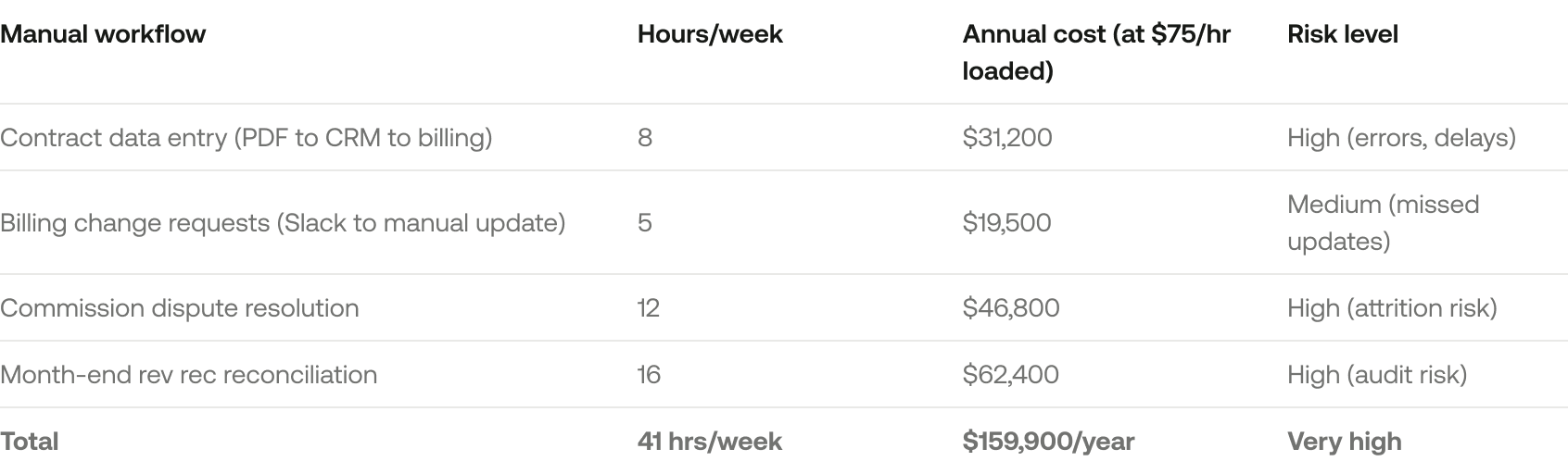
Don't hire a third ops person if your team is spending 20+ hours per week manually reconciling CRM to billing to accounting. That's $159K+ per year in manual work that a system should handle.
Do invest in unified contract-to-cash infrastructure if you're managing 500+ contracts across three or more disjointed systems.
Do hire person number three when you add a second product line, launch in a new geo, or your ops backlogs exceed four weeks.
Org chart:
CRO / CFO / CEO
|
Head of RevOps
|-- Sales/GTM Ops Specialist
|-- Data & Analytics Specialist
(Dotted line to Finance for rev rec, commissions, AR)
Common mistake at this stage: Hiring a "Revenue Analyst" who spends 90% of their time fixing data quality issues instead of generating insights. Fix the data plumbing first. An analyst without clean data is just a very expensive data entry clerk.
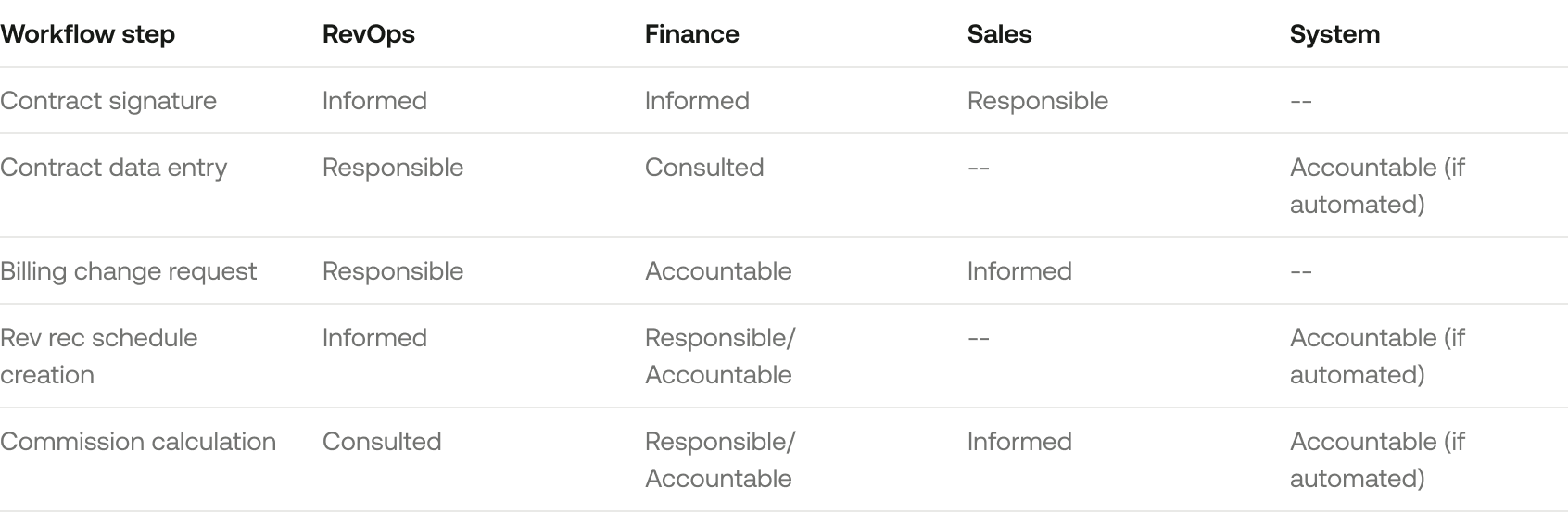
RACI at this stage:
Stage 3: 100-200 employees ($12-25M ARR). The embedded model
Team structure:
1 Director of RevOps (strategy, planning, cross-functional governance)
1 Sales Ops Lead (CRM, deal desk, forecasting)
1 Marketing Ops Lead (MAP, attribution, campaign ops)
1 CS Ops Lead (CS platform, health scoring, renewal workflows)
1 Data/Analytics Lead (reporting, BI, data governance)
Total: 4-5 people, plus formal Finance partnership and potentially a shared systems engineer.
What changes:
RevOps becomes a true operating system across the full customer lifecycle. Embedded specialists sit in functional teams but report to RevOps (hub-and-spoke model). Governance becomes formal: monthly GTM leadership meetings, quarterly planning cycles, tool rationalization cadence.
What this team owns:
Full contract-to-cash orchestration (minus rev rec calculations)
GTM systems architecture and integration strategy
Data governance and master data management
Sales/CS/Marketing process design
Deal approval workflows and pricing exceptions
Tier 3 billing escalations (complex multi-entity or usage-based contracts)
Commission plan administration (Finance still owns calculation and payout)
What Finance still owns:
Revenue recognition policy and schedules
Commission calculation engine and payout processing
AR/collections
Statutory reporting and compliance
Key handoffs that break:
Multi-product deals require approval from Sales, Product, Finance, and Legal. Takes 7+ days. Usage-based billing requires manual data pulls from product database to billing system. Multi-entity contracts create rev rec and invoicing chaos. Commission disputes now consume 60+ hours per quarter because the team is large enough to generate volume.
When to add headcount versus automate:
Don't hire a 5th or 6th ops person if your team is manually managing contract amendments, billing schedules, or commission adjustments. At this scale, every manual step multiplies.
Do invest in unified revenue infrastructure if your GTM team is managing 1,000+ active contracts across Salesforce + your accounting system + Stripe + spreadsheets.
Do hire person number six when you expand internationally (new entities, currencies, tax regimes) or launch a complex partner program.
Key insight for this stage: Your RevOps team should be spending less than 20% of their time on manual execution and more than 80% on process design, governance, and insight generation. If the ratio is reversed, you have an infrastructure problem.
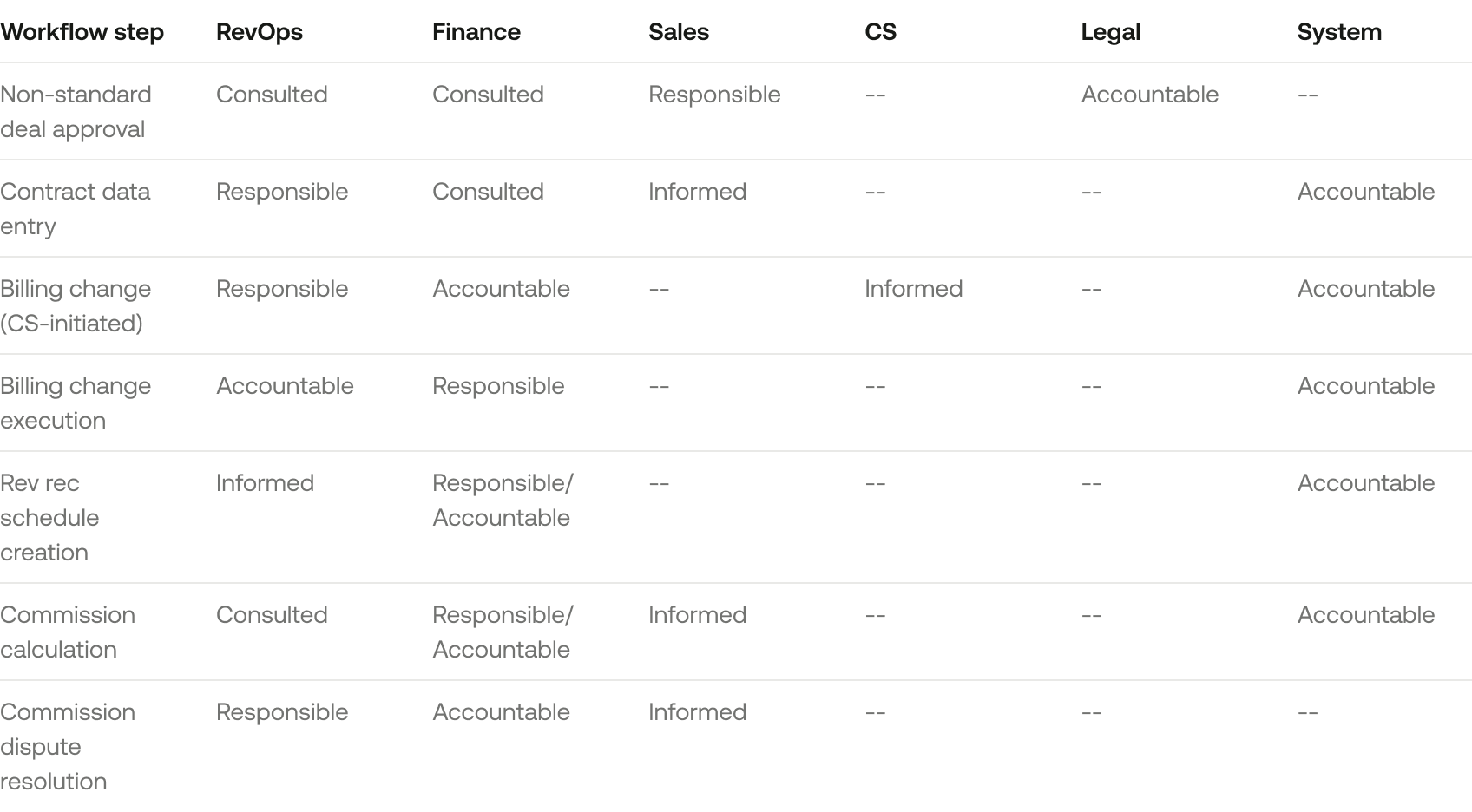
The RACI you can actually use: who owns billing, commissions, and contracts?
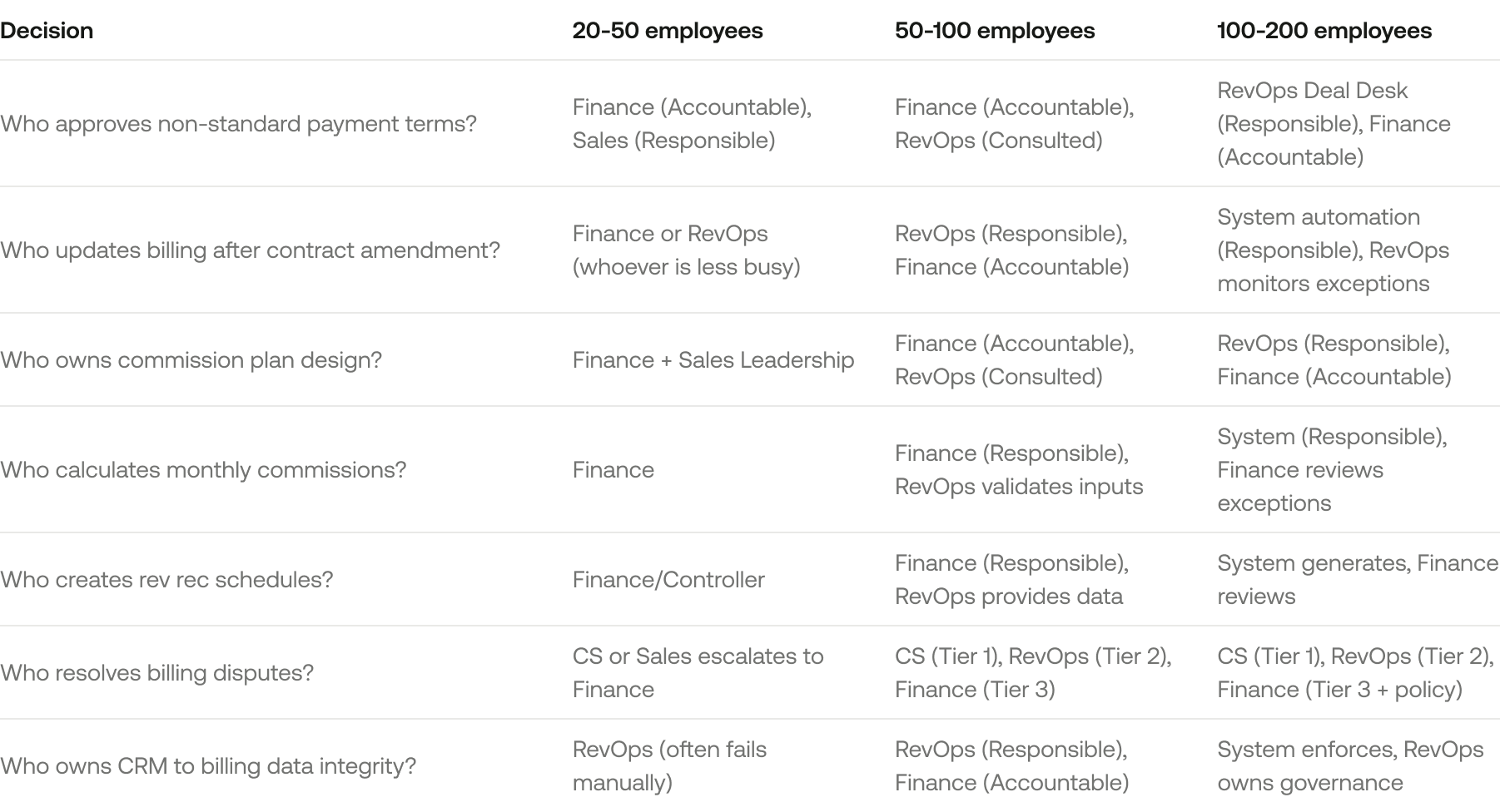
Generic RACIs are useless because they don't account for company stage. Here's a decision framework that evolves as you grow.
Decision framework: RevOps versus Finance versus Sales
System enforces, RevOps owns governance
Notice the pattern: as you grow, "System" appears more frequently in the "Responsible" column. That's not laziness. That's maturity. The workflows that should be system-enforced at scale are exactly the ones that consume 40+ hours per month when managed manually.
Red flags: 8 signs your RevOps structure is broken
These symptoms mean you have accountability gaps, not bad people.
1. Month-end close extends beyond 7 business days. Root cause: manual reconciliation between CRM, billing system, and accounting. Your Finance team is rebuilding reports in Excel because systems don't agree. Fix the data flow, not the team.
2. Commission disputes consume 15+ hours per quarter. Root cause: calculation logic is a black box. Sales can't self-serve statements. RevOps or Finance spends meeting time walking reps through "why the number is right." System-enforced commission logic with a rep-visible audit trail solves this permanently.
3. Billing changes take 3+ business days to execute. Root cause: multi-step approval workflow across Sales, CS, RevOps, Finance with no clear routing logic. Customers get invoiced incorrectly. Trust erodes. Churn follows.
4. Sales blames "ops" for slow deal cycles. Root cause: non-standard deals require 4+ approvals with no SLA or tracking. Deals sit in "Legal review" or "Finance approval" for 5-10 days with nobody owning the clock.
5. Finance discovers contract amendments weeks after signature. Root cause: no automated handoff from your contract tool to billing and accounting. Rev rec schedules are wrong. Month-end gets restated. Your Controller loses sleep.
6. Your team is asking "who owns this?" multiple times per week. Root cause: no documented RACI or process playbook. Slack threads with 12 people tagged, no clear DRI, and the issue resolves only when someone's frustration exceeds everyone else's.
7. You're hiring for "bandwidth" rather than "capability." Root cause: current team is drowning in manual execution. The job description says "detail-oriented" and "high-volume executor." That's a signal you need automation, not another analyst.
8. Data quality issues are a recurring leadership agenda item. Root cause: no source of truth. Multiple systems with conflicting data. Every board meeting starts with "why do these numbers not match?" because nobody can answer that question without two hours of investigation.
If you recognize three or more of these red flags, you don't need another headcount. You need revenue infrastructure that enforces data integrity and eliminates the manual handoffs creating the chaos.
The system versus headcount decision framework
Every manual handoff is a choice: hire someone to manage it, or automate it. Here's how to decide.
When to add headcount
Hire another ops person when:
You're launching a new GTM motion (adding PLG, launching partners, going upmarket)
You're entering a new geography with different legal, tax, or compliance requirements
Your existing team is operating at 80%+ capacity on strategic work (not manual execution)
You need deep functional expertise (e.g., complex lead scoring or partner program operations)
When to invest in infrastructure
Invest in a platform when:
Your team is spending 15+ hours per week on manual data entry or reconciliation
You're managing 500+ active contracts across multiple disjointed systems
Month-end close takes longer than 7 business days due to manual reconciliation
You're asking "Can we afford to hire 2-3 more ops people?" (the answer is usually "invest in infrastructure instead")
The true cost of manual handoffs
A platform that eliminates these manual workflows costs a fraction of that annual spend. And unlike headcount, it works the same way at 200 contracts as it does at 2,000. It doesn't call in sick, and it doesn't need a manager.
Common mistakes by stage (and how to avoid them)
Mistake 1 (20-50 employees): Letting RevOps report to VP Sales
It happens because RevOps starts as "Sales Ops" and the reporting line never changes. The problem: RevOps becomes a service function for Sales, not a strategic partner to Finance, CS, and Marketing. At 50 employees or $5M ARR, move the reporting line to CRO, CFO, or CEO. Do it before the political calcification makes it impossible.
Mistake 2 (50-100 employees): Hiring analysts before fixing data plumbing
Leadership wants "better insights" and assumes hiring a data analyst will deliver them. But analysts spend 90% of their time cleaning data instead of generating insights when the underlying systems don't connect. Invest in data infrastructure first. Automated contract-to-cash workflows. A unified data model. Then hire the analyst who can actually do analysis.
Mistake 3 (100-200 employees): Letting each GTM function build its own ops team
Sales, Marketing, and CS each hire their own ops person without coordination. You end up with four people using different definitions for "pipeline," "qualified lead," and "ARR." Establish a hub-and-spoke model with a central RevOps leader who owns data governance, tooling strategy, and cross-functional process design. The embedded specialists work within functional teams but report to RevOps.
Mistake 4 (all stages): Treating RevOps as a help desk
RevOps becomes the catch-all for "anything operational." The team gets buried in tickets and can't focus on strategic work. Establish clear tiering: Tier 1 is a self-service knowledge base. Tier 2 is RevOps. Tier 3 is escalation to Finance or Engineering. Add SLAs for response times so everyone knows what to expect.
Sample 90-day plan for your first RevOps hire
Hiring your first dedicated RevOps person? Here's how to set them up without the "what do I actually own?" trap.
Month 1: Audit and align. Weeks 1-2: Shadow Sales, CS, and Finance to map current workflows. Don't change anything yet. Just document how things actually work versus how people think they work. Week 3: Document existing handoffs and identify the top three breakage points. Week 4: Present findings to leadership with a prioritized fix list.
Month 2: Quick wins. Weeks 5-6: Implement one high-impact process improvement. A standardized billing change request form. A deal approval workflow with explicit thresholds. Something visible. Weeks 7-8: Build a first-pass RACI for contract-to-cash workflows.
Month 3: Foundation building. Weeks 9-10: Audit the tool stack. Propose consolidation or integration plan. Identify which manual handoffs cost the most in hours and errors. Weeks 11-12: Establish a weekly sync with Finance. Document decision rights. Draft a 6-month roadmap.
Key deliverable by day 90: A documented RevOps Operating Model including RACI, tool ownership map, escalation paths, and a 6-month roadmap for process and system improvements.
Tools and technology: what your RevOps team needs by stage
Core stack (20-50 employees)
CRM: Salesforce or HubSpot
Billing: Stripe Billing or Chargebee (basic subscription management)
Accounting: QuickBooks Online or Xero
Contracts: DocuSign or PandaDoc
Commissions: Spreadsheet (acceptable for now, not forever)
The key gap: manual handoffs between CRM, billing, and accounting. Everything connects through people and Slack messages instead of system integrations.
Maturing stack (50-100 employees)
CRM: Salesforce (typically becomes necessary at this stage)
Billing: Chargebee, Recurly, or a platform built for B2B SaaS complexity
CPQ: Native Salesforce CPQ or equivalent
Accounting: NetSuite or Sage Intacct
Contracts: DocuSign + CLM layer
Commissions: Spiff, CaptivateIQ, or system-native commissions
Data warehouse: Snowflake or BigQuery (if you have an analytics hire)
The key gap: still no unified system connecting contract terms to billing to rev rec to commissions. You've added tools but not reduced handoffs. Each new tool adds integration tax.
Scaled stack (100-200 employees)
CRM: Salesforce (advanced configuration)
Revenue infrastructure: A connected platform like Measure that handles contracts, billing, rev rec, and commissions natively
Accounting: NetSuite
Data infrastructure: Snowflake + Fivetran + dbt
BI: Tableau, Looker, or Mode
Commissions: Automated engine integrated with billing data
At this stage, you should be consolidating tools, not adding more. The right infrastructure eliminates 3-5 point solutions and the manual reconciliation between them.
When one system owns contracts, billing, rev rec, and commissions together, data propagates automatically. The invoice updates when the contract changes. The commission calculates when the invoice generates. The rev rec schedule adjusts when the amendment posts. No manual re-entry. No "who owns this?" Slack threads.
Build for workflows, not titles
Your org chart matters less than your workflow accountability. The real question isn't "who reports to whom?" It's "who owns billing changes, contract amendments, rev rec schedules, and commission calculations when things go wrong?"
The 20-200 employee range has three distinct phases. At 20-50, you need 1-2 generalists with a heavy Finance partnership and disciplined automation of your highest-volume manual handoffs. At 50-100, you need 2-3 specialists with formal governance and a reporting line that grants cross-functional authority. At 100-200, you need 4-5 embedded specialists with a unified data model where automation handles execution and humans handle strategy.
Accountability gaps create revenue leakage. Not bad people. If three or more of the red flags in this guide apply to your team, the answer isn't another headcount requisition. It's infrastructure that eliminates the manual handoffs generating the chaos in the first place.
Ready to see what happens when contracts, billing, rev rec, and commissions actually live in one connected system? Measure was built by operators who lived through exactly the RevOps chaos described in this guide. When contract data flows automatically from signature through billing, recognition, and commissions without manual re-entry, your RevOps team stops managing handoffs and starts driving strategy. Book a demo to see how it works.
See it in action.
Billing and revenue automation that handles contracts, invoicing, revenue recognition, and commissions in one connected system. Book a demo to see how Measure works.