Revenue leakage in B2B SaaS: the $500K problem hiding in your billing stack
Most $5M ARR SaaS companies leak 3–8% of revenue annually. Not from failed payments, but from contracts that never wired to billing. Here's how to find and fix it.
A $5M ARR SaaS company closes a $120K enterprise deal. The contract includes a usage overage clause. A 15% price escalator kicks in at renewal. Billing lives in Stripe, configured manually by a RevOps lead who's also managing 47 other accounts.
Twelve months later, the customer has exceeded their usage cap every quarter. The price escalator never fired. The overage invoices never generated. The money was contractually owed. It was never collected.
This isn't a failed payment. No dunning sequence will catch it. It won't show up in your payment failure report or your churn analysis. It's revenue leakage. And it's probably happening across a dozen accounts in your book right now.
Revenue leakage is not a payments problem. It's an infrastructure problem. It lives in the gap between what your contracts promise you'll collect and what your billing system actually sends.
Most $5M ARR B2B SaaS companies leak 3–8% of revenue annually. On a $5M book, that's $150,000 to $400,000 disappearing quietly. Not to churn. Not to fraud. To structural gaps between your contracts, billing, and operations.
Here's how to find it, quantify it, and fix it.
What revenue leakage actually means (and what it doesn't)
If you've researched this topic before, you've probably landed on articles about dunning sequences and failed payment retries. That's a slice of the problem. It's not the problem.
The common misconception: leakage = failed payments
Most content on revenue leakage SaaS focuses on what's visible. A credit card expires. A bank transfer fails. Your retry logic kicks in, recovers 60–70% of those failed charges, and the rest becomes involuntary churn.
That's real money. But it's the part you can already see in your dashboard.
Failed payments account for roughly 15–25% of total revenue leakage in B2B SaaS. The remaining 75–85% is contractual, operational, or systematic. Most of it never appears in your payment failure reports.
The distinction matters because it changes where you look.
The working definition for B2B SaaS
Revenue leakage is any gap between revenue you are contractually or commercially entitled to collect, and revenue that is actually invoiced and collected.
This is different from churn (a customer intentionally leaves). Different from bad debt (you invoiced, they didn't pay). Different from pricing decisions (you chose to discount).
Leakage is money you're owed that you never asked for. That's what makes it uniquely damaging. It's invisible in standard MRR and ARR reporting. It compounds annually. And it distorts your net revenue retention in ways that make your business look worse to investors, your board, and yourself.
The $5M ARR revenue leak audit: where is your money going?
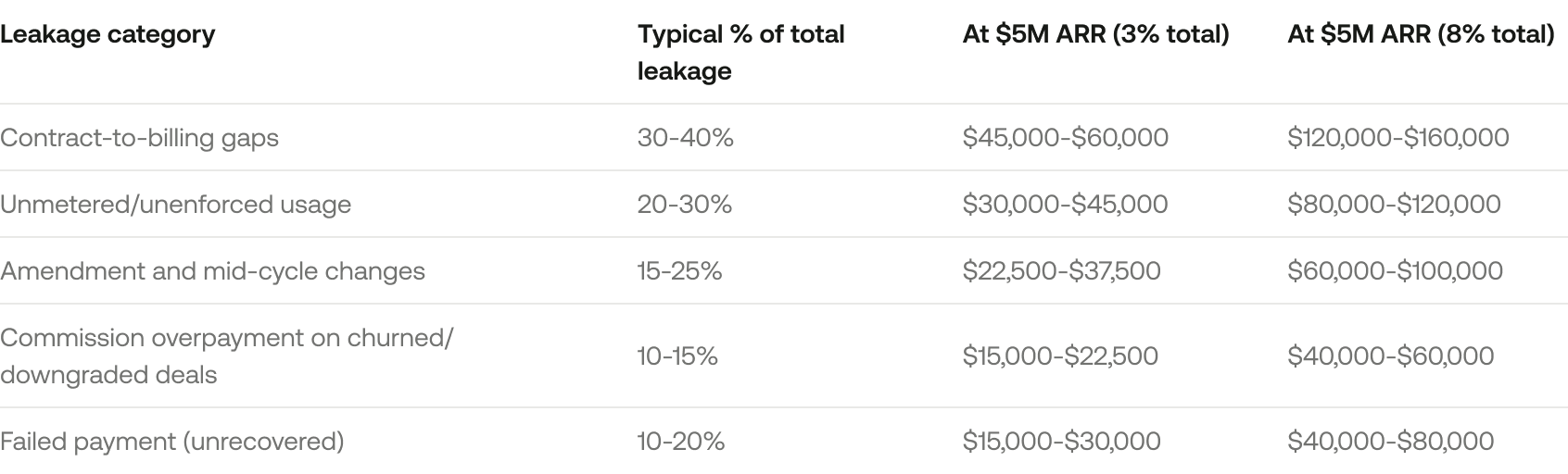
Let's make this concrete. If you're running a $5M ARR B2B SaaS company, here's where leakage typically hides and how much each bucket contributes.
That table is your starting framework. Now let's break each bucket open.
Bucket 1: contract-to-billing gaps (the silent killer)
This is the single largest source of revenue leakage in B2B SaaS. And it's the one nobody writes about because it's not a product problem. It's a handoff problem.
What it looks like in practice: Your contract says $24K/year. Billing is set to the old rate of $18K. The contract has a minimum commitment clause. The annual true-up was never configured. The customer's billing subscription doesn't reflect what they signed.
Why it happens: Sales closes the deal, hands off to CS or finance. No system forces contract terms to automatically populate billing configuration. Someone creates a Stripe invoice manually, types in a number, and moves on.
Here's the test you can run today. Pull your last 20 enterprise contracts. Check if every commercial term (price, duration, overage triggers, minimums, escalators) maps 1:1 to an active billing rule. In our experience, $5M+ ARR B2B SaaS companies with manual contract-to-billing handoffs have at least 10–15 active accounts where billing doesn't match the signed agreement.
That's not carelessness. It's the inevitable result of contracts and billing living in different systems with a human bridge between them.
Bucket 2: unmetered or unenforced usage
Your customer pays for 10 seats. They're using 17. Your usage-based billing tier should trigger an upgrade or an overage charge. It doesn't, because usage data isn't connected to billing.
This is the entitlement layer gap. Your product might enforce login credentials, but it doesn't enforce tier-level access or seat counts in a way that triggers a commercial action. The customer uses more than they pay for. Nobody notices until a renewal review six months later. Sometimes not even then.
For companies with hybrid pricing models (base subscription plus usage), this gets exponentially worse as contract complexity grows. Every new pricing dimension you add is a new surface area for leakage.
The detection question is simple: Can you run a query today showing every account where actual usage exceeds contracted entitlement? If you can't run that query, you don't have a metering problem. You have a data infrastructure gap. And that gap is leaking money every day.
Bucket 3: contract amendments that fall through the cracks
A customer negotiates a price increase deferral via email. An expanded scope gets verbally agreed on a QBR call. A new add-on is promised by the account manager in a Slack message. Sales says "done." Finance never receives a signed amendment. Billing is never updated.
Mid-market B2B SaaS is especially vulnerable here. High-touch deals, heavy account management, verbal commitments, email approvals. None of these are billing events unless someone manually creates them.
The practical test: How many amendments were executed last quarter? How many generated a billing change within 48 hours? If you don't know the answer to the second question, or if the gap between those two numbers is more than 10%, you have an active leak.
This isn't about discipline. It's about the fact that amendments happen in conversations, and billing happens in systems. Without a workflow that forces one to update the other, the gap is structural and persistent.
Bucket 4: commission overpayment on churned or downgraded deals
This one gets overlooked because it flows out the door as payroll, not as uncollected revenue. But it's real cash leaving your company based on incorrect data.
Your sales rep earns commission on a $60K deal. The customer downgrades to $30K in month four. Your commission clawback policy exists on paper. But it isn't systematically tracked. The overpayment persists.
At a $5M ARR company with approximately $500K in sales payroll and 10% commission rates, even a 5% overpayment error rate represents $25K or more in cash paid incorrectly. That's before you account for multi-year deals where the downstream revenue never materializes.
This is only fixable if your billing system produces the downstream revenue data that feeds commission calculations. When commissions live in a spreadsheet and billing lives in Stripe, there's no automatic reconciliation. Overpayments persist quietly.
The leakage audit: a 5-step diagnostic framework
Here's the process you can start this week. Sequence matters. Each step builds on the previous one, and the early steps will tell you whether later steps are even possible with your current infrastructure.
Step 1: the contract-billing reconciliation pull
Export all active contracts from your CRM or CLM. Include contract value, start date, billing frequency, and any variable terms (escalators, overages, minimums).
Cross-reference against all active billing subscriptions with current MRR and invoice amounts.
Flag any account where billed amount doesn't equal contracted amount. Sort by gap size. That's your prioritized list of confirmed or suspected leakage.
This is the highest-ROI step because it's purely a data comparison. You don't need new tooling. You need a spreadsheet, access to both systems, and a few hours. If you want a structured template for this, we've built a billing audit checklist you can use.
Step 2: the usage entitlement scan
Pull usage data from your product analytics or data warehouse for every billable dimension. Seats, API calls, records, storage, features. Whatever your pricing is built on.
Cross-reference against contracted entitlements in each account.
Flag any account where actual usage exceeds the contracted tier. If you can't run this query today, that's your finding. The data infrastructure gap is the leak.
Step 3: the amendment audit
Pull all contract amendments from the last 12 months. Check emails, DocuSign, Salesforce notes, Slack threads, wherever amendments live in your organization.
Cross-reference each with billing change logs. Flag any amendment without a corresponding billing update within 7 days of execution.
In most $5M ARR companies, we see 20–40% of amendments sitting in a gray zone. Either they never reached billing, or they reached billing weeks or months late.
Step 4: the commission reconciliation check
Pull paid commissions for deals that subsequently churned or downgraded within the clawback window.
Apply your clawback policy retroactively to determine overpayment. If you don't have a clawback policy, or you can't run this check because commission data and billing data don't live in the same system, flag it as a policy and infrastructure gap.
Step 5: calculate your leakage rate
Total Identified Leakage (annualized) / ARR = Leakage Rate
Here's your benchmark guide:
Below 3%: Healthy. Focus on prevention and monitoring.
3–6%: Moderate. Structural fixes are high-ROI and should be prioritized this quarter.
6–10%: Significant. Multiple systemic gaps exist across all four buckets. This is a board-level conversation.
Above 10%: Critical. Your revenue infrastructure is not functioning. Fix before you invest in growth.
Why this gets worse as you scale (the $10M trap)
If you're looking at this thinking "we'll fix it when we're bigger," here's why waiting makes the problem compound.
A $150K leak at $5M ARR doesn't become a $300K leak at $10M ARR. It becomes $350K or more. Deal volume and complexity increase faster than ops capacity. More enterprise contracts. More amendments. More usage dimensions. More commission structures. Every new variable creates new surface area for leakage.
The NRR distortion is particularly damaging. Undetected leakage makes your net revenue retention look worse than it actually is. You appear to have a retention problem when you actually have a billing problem. This affects Series B valuations, investor perception, and internal planning. If your NRR feels lower than it should, leakage might be why.
The team scaling myth compounds the issue. Hiring more finance or RevOps staff without fixing the underlying systems adds labor cost to a structural problem. You're paying people to manually reconcile gaps that shouldn't exist.
And then there's the compliance risk. As you grow past $10M ARR, mismatches between contracts and recognized revenue create ASC 606 exposure. What was a billing inconvenience at $3M ARR becomes an audit finding at $15M ARR. The fix at that stage is ten times more expensive and ten times more disruptive.
The structural fix: connecting contracts, billing, and operations
So the diagnosis is clear. How do you actually fix it?
The root cause is infrastructure, not process
Most leakage "prevention" advice says "create a process." Assign an owner. Do a monthly audit. Build a checklist.
This treats a system failure as a human failure. You can't process your way out of an infrastructure gap. If your contract lives in Salesforce, your billing lives in Stripe, your usage data lives in Segment, and your commissions live in a spreadsheet, no amount of process discipline eliminates the gaps between them. People forget. People leave. People get busy.
The real fix: The commercial terms in your contracts need to be the source of truth for billing. Not interpreted by a person. Not re-keyed into a billing tool. Automatically reflected.
What connected revenue infrastructure looks like
The architecture is straightforward in concept: Contract closes. Billing rules auto-configure. Usage data feeds entitlement checks. Amendments trigger billing updates. Billing data feeds commission calculations. Every commercial event produces an automatic billing event. No manual step required.
Contrast that with the current state most $5–10M ARR companies operate in: CRM holds contracts. Email handoff to finance. Billing tool configured manually. Commissions calculated in a spreadsheet. Four systems, three humans bridging the gaps, zero automatic propagation.
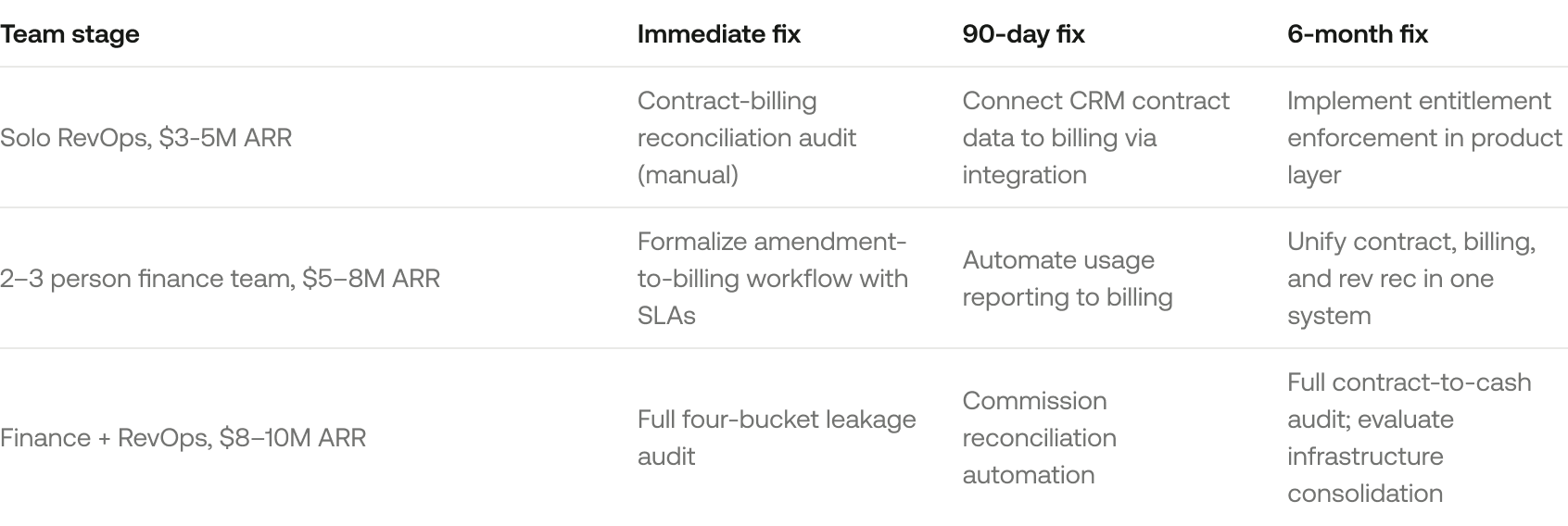
Not every company needs the same fix at the same time. Here's how to prioritize based on where you are.
The tooling question
Here's the honest version: You don't need a $100K enterprise platform to fix leakage. You don't need an 18-month implementation. You need billing that reads from your contracts, not the other way around.
What to look for: Contract-native billing configuration. Usage metering with entitlement enforcement. Amendment workflow triggers that automatically update invoices. Downstream commission data that stays in sync with actual collected revenue.
Measure was built to be this connective layer. Contracts, billing, rev rec, and commissions in one system. Purpose-built for the $3–10M ARR B2B SaaS team that can't afford to keep stitching together four tools with manual handoffs between them. Our founders spent three years building everything together from the start because they'd seen what happens when revenue operations break at scale.
That's not a pitch. It's the architectural answer to the problem this entire article describes.
Measuring success: the KPIs that tell you leakage is under control
Fixing leakage isn't a one-time project. It's an ongoing measurement discipline. Here are the metrics that tell you whether your infrastructure is actually working.
Primary leakage KPIs
Billing-to-Contract Variance Rate: Billed ARR divided by Contracted ARR. Target above 99%. If this number is below 97%, you have active leakage across multiple accounts.
Amendment Billing Lag: Days from amendment execution to billing update. Target under 3 business days. Anything over 7 days means amendments are accumulating in a backlog.
Usage Overage Capture Rate: Percentage of usage overages that generated an invoice. Target 100%. Anything less means metered usage isn't connected to billing triggers.
Commission Overpayment Rate: Percentage of paid commissions later identified as errors. Target below 1%. Track quarterly against churned and downgraded deals.
Recovered Revenue from Leakage Audit: Track this quarterly as a standalone metric. It builds the ROI case for infrastructure investment and demonstrates to your board that finance is actively recovering value.
The NRR connection
Here's why this matters beyond recovered cash: Fixing leakage improves NRR without acquiring new customers or improving retention. It's the fastest NRR lever most mid-stage companies have.
A practical rule of thumb: Recovering 3% leakage at $5M ARR adds 3 NRR points and $150K in recovered revenue. For the cost of a system change, not a headcount hire. That's the kind of efficiency gain that compounds. At your next board meeting, it's a much better story than "we need two more hires to reconcile spreadsheets."
Revenue leakage quick-reference summary
For the VP Finance who's about to forward this to their RevOps lead, here's the executive summary:
The four leakage buckets: Contract-to-billing gaps (30–40% of total leakage), unmetered usage (20–30%), amendment gaps (15–25%), and commission overpayment (10–15%). Failed payments are only 10–20%.
The benchmark: 3–8% of ARR. At $5M, that's $150K–$400K annually.
Fix priority: Depends on team maturity. Solo RevOps starts with the manual reconciliation pull. A three-person team formalizes amendment workflows. A full finance and RevOps team evaluates infrastructure consolidation.
Three KPIs to track: Billing-to-contract variance rate (above 99%), amendment billing lag (under 3 days), and usage overage capture rate (100%).
You can't fix what you can't see
Most revenue leakage doesn't show up in your payment failure report. It lives in the gap between your contracts and your billing system. Between what a customer agreed to pay and what your infrastructure actually asks them for.
If your NRR feels lower than it should be, if you've found billing mismatches before, if amendments feel chaotic and commission reconciliation is a quarterly fire drill. Your instinct is right. The money is there. You're just not collecting it.
The companies that fix this at $5M ARR don't just recover cash. They build the infrastructure to grow to $20M without their revenue operations breaking under the weight of manual handoffs and disconnected systems.
If you suspect your billing stack is leaking revenue, book a 20-minute revenue leak audit with our team. We'll walk through your contract-to-billing setup, identify the most likely leakage vectors, and show you what connected revenue infrastructure looks like in practice. No pitch required. Just a diagnostic conversation about where your money is going.
See it in action.
Billing and revenue automation that handles contracts, invoicing, revenue recognition, and commissions in one connected system. Book a demo to see how Measure works.