Milestone billing software: what finance teams at growing B2B SaaS companies actually need
Your subscription billing tool can't handle milestone payments. Here's what milestone billing software actually does, how to choose one, and how to implement it without breaking everything.
Your SaaS company just closed a $150K implementation deal with five milestone payments spread over six months. Your subscription billing tool can't handle it natively. Your project management tool isn't built for invoicing. Your finance team is about to spend the next six months manually tracking deliverable completion, generating invoices in spreadsheets, and praying nothing falls through the cracks.
This is the milestone billing gap most B2B SaaS companies hit between $3-10M ARR. Professional services revenue becomes material, but it doesn't justify a full enterprise platform implementation yet. You're stuck between tools built for recurring revenue and tools built for companies ten times your size.
Here's what actually matters when you're evaluating milestone billing software. Not the vendor marketing version. The finance team version.
What is milestone billing software? (And why subscription billing tools fail at it)
Milestone billing software automates payment collection tied to verified project deliverables. Not time elapsed. Not usage consumed. Specific outcomes your customer agrees are complete.
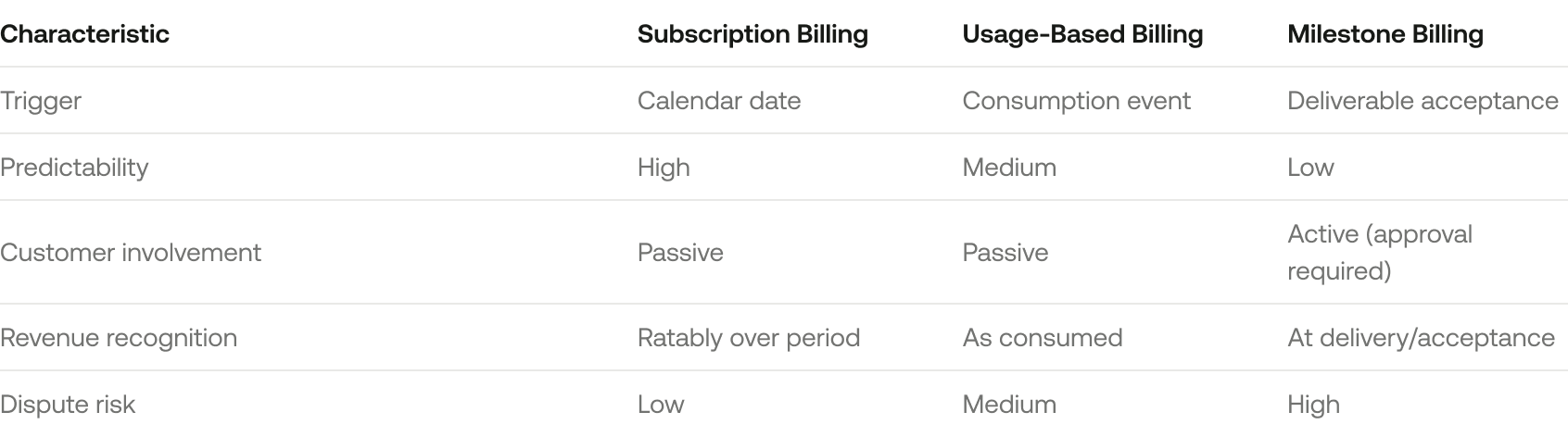
This is fundamentally different from subscription billing. Subscriptions are recurring and predictable. Milestones are project-based and conditional on acceptance. Your subscription tool knows how to charge $5,000 on the first of every month. It doesn't know how to invoice $25,000 when your customer confirms data migration is complete.
Here's a real example: Implementation project, $100K total. Paid as $25K upfront upon contract signing, $25K after data migration, $25K after user acceptance testing, $25K at go-live. Four different triggers. Four different approval workflows. Four different revenue recognition events.
Most B2B SaaS companies at this stage need both models running simultaneously. You have MRR from subscriptions and project-based revenue from implementations, onboarding, or custom development. The problem isn't billing. It's contract-to-cash orchestration across multiple revenue streams.
The core problem: why CFOs at growing SaaS companies struggle with milestone projects
The pain isn't "we need to send invoices." The pain is that milestone revenue touches every system you have and lives cleanly in none of them.
The revenue recognition nightmare. ASC 606 requires you to recognize milestone revenue when you deliver value, not when you invoice or receive cash. A $25K upfront payment for a project that hasn't started is deferred revenue. Your subscription billing tool handles this automatically for MRR. For milestones? You're making manual GL adjustments every month.
Cash flow unpredictability. When milestones slip (and they always slip), your cash forecast breaks. A three-month implementation that stretches to five creates a two-month gap between expected and actual cash receipts. Multiply that across ten active projects and your month-end close becomes a guessing game.
Client approval bottlenecks. Unlike subscriptions, milestone payments require someone on the customer side to confirm deliverable completion. That person is busy. They're on vacation. They "need to loop in their technical lead." Every day of delayed approval is a day of delayed payment.
System fragmentation. Contract terms live in Salesforce. Project status lives in Asana. Invoicing happens in QuickBooks. Revenue recognition lives in a spreadsheet. Nobody has a single source of truth for "which milestones are complete, which are invoiced, and which are paid?"
How many systems does it take to answer the question: "How much milestone revenue have we earned but not yet invoiced?"
If the answer involves opening four tabs and cross-referencing a spreadsheet, you have an infrastructure problem. Not a process problem.
What milestone billing software actually does (the 5 core capabilities)
Not every feature vendors list actually matters. Here are the five that do.
1. Contract-aware invoice triggering
The software reads your contract terms, maps milestones to deliverables, and automatically queues invoices when conditions are met. This eliminates manual calendar reminders and "did we invoice them yet?" Slack threads.
What to look for: integration with your CRM to pull contract data, customizable milestone definition fields (not just percentage complete or date-based), and support for conditional logic. "Invoice upon customer acceptance" is different from "invoice on March 15."
Red flag: tools that only support date-triggered milestones. That's calendar-based invoicing, not true milestone billing.
2. Deliverable verification workflow
This provides a structured process for marking milestones as "complete" with a customer acknowledgment trail. It protects against "we never agreed this was done" disputes.
Look for a customer-facing milestone approval portal. Not just internal checkboxes. Configurable acceptance criteria templates. An audit trail for who approved what and when. Escalation rules for overdue approvals.
Real-world example: "UAT milestone. Customer has 5 business days to accept or reject with feedback. If no response, auto-escalate to executive sponsor."
3. Hybrid revenue recognition engine
This separates milestone revenue from subscription MRR, handles prepayments as deferred revenue, and automates ASC 606 compliance. It prevents the "our numbers don't reconcile" board meeting.
Your subscription billing tool already does this for MRR. You need the same rigor for milestone revenue. Otherwise your CAC payback and LTV:CAC metrics are wrong. Not slightly off. Wrong. Your billing system is telling different stories depending on which revenue stream you're looking at.
4. Cross-team visibility dashboard
Finance needs to forecast cash. Delivery needs to prioritize work. Sales needs to know when to upsell. One dashboard that gives each team the view they need. Not a shared spreadsheet that's outdated by the time you open it.
Look for role-based views, pipeline visibility showing upcoming milestones by customer, cash forecasting based on milestone schedules, and alerts for blocked milestones or overdue approvals.
5. Integration with existing revenue infrastructure
You can't rip and replace your entire stack. Your milestone billing software needs to sit between your CRM, project management tools, accounting system, and payment processor. It works as an orchestration layer.
At $3-10M ARR, you likely have Salesforce or HubSpot for CRM, QuickBooks or Xero for accounting, and a project management tool. Native integrations matter here. Zapier band-aids break at exactly the wrong moment.
Milestone billing software vs. alternatives: what makes sense for your ARR stage
Let's be honest about the options.
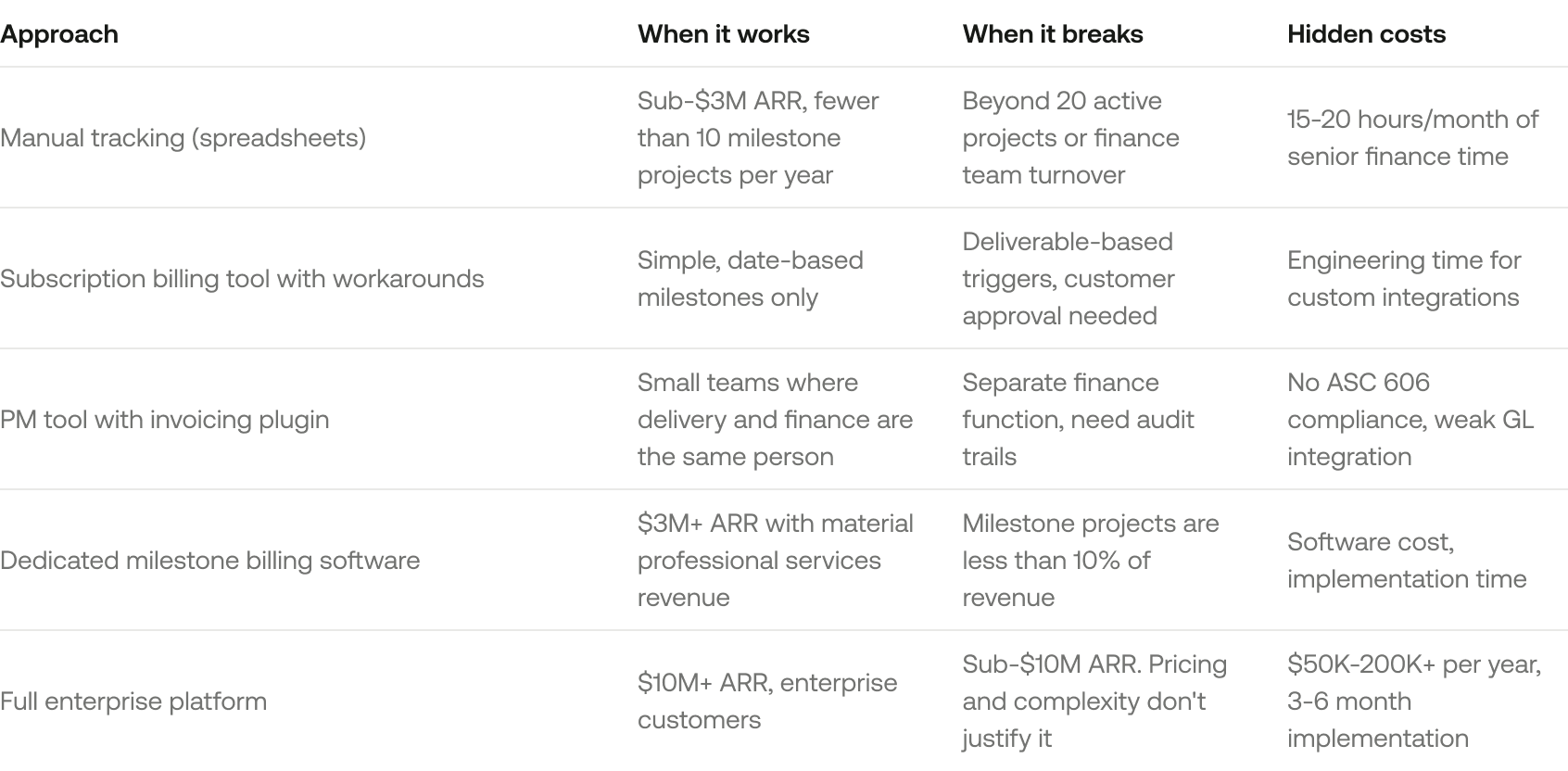
The milestone billing software category barely exists as a standalone market. Most solutions are either project management tools with billing bolted on, subscription platforms with milestone workarounds, or enterprise suites that are overkill below $10M ARR.
The sweet spot for most $3-10M SaaS companies: revenue infrastructure that treats milestones as a first-class revenue stream alongside subscriptions. Not a workaround. Not an afterthought.
How to choose milestone billing software: the 7 questions finance teams should ask
This isn't a buyer's guide. It's a decision framework.
1. "Can it read our contract language, or do we have to translate it into system fields?"
Contract-to-cash automation only works if the system understands "Invoice 30% upon completion of Phase 2 as defined in SOW Section 4.2." If you're manually interpreting contracts into rigid amount and date fields, you've just moved the spreadsheet problem into a different tool.
2. "Does it enforce deliverable verification before invoice generation?"
This prevents the "we invoiced before the client accepted" dispute. Look for customer-facing acceptance workflows. Not just internal PM checkboxes that nobody audits.
3. "How does it handle partial milestone completion or rejected deliverables?"
Clients refuse to pay for 70% complete work. What happens if a client rejects a deliverable? Can you reverse the invoice and adjust the milestone schedule without manual accounting entries? This is where most tools fall apart.
4. "Can it separate prepaid cash from earned revenue for ASC 606?"
Your board and investors need clean revenue recognition. At $3-10M ARR, you're likely dealing with sophisticated investors who will audit your revenue recognition. "We track it in a spreadsheet" won't fly past Series A.
5. "Does it integrate with our existing stack without custom dev work?"
Ask vendors to show you the data flow diagram. Where does contract data originate? How does milestone completion status flow from PM tool to billing system? How do invoices sync to accounting? If the answer involves custom API work, plan accordingly.
6. "What's the implementation timeline, and who does the work?"
Red flags: "Requires 3-6 month implementation with professional services." Green flags: "Go-live in 30 days or less. Start with new contracts, phase in existing customers." Your finance team is lean. You can't afford a year-long implementation.
7. "What happens when our pricing model changes?"
You're in growth mode. Your professional services packaging will evolve. How easy is it to modify milestone structures? What happens to in-flight contracts when you change your standard terms? Flexibility here separates infrastructure from point solutions.
Implementation best practices: how to roll out milestone billing without breaking everything
Phase 1: Audit your current state (week 1)
Map all active milestone contracts and their payment schedules. Document your current manual process. Who does what, how long it takes. Calculate the cost of status quo: finance hours plus revenue leakage plus compliance risk.
The deliverable is a one-page "Milestone Billing State of the Union" for leadership. If you can't quantify the problem, you can't justify the solution.
Phase 2: Define milestone standards (weeks 2-3)
Create standard milestone definitions for common project types. Write acceptance criteria templates. Document approval workflows and escalation paths.
This is the work most companies skip. And it's why they blame the software when things go wrong. Clear milestone definitions are 80% of the solution. Software is 20%.
Here's what a good milestone definition looks like:
Milestone: Data Migration Complete
Acceptance criteria: 100% of customer data migrated to production. Zero critical validation errors. Customer confirms data accuracy in writing.
Payment terms: Invoice within 2 business days of acceptance.
Amount: 25% of total contract value.
Escalation: If no customer response within 5 business days, escalate to executive sponsor.
Compare that to: "Phase 1 complete." One is invoiceable. The other is a dispute waiting to happen.
Phase 3: Pilot with new contracts (weeks 4-8)
Launch for new contracts only. Don't migrate existing customers yet. Run parallel processes for one to two months. Compare outputs: invoices, revenue recognition, cash flow forecasts.
Success criteria: zero invoicing errors, 50% reduction in manual finance hours on new milestone projects.
Phase 4: Gradual migration of existing contracts (months 3-6)
Start with simplest existing contracts. Fewest milestones, most straightforward terms. Move complex contracts last. Maintain audit trail of migration.
Never do a big-bang migration. Customers don't care about your internal systems. Invoices must be flawless.
Red flags: when "milestone billing software" is actually something else
It's really just a project management tool with invoicing
How to spot it: marketed to freelancers and agencies, not B2B SaaS. No revenue recognition features. Basic invoice generation only. Can't handle ASC 606. Won't integrate with your GL.
It's a subscription platform with "milestones" as a feature
How to spot it: all marketing focuses on recurring revenue. Milestone billing is buried in documentation as an edge case. Workarounds required for deliverable-based triggers. Customer approval workflows don't exist.
Stripe is a good example. Excellent for subscriptions. You can create one-off invoices. But tracking milestone completion, customer approval, and revenue recognition across 20+ active projects? That's not what it was built for.
It's an enterprise platform you're not ready for
How to spot it: pricing requires "contact sales." Implementation takes 6+ months. Minimum contract $100K+ per year. Requires full-time admin.
Not a point solution for milestone invoicing. Revenue infrastructure that treats subscriptions, usage-based revenue, and milestone projects as different expressions of the same underlying customer relationship. One connected system. One source of truth.
Milestone billing best practices (beyond software)
Define acceptance criteria before contracts are signed
Bad milestone definition: "Phase 1 complete." Good milestone definition: "All user stories in Epic XYZ accepted by Product Owner, deployed to production, and confirmed stable for 48 hours."
If your sales team is signing milestone contracts with vague deliverable definitions, no software will save you from disputes later.
Set milestones based on customer value, not your internal timeline
Clients won't pay for work that has no standalone value. "70% complete" means nothing to them. It's not usable.
Invoice when data migration is complete and the customer can verify their data. Not when your dev team finishes coding. Not every two weeks regardless of deliverables. Tie each payment to something the customer can see, touch, and confirm works.
Build in at least one milestone per month for cash flow
Six-month projects with two milestones create three-month cash gaps. Simple formula: project duration in months equals your minimum number of milestones.
But don't artificially split work just to create invoices. Each milestone should represent meaningful value delivery. If you can't explain to the customer why this milestone deserves a payment, it shouldn't be a milestone.
Use milestone billing to de-risk large deals
Milestone billing isn't just operational. It's strategic. Your sales team should position it as "we only get paid when you're happy with each phase." That's a powerful trust signal for risk-averse buyers.
It also protects your downside. You're not financing the entire project. And it forces early feedback loops. You catch misalignment at milestone 2, not month 6.
Frequently asked questions
Can I use Stripe (or Chargebee/Recurly) for milestone billing?
Yes, but with significant limitations. These platforms are optimized for recurring revenue, not project-based deliverables. You can create one-off invoices, but you'll need to manually track milestone completion, customer approval, and revenue recognition. At scale, this creates the same problems you're trying to solve. It works for simple, date-based milestones with no approval workflow. It breaks with deliverable-based triggers, complex revenue recognition, or more than 10 active milestone projects.
What's the difference between milestone billing and progress billing?
These terms are often used interchangeably, but there's a meaningful difference. Milestone billing triggers payment upon completion of defined deliverables. It's event-driven. Progress billing triggers payment based on percentage of work completed. It's time-or-effort-driven. For B2B SaaS professional services, milestone billing is usually preferred because it ties payment to customer-verifiable outcomes, not internal progress estimates that are impossible to audit externally.
Do I need milestone billing software if I only do fixed-price implementation projects?
Yes, if those projects take longer than 30 days and involve multiple deliverables. Even fixed-price projects benefit from milestone payment structures. You improve cash flow by not financing six-month projects. You reduce scope creep with clear deliverables for each payment. And you simplify revenue recognition. ASC 606 requires recognizing revenue as you deliver value, not just when you send the final invoice.
How do I handle scope changes mid-project without breaking milestone billing?
Document the change order with an updated milestone schedule. Recalculate remaining milestones based on the new SOW. Get customer approval on the updated payment schedule. Your billing system should maintain version history of milestone schedules, not just overwrite the original. You need audit trails for both finance and customer success. If your current tool can't handle contract amendments without manual rework, that's a clear signal you've outgrown it.
Milestone billing software as revenue infrastructure
Here's what this comes down to:
Milestone billing is fundamentally different from subscription billing. Don't force-fit it into a tool built for recurring revenue.
The core problem isn't invoice generation. It's contract-to-cash orchestration across multiple revenue streams.
At $3-10M ARR, you need enterprise-grade revenue recognition without enterprise complexity or pricing.
Clear milestone definitions and acceptance criteria are 80% of the solution. Software is 20%.
Implementation should be phased. New contracts first. De-risk the transition.
If professional services revenue is more than 20% of your total ARR and growing, milestone billing is a revenue operations imperative. The right platform connects contracts, billing, revenue recognition, and cash forecasting in one system. Your board metrics become real-time. Your finance team spends time on strategy, not manual invoice tracking.
Measure handles milestone billing alongside subscription revenue and usage-based pricing in one connected system. No manual spreadsheets. No complex workarounds. No six-month implementation. Book a demo and see how it actually works for companies at your stage.
See it in action.
Billing and revenue automation that handles contracts, invoicing, revenue recognition, and commissions in one connected system. Book a demo to see how Measure works.