Measure vs. Hyperline: which billing platform is right for your SaaS?
Hyperline handles billing. But what about rev rec, commissions, and contract amendments? See where Hyperline and Measure actually differ for $3-10M ARR SaaS.
You're a VP Finance or Head of RevOps at a $5M ARR B2B SaaS company. You're evaluating billing platforms. Hyperline comes up. And it should. It's a well-built tool with real strengths.
But before you sign, one question matters more than any feature comparison: does Hyperline handle everything your finance team actually touches? Or does it hand you the invoice and leave you to figure out rev rec, commissions, and contract amendments on your own?
This is a comparison written by Measure, so we have a perspective. We'll be transparent about that. But we'll also be honest about where Hyperline wins. Because the real question isn't which tool is "better." It's which one matches the work your team actually does every month.
Full disclosure: this page is written and maintained by the Measure team. We've done our best to represent Hyperline's capabilities accurately as of the date published. If anything here is outdated, reach out and we'll update it.
What is Hyperline?
Hyperline is a billing platform built for SaaS companies that need to move fast on pricing and invoicing without the overhead of enterprise tools like Zuora or Chargebee.
It does several things well. Its CPQ and quoting workflow connects directly to invoicing, so sales teams can close deals and billing kicks in without a handoff gap. It handles usage-based billing with purpose-built metering infrastructure. It integrates with HubSpot and Salesforce. And it supports multi-currency invoicing and payment collection out of the box.
Hyperline is built for SMB to mid-market SaaS teams. If you need a clean, modern billing tool that handles subscriptions, usage-based models, and hybrid pricing without months of implementation, Hyperline is a legitimate option. It's particularly strong for teams with engineering resources that can own the metering and API integration layer.
That's a fair summary. Now here's ours.
What is Measure?
Measure is revenue infrastructure that connects contracts, billing, rev rec, and commissions in one system. Not four tools stitched together. One connected data model where a signed contract automatically propagates downstream to billing schedules, ASC 606 revenue recognition, and commission calculations.
It's built for Finance and RevOps teams at $0-20M ARR B2B SaaS companies. The ones where two or three people own the entire revenue operations workflow. Where month-end close means reconciling data across billing, accounting, and a commission spreadsheet that nobody fully trusts.
The core claim: one source of truth from signed contract to recognized revenue to commission payout. No export. No reconciliation layer. No second system.
Where they overlap
Before we get to the differences, let's be honest about shared ground. Both Measure and Hyperline cover the billing fundamentals:
Subscription and recurring billing automation
Usage-based and hybrid pricing model support
CRM integrations (Salesforce, HubSpot)
Invoicing and payment collection
Multi-currency support
If your only need is billing automation, both tools can get you there. The question is whether billing automation is actually your only need, or whether it's one piece of a larger revenue operations problem your team solves every month.
Where they diverge: the key differences
This is where the comparison matters. Each difference below connects to a specific workflow that Finance and RevOps teams at $0-20M ARR SaaS companies deal with regularly. Not edge cases. Recurring, monthly work.
Revenue recognition
Hyperline generates invoices and captures billing events. But it's not a native rev rec system. To get ASC 606-compliant revenue recognition, you need to export billing data to your accounting system (NetSuite, QuickBooks, or similar) and handle the rev rec treatment there. That means a manual or semi-automated reconciliation step every month.
Measure handles revenue recognition natively. Performance obligations, standalone selling prices, and deferred vs. recognized revenue are calculated automatically from contract terms and billing events. Not rebuilt after the fact in a spreadsheet.
Why this matters: A Controller at a $6M ARR SaaS company shouldn't spend two days every month-end doing rev rec reconciliation because their billing tool doesn't speak ASC 606. This isn't an edge case. It's the close process. And if you're preparing for an audit or a fundraise, the accuracy of your rev rec schedule isn't optional.
How many systems does it take to recognize revenue correctly? With Hyperline, at least two. In Measure, it's one.
Commission management
Hyperline doesn't include commission tracking or calculation. Sales comp is out of scope. That's a reasonable product decision. But it means your RevOps team needs a separate tool (or, more realistically, a spreadsheet) to calculate what reps get paid.
In Measure, commissions are calculated from the same contract and billing data that drives invoicing. When a deal closes, the commission calculates automatically. When a contract amends, the commission updates. No double-entry. No CSV exports to a separate comp tool.
Why this matters: RevOps teams at this company size often own comp plan administration. When commissions run off a separate system that doesn't share a data model with billing, errors compound. Reps dispute payouts. Finance spends hours reconciling. Trust erodes. The billing stack tax is real, and commissions are where it hits hardest.
Contract-to-billing linkage
Hyperline has a strong CPQ-to-invoice flow for straightforward deals. But contract amendments, mid-term upgrades, co-terms, and multi-year structures often require manual handling or workarounds.
In Measure, the contract is the source of truth. When a contract amends mid-term, the billing schedule updates automatically. The rev rec schedule updates. The commission calculation updates. Everything propagates from one change, because everything is connected to the same underlying data model.
Why this matters: At $0-20M ARR, deal structures get complex fast. Your first enterprise customer wants a 3-year deal with annual price escalators and a mid-year expansion. A one-time spreadsheet fix becomes a recurring reconciliation problem that compounds every month.
Finance team scope vs. engineering scope
Hyperline's setup and configuration often requires engineering involvement. Usage metering, API integrations, and custom billing logic typically need developer time to implement and maintain.
Measure is built for Finance and RevOps to own and configure directly. Adding a new billing rule, updating a commission structure, or adjusting a rev rec schedule doesn't require waiting for an engineering sprint.
Why this matters: A 2-person finance team can't afford to file a ticket and wait two weeks to update a commission rate or add a billing exception. The team that owns the workflow should own the configuration.
Pricing model complexity
Hyperline is genuinely strong here. Its usage-based billing infrastructure is purpose-built, and if your primary pricing model is consumption-based with clean metering logic, Hyperline's tooling is mature.
Measure handles usage-based, subscription, milestone, and custom contract structures natively. For teams with complex or hybrid pricing. Think ramp pricing, consumption with committed minimums, or deals that blend multiple models. Measure's contract-first approach means the pricing model lives in the contract and everything downstream follows.
We'll be honest: if your billing challenge is purely about high-volume usage metering at scale, Hyperline's metering infrastructure may be more mature today. But if your challenge is connecting that billing data to rev rec and commissions without a reconciliation layer, that's a different problem.
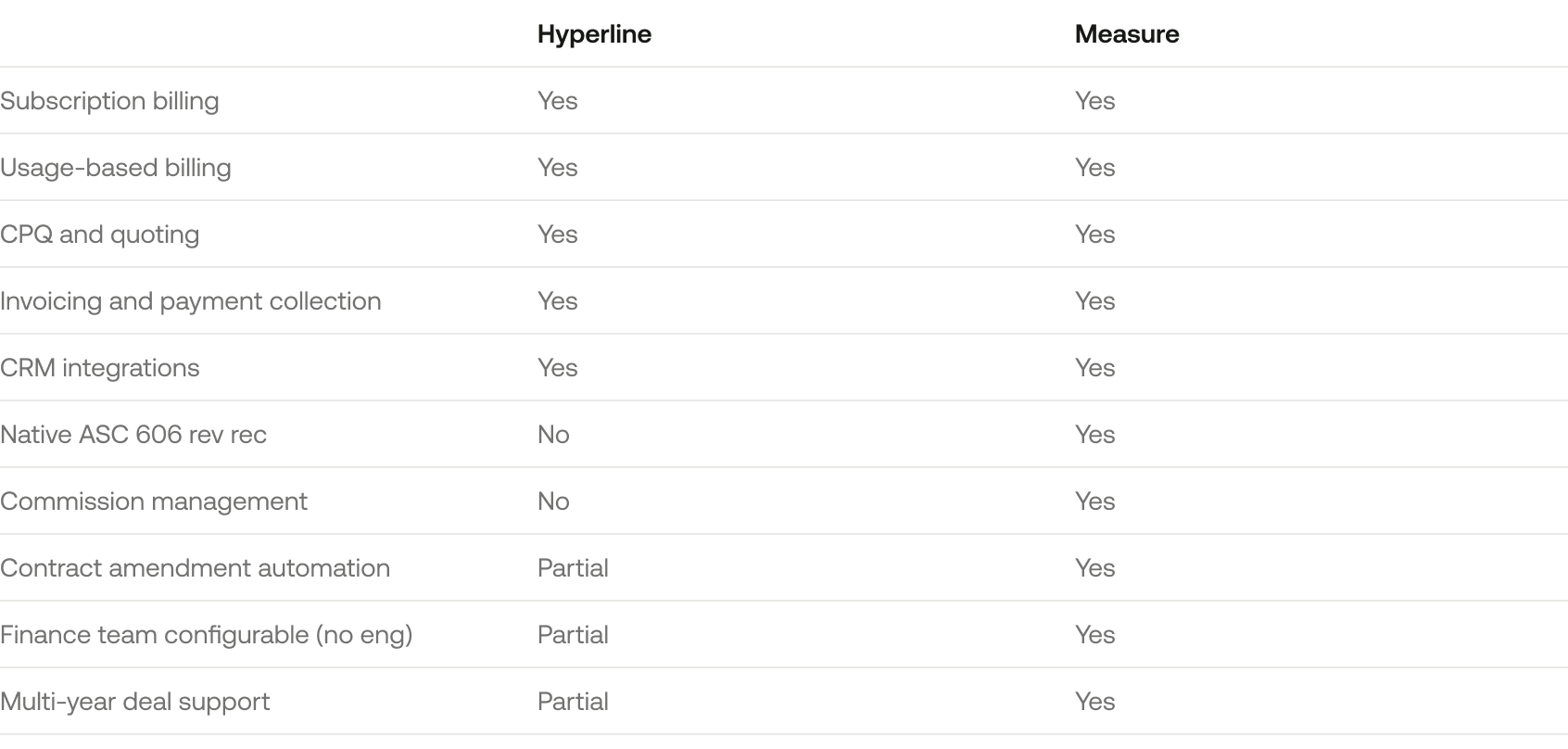
Side-by-side comparison table
See how Measure connects your contracts, billing, and rev rec without the spreadsheet layer. Book a demo to see it in action.
When Hyperline is the right choice
We mean this genuinely. Hyperline is the better choice when:
Your primary need is billing automation with minimal rev rec complexity (early-stage, simple pricing, no ASC 606 pressure yet)
Your team has engineering resources comfortable owning billing infrastructure, metering, and API integrations
Your pricing model is primarily usage-based with clean, high-volume metering logic
You don't need native commission management today and have budget for a dedicated comp tool later
You want the fastest possible path from "no billing system" to "invoices going out"
Hyperline does billing well. If billing is the only gap in your stack, it's a strong option.
When Measure is the right choice
Measure wins when the problem is bigger than billing:
Finance or RevOps owns billing, rev rec, and commissions. And they're tired of reconciling across three systems (or three tabs in the same spreadsheet)
Month-end close involves manually matching billing data against rev rec entries and hoping the numbers agree
Commission calculations run off the same deal and contract data as billing. And you need them to actually stay in sync
Contract amendments, co-terms, and mid-year expansions are common. Not exceptions
Your team needs one source of truth. Not three tools that sort of talk to each other
What finance teams at $0-20M ARR actually ask before choosing
Can Hyperline handle ASC 606 compliance on its own?
Not natively. Hyperline generates invoices and captures billing events, which is the input to revenue recognition. But the actual ASC 606 treatment. Performance obligations, allocation of transaction prices, deferred revenue schedules. Requires a separate system or manual process. For many teams at this stage, that "separate process" is a spreadsheet maintained by one person who really hopes they don't get sick during close week.
Will I need to rebuild this stack when I hit $15M ARR?
This is the right question. Outgrowing a billing-only tool looks like this: you adopt Hyperline for billing, add a separate rev rec tool at $8M ARR when your auditor pushes back on spreadsheet-based schedules, then add a commission tool at $12M when your sales team grows past 10 reps. Now you have three systems with three data models that need constant reconciliation. Growing into revenue infrastructure looks different. You start with one connected system and the same data model supports you at $5M and $15M. The work changes. The foundation doesn't.
How long does implementation take?
For Measure, typical implementation for a $3-10M ARR SaaS company takes 4-6 weeks. That includes contract migration, billing configuration, rev rec setup, and commission plan modeling. It's not a flip-the-switch process. Revenue operations are complex, and getting the foundation right matters more than speed. For Hyperline, implementation timelines vary depending on the complexity of your usage metering and API integration requirements. Simpler setups can go faster. More complex metering logic takes longer.
What does migration look like if we're already on Hyperline?
This is the question we hear most often from teams already using a billing tool. The migration path involves moving contract data, historical billing records, and customer subscription details into Measure. We handle this as part of the implementation process. Your existing invoicing doesn't stop while we set up the new system. We run in parallel until everything is validated. The key data that needs to move: active contracts, billing schedules, customer payment methods, and historical transaction data for rev rec continuity.
Final verdict
Here's the honest version.
Hyperline is a billing tool. A good one. If your finance team's biggest gap is "we need to send invoices and collect payments without doing it manually," Hyperline solves that problem well.
But if your team's actual work looks like this. Reconciling billing data against a rev rec spreadsheet every month, calculating commissions in a separate system that doesn't share data with billing, manually adjusting schedules when contracts amend mid-term. That's not a billing problem. It's a revenue infrastructure problem.
Measure is built for the second scenario. One connected system where contracts, billing, rev rec, and commissions work together from the start. Not because we bolted four tools together. Because our founders spent three years building one data model before ever going to market.
If your finance team is spending more time reconciling tools than actually closing books, that's the signal. Book a demo and see what it looks like when everything is actually connected.
Billing and revenue automation that handles contracts, invoicing, revenue recognition, and commissions in one connected system. Book a demo to see how Measure works.