Getmeasure.com: What it is, who it's for, and what finance teams should know
Getmeasure.com is Measure, revenue infrastructure for B2B SaaS. Contracts, billing, rev rec, and commissions in one connected system. Here's what to know.
You typed getmeasure.com into a search bar. Maybe someone on your team mentioned it. Maybe you saw it in a competitor's tech stack during a sales call. Maybe your VP of Finance dropped the name in a Slack thread about replacing your billing spreadsheets.
Here's the short version: Measure is revenue infrastructure for B2B SaaS companies. Contracts, billing, revenue recognition, and commissions. One connected system. Not five tools stitched together with spreadsheet bridges. One.
This page gives you everything you need to decide if it's worth a closer look. No spin. Just what Measure actually does, who it works for, where it fits, and where it doesn't.
What is getmeasure.com?
Getmeasure.com is the home of Measure, a revenue infrastructure platform built specifically for B2B SaaS finance and RevOps teams. The company was founded by Aswin (first employee at Rippling) and Ruchi (Engineering Director at Dropbox). They spent three years building the product before going to market. Not because they were slow. Because they understood that the only way to fix broken revenue operations was to design every piece together from the start.
Measure replaced the patchwork of tools that finance teams at growing SaaS companies typically manage: a billing tool here, a rev rec spreadsheet there, a commissions calculator somewhere else, and a CRM that doesn't actually talk to any of them.
The product handles the full revenue lifecycle. Contracts go in. Billing fires automatically. Revenue recognition follows ASC 606. Commissions calculate without a downstream spreadsheet. When a contract changes mid-period, that change propagates across every connected function. No reconciliation sprints. No month-end fire drills.
Who Measure is designed for
Measure is built for one specific buyer: the VP of Finance, Controller, or Head of RevOps at a B2B SaaS company between $3M and $10M ARR. That's roughly 20 to 200 employees, typically approaching or just past Series A.
This is the stage where revenue complexity actually starts to hurt. You're signing your first enterprise contracts. You're dealing with ramp pricing, multi-year terms, and mid-contract amendments. Your board wants clean metrics. Your auditors want documentation. And your finance team is spending 40% of their time reconciling data across systems that were never built to work together.
If you're pre-revenue or at $500K ARR running everything through Stripe Checkout, Measure isn't for you yet. If you're at $50M ARR with a 15-person finance team and an ERP already in place, you've likely outgrown the need. The sweet spot is that $3M to $10M window where the complexity ramps but the team hasn't.
How Measure works: the core workflow
Data inputs and integrations
Measure connects natively to the systems your finance and revenue team already uses. That means Salesforce, HubSpot, Stripe, QuickBooks, and NetSuite. Not Zapier-level workarounds. Not "we have an API you can build against." Native connectors that sync data automatically and keep it updated.
A contract created in your CRM propagates into Measure. Billing schedules generate from contract terms. Revenue recognition schedules build automatically. Commissions calculate from the same source data. There's one source of truth, and it updates everywhere.
Implementation typically takes weeks, not months. If you've dealt with a billing system that took a year to go live, that deserves its own conversation. But the point is this: Measure was designed for a finance team of two to five people who don't have engineering resources to spare. You shouldn't need a dedicated integration engineer to get your billing working.
Key features and capabilities
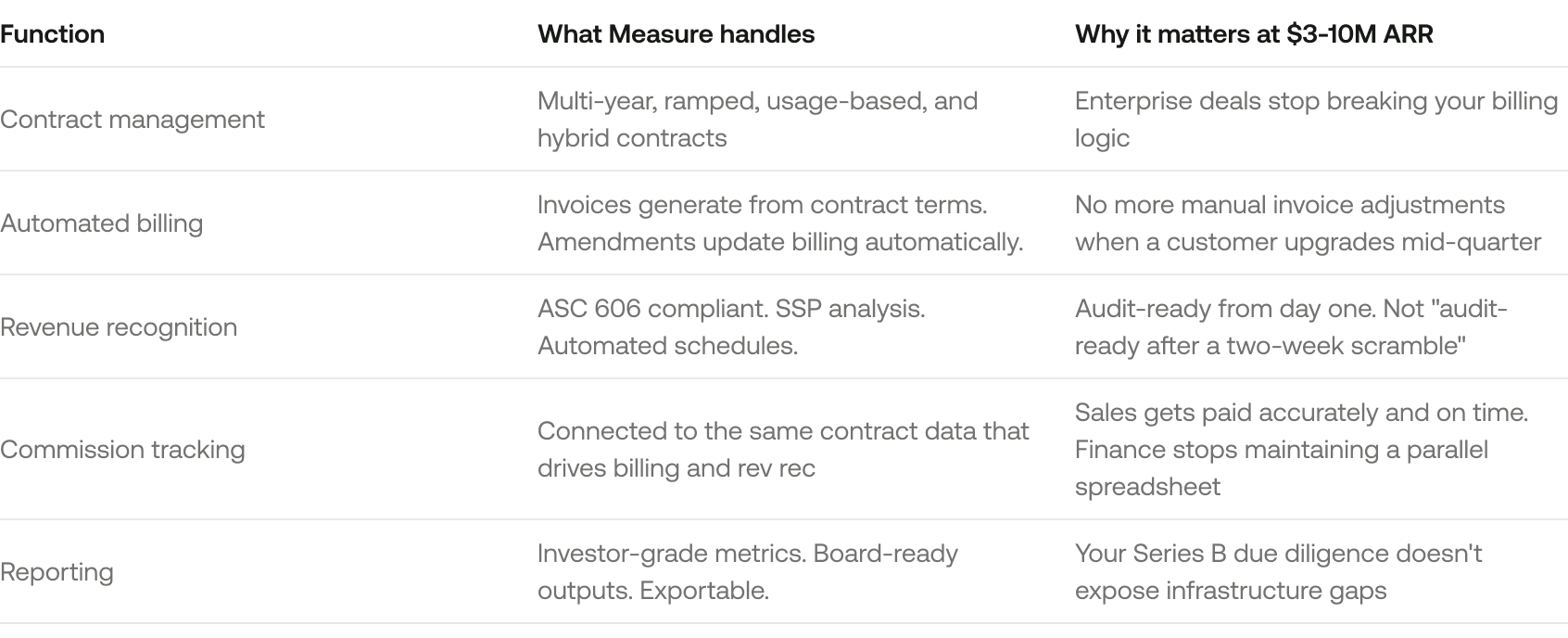
Here's what Measure actually does across the revenue lifecycle:
Every feature listed above works from the same underlying data. That's the actual differentiator. It's not that each feature is individually unique. It's that they're connected. When a contract amendment hits, billing updates, rev rec adjusts, and commissions recalculate. Automatically.
Reporting and output
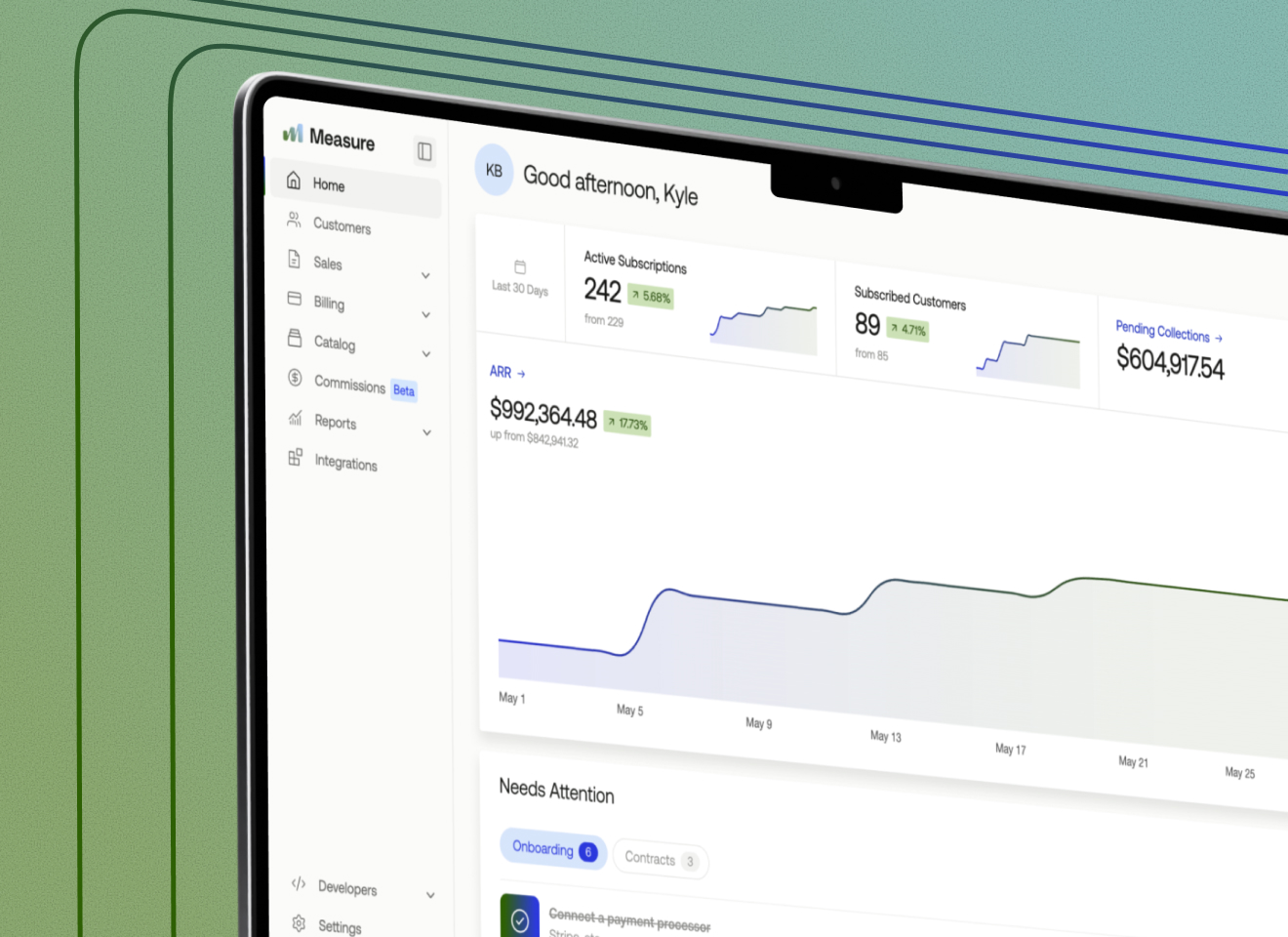
What does a finance team actually see in Measure? Clean revenue waterfalls. Deferred revenue schedules. Commission statements. ARR, MRR, churn, and expansion metrics pulled from real contract data, not approximations from your CRM.
Reports export in formats your auditors and investors will accept. This isn't a dashboard you screenshot and paste into a board deck. It's structured financial output that survives scrutiny.
What Measure costs and what to expect
Measure doesn't do flat pricing in the traditional sense. Pricing scales with your revenue and contract volume, not per seat. That means your costs grow proportionally as your business grows, not because you added a third finance hire who needs access.
There's no free tier. This isn't a freemium product designed for individual contributors. It's infrastructure for a finance team running real revenue operations.
The real total cost of ownership
Here's where Measure's economics get interesting. Most finance teams at $3M to $10M ARR are already paying for three to five separate tools: a billing platform, a rev rec spreadsheet or tool, a commission calculator, and reporting software. Plus the time cost of reconciling data between all of them.
The billing stack tax is real. If your Controller spends 15 hours per month reconciling billing data against your rev rec schedules against your commission spreadsheet, that's a cost. If your month-end close takes an extra week because data lives in four systems, that's a cost. Measure replaces the stack, not just one tool in it.
Implementation doesn't require an engineering team. Setup works in weeks. The ongoing maintenance burden sits with finance, not engineering. That matters when your engineering team is building product, not debugging billing integrations.
Where Measure works well
Measure is strongest in three specific scenarios:
First enterprise contracts. When a $5M ARR SaaS company signs its first multi-year, ramped enterprise deal, the billing and rev rec complexity jumps overnight. Measure handles contract structures that would break a basic billing tool or require extensive manual workarounds.
Pre-audit and pre-fundraise preparation. Companies approaching Series B or their first formal audit need revenue infrastructure that produces clean, defensible numbers. Measure's ASC 606 automation and audit trail satisfy the kind of scrutiny a Big 4 auditor or growth equity investor applies.
Finance teams that own commissions. When commissions live in the same system as contracts and billing, accuracy goes up and payment cycles get shorter. Finance stops being the bottleneck between a closed deal and a sales rep's commission check.
Where Measure isn't the right fit
Measure isn't for everyone.
If you're a pre-revenue startup running Stripe Checkout with ten customers, you don't need revenue infrastructure yet. A spreadsheet works fine at that stage, and adding complexity before you have it is a waste.
If you're a $50M ARR company with a mature finance team, an ERP, and established processes across every revenue function, you likely have a system that works. Switching costs at that stage are high, and the ROI calculus changes.
If your billing is genuinely simple, with monthly subscriptions at a single price point, no usage component, and no contract amendments, Measure is more horsepower than you need.
Measure is built for the messy middle: the stage where revenue operations get complicated faster than the team grows. Where the contracts aren't cookie-cutter, the rev rec isn't straightforward, and the finance team is too small to brute-force their way through reconciliation every month.
How Measure compares to alternatives
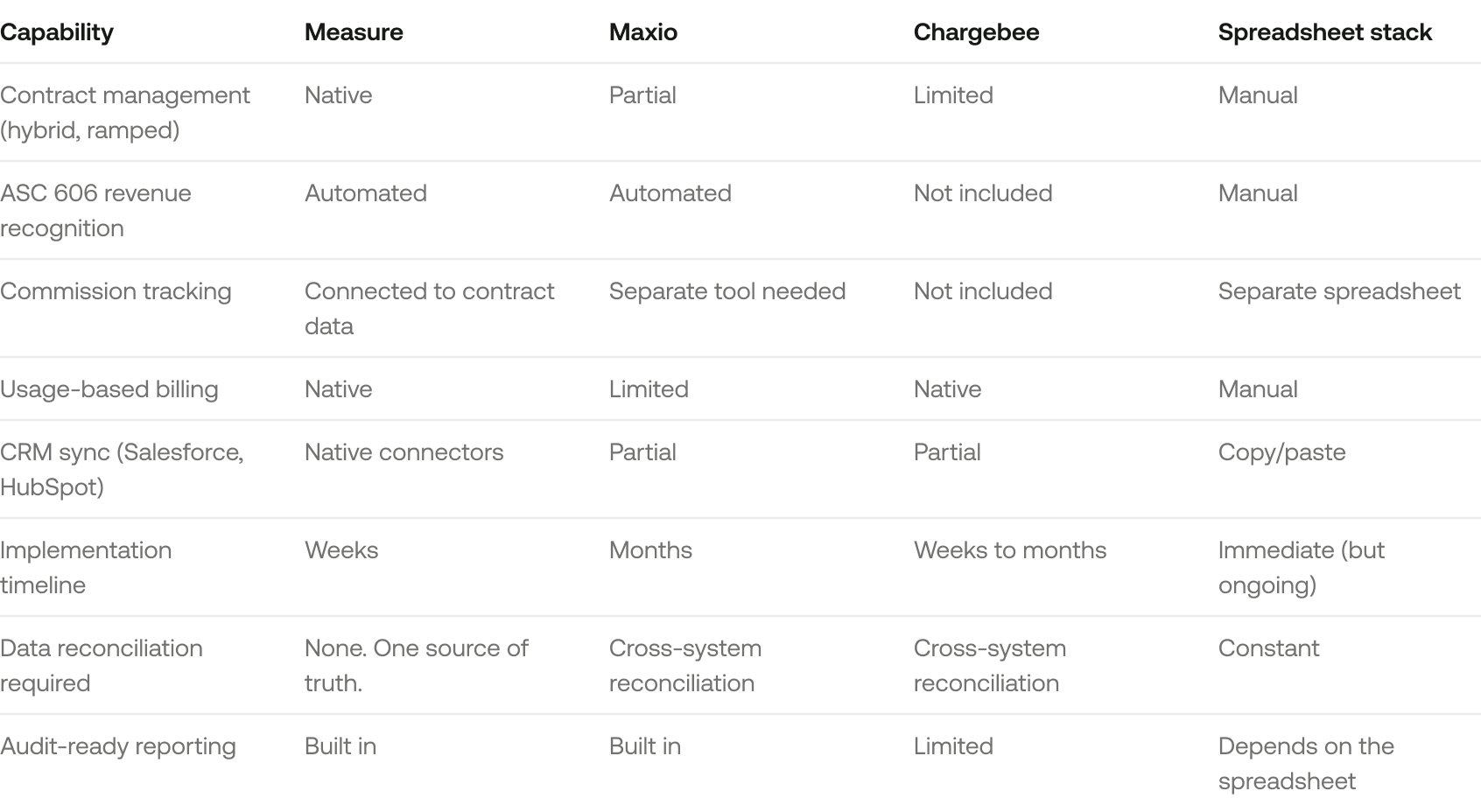
The comparison depends on what category you're evaluating. Measure occupies a different position than most tools in the revenue tooling landscape.
The distinction that matters most: Measure connects contracts, billing, rev rec, and commissions natively. Most alternatives handle one or two of those functions and require you to integrate or spreadsheet the rest. The result is what we call the billing stack tax. You pay it every month in reconciliation time, delayed closes, and data errors that compound.
What to ask before you commit to any revenue tool
Whether you're evaluating Measure or anything else, here's the due diligence checklist a finance team at $3M to $10M ARR should run through:
How does it handle contract amendments mid-period? Does the billing and rev rec schedule update automatically, or does someone manually adjust?
What's the revenue recognition methodology? Is ASC 606 built in, or bolted on?
Is there an audit log for every financial adjustment? Can your auditor trace a revenue number back to the source contract?
What happens when you outgrow your current plan? Does historical data migrate cleanly, or do you start over?
Who owns ongoing maintenance? Finance, ops, or engineering?
How long does implementation actually take? Ask for a reference customer at your ARR stage.
Does commission data come from the same source as billing and rev rec, or does it live in a separate system?
If the answers to these questions involve the words "spreadsheet," "manual," or "we're working on it," you have useful information about where that tool will break.
The bottom line on getmeasure.com
Measure exists because revenue operations at growing B2B SaaS companies shouldn't require five disconnected tools and a month-end reconciliation sprint. If you're running a finance team at $3M to $10M ARR, dealing with contract complexity that's outgrown your current stack, and approaching a milestone that demands clean, auditable revenue data, Measure is worth evaluating.
It's not a dashboard. It's not a metrics tool. It's the infrastructure underneath your revenue. Contracts, billing, rev rec, and commissions. Connected. One source of truth that updates everywhere when anything changes.
If that matches the problem you're trying to solve, book a 20-minute revenue infrastructure review and see how Measure handles the specific contract structures, billing models, and compliance requirements your team is working through right now.
See it in action.
Billing and revenue automation that handles contracts, invoicing, revenue recognition, and commissions in one connected system. Book a demo to see how Measure works.