

Nov 10, 2026
Metered Billing: What It Is & Why It Matters
Metered billing sounds simple until it hits your books. How it actually works across revenue recognition, forecasting, commissions, and collections for B2B SaaS.

Evelyn Ly
Head of Marketing

Metered billing sounds simple until it hits your books. How it actually works across revenue recognition, forecasting, commissions, and collections for B2B SaaS.
Evelyn Ly
Head of Marketing
Your product charges based on what customers actually use. Simple idea. The financial complexity that follows is anything but.
If you're a finance or RevOps leader at a growing B2B SaaS company, metered billing isn't just a pricing model decision. It's a commitment that touches your revenue recognition, your forecasting accuracy, your collections process, and your commission plans. This piece covers what metered billing actually is, how it works operationally, where it breaks down, and how to know if it's the right move for your business.
Metered billing is a pricing model where customers are charged based on measured consumption of a product or service during a billing period. Instead of paying a fixed monthly fee regardless of activity, the customer's invoice reflects what they actually used.
The distinction from flat-rate subscription billing is straightforward: subscriptions charge a predetermined amount; metered billing charges a calculated amount based on observed usage. But here's the misconception worth clearing up immediately. "Metered" refers to the measurement mechanism, not a specific pricing structure. You can have metered billing with tiers, minimums, caps, and committed volumes. It's not synonymous with pure pay-as-you-go.
This matters because most B2B SaaS companies at $3-10M ARR don't run pure metered models. They run hybrid models that combine committed minimums with metered overages. Understanding what metered billing actually is, and isn't, shapes every downstream decision.
The operational loop has four steps. Each one introduces specific risks and requirements that compound as you scale.
Everything starts with what you measure. Common metrics in B2B SaaS include API calls, active seats, compute hours, storage consumed, transactions processed, and AI tokens generated.
The metric you choose needs to be three things: observable (you can reliably capture it), attributable (you can tie it to a specific customer account), and contestable (the customer can verify it independently if they dispute an invoice). Competitor content covers the first two. The third one matters more than most companies realize until their first enterprise customer challenges a $40,000 invoice.
Examples beyond the obvious API companies: HR platforms billing per active employee record per month, document automation tools charging per page processed, and revenue intelligence software billing per monitored account. If your SaaS delivers discrete, countable value units, metered billing is structurally possible. You don't need to be Twilio.
Usage events get recorded throughout the billing period. Some systems capture in real-time; others batch at intervals. Both work, but the aggregation method changes the outcome significantly.
Sum-based aggregation (total API calls) behaves differently than peak-based (highest concurrent users) or percentile-based (95th percentile bandwidth). The aggregation method you choose directly determines what appears on the invoice. It also determines where data integrity problems originate. Duplicate events inflate bills. Gaps under-count usage. Lag between event capture and aggregation creates timing mismatches at period boundaries.
This is infrastructure work that lives between your product and your billing system. When it works, nobody notices. When it breaks, finance finds out at month-end.
Once usage is aggregated, you apply the contracted rate structure. This sounds simple until you account for tiered pricing (first 10,000 calls at $0.01, next 50,000 at $0.008), committed minimums (customer pays at least $5,000/month regardless of usage), overage rates, volume discounts, and contractual caps.
Invoice generation typically triggers at period end. But enterprise contracts with milestone billing or mid-period true-ups add another layer. The calculation logic needs to honor the specific terms of each customer's contract, not just a default rate card.
This is the step most billing content ignores entirely. Under ASC 606, usage-based revenue is recognized as the performance obligation is satisfied. That means each billing period as usage occurs. Not when the contract is signed. Not when the invoice is sent.
For finance teams, this distinction is material. Hybrid models with a committed minimum plus metered overage create a split recognition treatment. The minimum is recognized ratably over the contract term. The overage is recognized in the period consumed. Getting this wrong isn't a reporting preference. It's an accounting error that surfaces at audit.
If your billing system doesn't natively separate these recognition treatments, your finance team is doing it manually in spreadsheets every close. That's not a workflow. That's a liability.
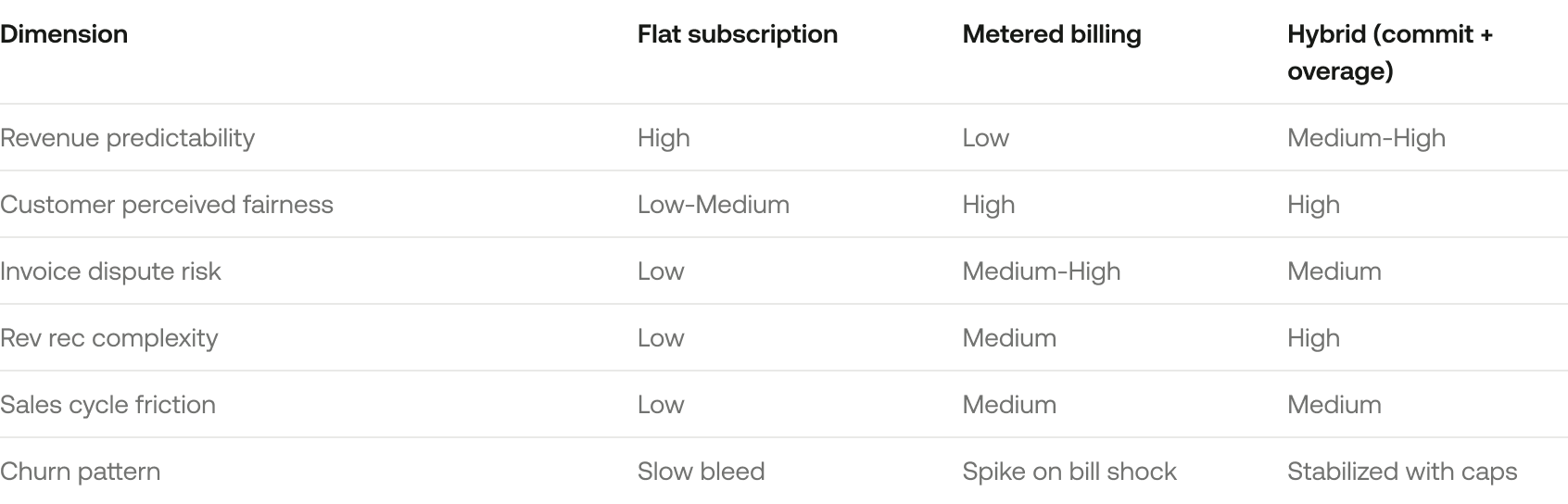
The key takeaway: pure metered billing is relatively rare at $3-10M ARR. Most successful B2B SaaS companies at this stage use hybrid models that pair a committed minimum with metered overages above a threshold. This gives finance teams an MRR floor for forecasting while preserving the expansion revenue dynamics that drive Net Revenue Retention.
The "fair pricing" benefit investors love comes with forecasting variance that those same investors hate. Hybrid models split the difference. They're not a compromise. They're actually the more sophisticated structure.
Twilio charges per SMS sent or call minute. AWS charges per GB stored or transferred. OpenAI charges per token consumed. Datadog charges per host monitored. What these share: the usage unit is discrete, countable, and verifiable by both parties.
This is the underrepresented example set. Most metered billing content implies you need to be an API company. You don't.
HR platforms billing per active employee record per month. Document automation tools charging per contract generated. Outbound sales tools billing per email sent or contact enriched. Accounting platforms charging per transaction processed. If your product's value delivery is measurable in discrete units, metered billing applies.
A base subscription of $3,000/month covers 50,000 API calls. Calls above that threshold bill at $0.04 each. Think of it like a cell phone plan. The base rate covers expected usage. You only pay more when you exceed it.
This is how most B2B SaaS companies at the $3-10M stage structure it. The committed base provides predictable revenue. The metered overage captures expansion without requiring a sales conversation.
Revenue-value alignment. Customers pay proportionally to what they get. This reduces friction in procurement conversations. Nobody asks "why are we paying full price in slow months?" when the bill already reflects that.
Lower barrier to entry. New customers start small and scale spend as adoption grows. The initial "yes" is easier. This is particularly powerful in product-led growth motions.
Natural expansion revenue. Usage growth equals revenue growth without a sales touch. This is the NRR story that investors want to hear. And with metered billing, it's structurally built into the model.
Competitive positioning. In crowded markets, metered pricing signals confidence. You're saying: "We only charge when we deliver value."
But here's what most metered billing evangelists skip. These benefits are realized over time, not immediately. The first 6-12 months often show higher churn and lower MRR predictability versus flat-rate. Sales teams trained on flat-rate ARR often resist metered models because it makes their pipeline math harder. These are real adoption costs.
This is where metered billing gets honest. The model has genuine operational consequences that show up in your books, your collections, and your comp plans.
Usage correlates to customer activity, not contract terms. Seasonal dips, product outages, customer layoffs, even a holiday week can affect your metered MRR. Month-to-month variance of 15-40% is common in pure metered models without commitments.
The fix isn't abandoning metered billing. It's combining committed minimums with leading indicators. Active user logins as a proxy for upcoming billing. Feature adoption velocity as a signal of expansion. Your billing data becomes a forecasting input, not just a revenue record.
When a customer disputes $47,000 in usage charges, "trust us" isn't an answer. You need an auditable record of every event. Not an aggregate number. The individual events, timestamped, deduplicated, and traceable to their source system.
Enterprise procurement teams increasingly request usage audit reports before approving invoices above threshold amounts. A billing system that can't produce event-level logs creates accounts receivable exposure. And SOC 2 auditors flag incomplete usage logs as a control gap.
Metered revenue is variable consideration. For pure metered models, you recognize revenue as each performance obligation is satisfied in the billing period. For hybrid plans, committed minimum recognized ratably, overage recognized in the period consumed.
The common error: recognizing overage revenue in the period invoiced rather than the period consumed. If usage occurs in March but you invoice in April, that revenue belongs in March. This is a material accounting mistake that surfaces at audit, and it's disturbingly easy to make when your billing and rev rec systems aren't connected.
Do AEs earn commission on overage revenue? On contract value only? On recognized revenue or invoiced amounts? Most comp plans are built for flat-rate ARR. Metered models create under- or over-payment of commissions if the plan isn't updated to account for variable revenue.
This is a RevOps coordination problem that straddles finance, sales, and systems. It requires your commission tracking to understand contract structure, not just top-line bookings.
Metered billing requires a reliable pipeline: product generates usage events, events flow to a tracking system, tracking feeds the billing system, billing posts to your ERP or general ledger. Breaks anywhere in that pipeline cause revenue leakage (under-billing) or invoice disputes (over-billing).
Many $3-10M ARR companies run this on Stripe plus spreadsheets. It works until it doesn't. Usually the breaking point is somewhere around 50 metered customers or your first enterprise contract with custom rates.
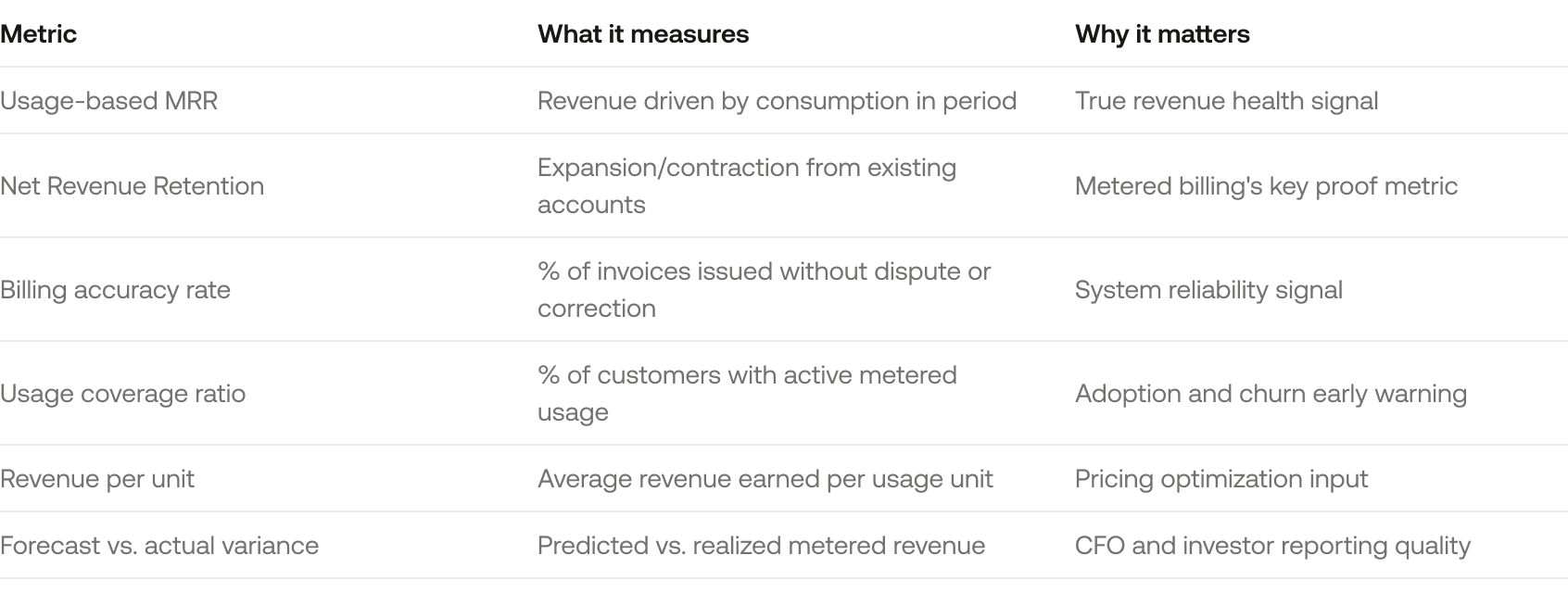
If you're running metered billing and only tracking MRR, you're missing the operational signals that tell you whether the model is actually working.
Good fit signals:
Poor fit signals:
For most B2B SaaS at $3-10M ARR, the honest recommendation is a committed minimum plus metered overage structure. You get the expansion dynamics of usage-based pricing with enough of an MRR floor for forecasting and investor reporting.
If you're evaluating infrastructure to support metered billing, here's what actually matters:
Most billing tools handle items 1-3 reasonably well. Items 5, 6, and 7 are where most systems fall short, and where the actual financial operations complexity lives.
Metered billing is not primarily a product or engineering decision. It's a financial operations commitment. The companies that do it well have built infrastructure that connects usage events all the way through to clean books, accurate forecasts, and fair commissions. Those that struggle usually have a data or systems gap somewhere in that chain.
The question isn't whether metered billing is "good." It's whether your systems can handle the downstream consequences of variable revenue without creating manual work every month-end.
Managing metered billing across contracts, invoices, and rev rec in separate tools? Measure connects them in one system. From usage events through revenue recognition and commissions, everything propagates automatically. Book a 20-minute walkthrough to see how it works for metered and hybrid billing models.
Billing and revenue automation that handles contracts, invoicing, revenue recognition, and commissions in one connected system. Book a demo to see how Measure works.