Measure billing: the B2B SaaS finance leader's guide to KPIs, accuracy, and revenue health
Most B2B SaaS companies are billing but not measuring billing. A 5-dimension framework for finance leaders to track accuracy, leakage, and contract alignment.
You switched to usage-based billing to align pricing with value. Six months in, you're fielding customer disputes, your MRR forecasts feel unreliable, and your auditor is asking pointed questions about revenue recognition. The problem isn't your pricing model. It's that nobody defined what "working correctly" actually looks like for your billing system.
Here's the thing most finance leaders discover too late: billing and measuring billing are two completely different disciplines. Your engineering team built the metering pipeline. Your ops team configured the billing tool. But who actually owns the question, "Is every invoice we send accurate, complete, and aligned with what the contract says?"
"Measure billing" means two things in B2B SaaS. It refers to metered billing, where you charge customers based on measured usage. And it refers to the practice of measuring billing performance, where you verify that your billing system is actually doing what it's supposed to do. This piece covers both, with a focus on the finance layer that connects them.
By the end, you'll have a five-dimension framework for evaluating your billing setup, a set of KPIs to track monthly, and clarity on where most $3M to $10M ARR SaaS companies lose revenue without realizing it.
What is measure billing? Two definitions that matter
The term "measure billing" sits at an intersection that most billing content ignores entirely. Let's separate the two meanings before we connect them.
Metered billing: billing based on usage
Metered billing charges customers based on a measurable unit of consumption. Instead of a flat monthly fee, the invoice reflects what the customer actually used during the billing period. API calls, active users, data volume, compute hours, tokens processed.
It differs from seat-based or flat-rate models in one critical way: the invoice amount isn't known until the billing period closes. That's what makes it powerful for land-and-expand motions. It's also what makes it hard to get right.
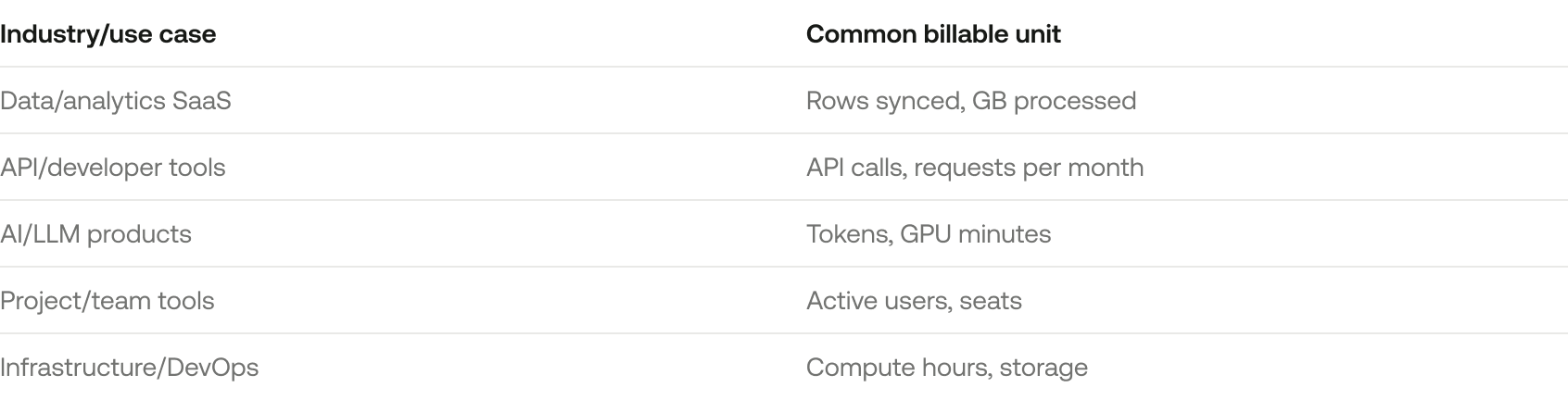
Common billable units vary by product category:
The growth of metered billing is driven by real economics. Customers prefer paying for what they use. Sales teams like the expansion revenue it creates. And with AI products, usage-based pricing has become the default because consumption patterns vary so wildly across customers.
But the core implementation challenge is deceptively simple to describe and incredibly hard to execute: usage data must flow accurately from your product to a metering layer, then to your billing system, then to an invoice. Every handoff is a potential failure point.
Measuring billing performance: how you know it's working
The second meaning of measure billing is the one nobody writes about. It's the practice of tracking, auditing, and reporting on whether your billing system operates accurately, completely, and in alignment with your contracts.
This gets neglected because billing works until it catastrophically doesn't. There's no dashboard in Stripe that tells you "3% of your invoices don't match the contracted terms." There's no alert when a customer gets undercharged because a metering event was dropped.
At most $3M to $10M ARR companies, billing ownership falls between three teams. Engineering owns the metering pipeline. Finance owns invoicing. RevOps owns contracts. The gap between those three is where revenue leakage lives. And in practice, nobody owns the measurement of whether those three systems agree.
The cost of not measuring is real: revenue that never gets invoiced, customer disputes that erode trust, revenue recognition entries that don't match billing events, and commission calculations built on incorrect invoice data.
Most billing failures are silent. A customer doesn't tell you they were underbilled. An overage charge that goes out without warning triggers a churn conversation, not a support ticket.
Why B2B SaaS billing is harder to measure than it looks
If you're running a B2C subscription with three pricing tiers, billing measurement is straightforward. B2B SaaS is a different animal entirely.
The contract-billing gap
B2B billing doesn't start at a checkout flow. It starts at a contract. And that contract almost always contains terms that your billing system wasn't configured to handle automatically.
Custom discounts. Negotiated overage rates. Committed minimums with true-up provisions. Volume tiers that kick in at specific thresholds. These terms live in PDFs, Salesforce opportunity notes, and the memory of the account executive who closed the deal.
Here's a concrete scenario. A customer signed for 500,000 API calls per month at $0.002 per call, with a 20% volume discount that applies after 250,000 calls. Can your billing system apply that discount correctly? Does it recalculate when the customer's usage crosses that threshold mid-month? Most finance leaders can't answer that question with confidence. And that uncertainty is the contract-billing gap in action.
When billing runs independently of contract terms, drift is inevitable. It doesn't happen all at once. It accumulates through amendments, renewals, upsells, and plan changes that update the contract but never propagate to the billing configuration.
Multi-period and ramp complexity
Ramp deals, true-ups, and annual commitments billed monthly all create timing mismatches between what's owed and what's invoiced. A customer on a ramp deal might owe $5,000/month in Q1 and $8,000/month in Q2. If your billing system doesn't model that ramp natively, someone is manually updating the invoice amount each quarter. And manual updates don't have audit trails.
These timing issues affect more than just invoice accuracy. They create period-recognition mismatches that complicate ASC 606 compliance. Finance teams often discover these errors during audit prep, months after the billing event occurred.
The data pipeline problem
In a metered billing setup, usage data must travel from product events to an aggregation layer to the billing system. At every handoff, there's risk.
Latency is common. A 24 to 48 hour lag between usage and billing data is typical. Deduplication errors happen when events are replayed or retried. Edge cases multiply around partial months, trial-to-paid conversions, and mid-cycle plan changes.
The real issue isn't that these problems exist. It's that engineering teams fix metering bugs silently, and finance teams don't know a correction occurred until weeks later. This is a visibility problem, not just a technology problem.
Customer-facing trust
Enterprise B2B buyers expect invoices to reconcile against their own internal usage tracking. When they can't verify a charge, they dispute it. Even if the charge is correct.
Without an immutable usage audit trail that you can share with customers, your finance team argues billing disputes from a position of weakness. "Trust us, the data is right" doesn't work when a customer's procurement team is asking for line-item verification.
The measure billing framework: five dimensions to track
To fully measure billing health in a B2B SaaS context, you need visibility across five dimensions. Most companies track two of them. Here's the full framework.
1. Billing accuracy rate
What it measures: The percentage of invoices generated that match contracted terms without manual correction.
How to calculate: (Invoices issued correctly on first pass) divided by (total invoices issued), multiplied by 100.
Example: A 150-customer SaaS company discovers that 12 invoices last month required manual adjustment after issuance. Seven had the wrong discount applied. Three used a stale price from a previous contract term. Two missed a committed minimum. That's a 92% billing accuracy rate. It sounds acceptable until you realize each correction required a credit note, a revised invoice, and an average of 45 minutes of finance team time.
Strong B2B SaaS billing operations target above 99%. Companies below 95% typically have a contract-billing sync issue that won't fix itself.
2. Revenue leakage rate
What it measures: Billable usage or contracted ARR that was not invoiced.
Revenue leakage is the billing metric that keeps CFOs up at night once they actually measure it. It doesn't show up as a loss on any report. It just never shows up as revenue.
Example: A data platform charges per GB processed. A customer's usage consistently exceeds their committed tier by 15-20%, but the overage billing was never configured because the original deal was set up as flat-rate in Stripe. That's 15-20% of that account's potential revenue, quietly disappearing every month.
Common sources include metering gaps, free-tier overflows that don't trigger conversion, manual override errors, and grace periods that were never turned off. The fix is straightforward: reconcile usage data against invoiced amounts monthly. Flag any account where billed revenue is less than the contracted minimum.
3. Invoice dispute rate and resolution time
What it measures: The percentage of invoices that generate a customer dispute, and the average time to resolve those disputes.
Disputes are lagging indicators. By the time a customer disputes an invoice, the billing error (or the communication failure) happened weeks or months ago.
Example: A company's dispute rate jumps from 2% to 7% over two quarters. Investigation reveals that a billing system migration changed how usage tiers were displayed on invoices. The charges were correct, but customers couldn't reconcile the new format against their internal records. Seven percent dispute rate, zero percent billing error rate. The problem was transparency, not accuracy.
High dispute rates are a churn signal. Long resolution times extend Days Sales Outstanding, a metric CFOs and investors watch closely. If it takes your team 15 days to resolve a dispute, that's 15 days of delayed cash collection on every disputed invoice.
4. Time-to-invoice (billing cycle lag)
What it measures: Elapsed time from billing period close to invoice delivery.
Example: A usage-based SaaS company closes each billing period on the last day of the month. But between usage data finalization, manual review, and invoice generation, invoices don't go out until the 12th or 13th of the following month. Customers receive an invoice for January usage in mid-February. By then, the usage feels abstract and harder to verify, which increases disputes.
Top-performing teams invoice within two to three business days of period close. Manual processes often push this to 10 to 15 days. The gap between those two numbers directly impacts your cash collection cycle and creates period-recognition mismatches that complicate revenue recognition.
5. Contract-to-bill alignment score
What it measures: How closely your billing configuration reflects current contract terms across all active accounts.
This is the hardest dimension to measure without a connected system. Most companies do it through periodic manual audits, if they do it at all.
Example: A customer renewed six months ago with a 10% price increase and an additional product module. The renewal updated Salesforce. It updated the contract PDF. But nobody updated the billing configuration. The customer has been billed at last year's rate for six months. That's six months of revenue leakage that went completely undetected.
A simple trigger: any contract amendment, renewal, or upsell should prompt a billing configuration review. If a billing config hasn't been audited since the original deal closed, assume drift exists.
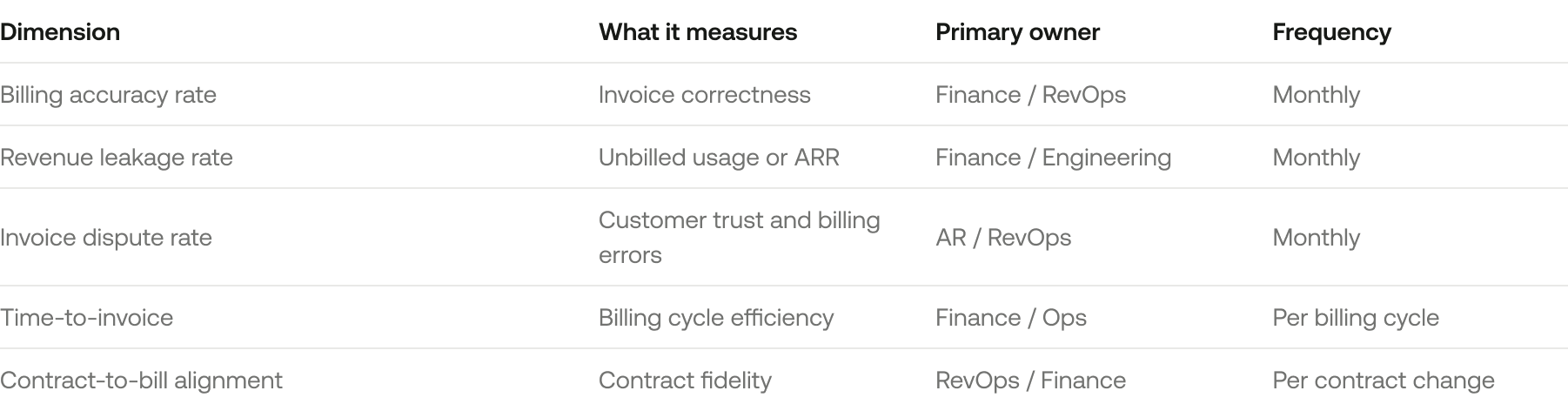
Framework summary:
Common measure billing mistakes at the $3M to $10M ARR stage
Knowing what to measure is half the battle. The other half is avoiding the structural mistakes that make measurement impossible in the first place.
Treating billing as an engineering problem
Metering is engineering. Billing is finance. The two need shared ownership with clear handoffs between them.
The symptom is familiar: your finance team only finds out about a metering bug when a customer complains. By then, the bug may have affected invoices for weeks. Engineering fixed the data pipeline, but nobody re-issued the affected invoices because finance didn't know there was a problem.
Using flat-rate tooling for usage-based models
Many billing tools were designed for straightforward subscription billing. They can handle metered billing technically, but they weren't built for complex B2B contract terms like committed minimums, tiered overages, or ramp schedules.
The common pattern at this stage: one tool for payments, spreadsheets for reconciliation, Salesforce for contracts. Three systems that never talk to each other. Each one holds a piece of the billing truth, but no single system holds all of it.
No audit trail for usage data
SOC 2 audits and enterprise procurement teams increasingly ask for immutable usage logs. Without them, billing disputes become credibility issues, not just finance issues. You can't prove a charge is correct if you can't produce the underlying usage data that generated it.
Measuring MRR instead of billing health
MRR is an output metric. Billing accuracy, leakage, and dispute rate are the process metrics that determine whether your MRR number is real.
The classic version: ARR looks healthy in the board deck, but cash collection is slow because invoices are wrong. Net revenue retention looks strong, but 4% of expansion revenue was never actually billed. The model tells one story. The bank account tells another.
Skipping customer-facing usage visibility
Customers who can't self-serve their usage data will either over-dispute or under-trust. Building a customer-facing usage dashboard doesn't require a massive engineering investment. But it does require that your billing system surfaces the data in a way that's accessible.
When customers can verify their own usage before the invoice arrives, dispute rates drop. It's that straightforward.
How to build a billing measurement practice (without a billing ops team)
You don't need a dedicated billing operations team to measure billing health. You need a checklist, clear ownership, and the right cadence.
Start with a billing audit checklist
Before you build dashboards or buy tools, run a manual audit. It takes less than a day and almost always surfaces something actionable.
Do all active accounts have billing configurations that match their current contract?
Is usage data flowing from product to billing system with less than 24-hour lag?
Are all negotiated discounts and committed minimums reflected in the billing system?
Have you reconciled billed amounts against contracted amounts in the last 30 days?
Do you have an immutable log of usage events for the last 12 months?
What is your current invoice dispute rate? Is it trending up or down?
When was the last time a contract amendment triggered a billing configuration review?
Can your team produce a usage breakdown for any customer within one business day?
If you can't confidently answer more than half of these, you have measurement gaps. That's not a crisis. It's a starting point.
Define ownership across the revenue org
Measurement fails when nobody owns the outcome. Here's how ownership typically works at the $3M to $10M ARR stage:
RevOps owns contract-to-billing configuration accuracy. Every deal change should trigger a billing review.
Finance and AR owns invoice issuance, dispute resolution, and DSO tracking. They're the first team to feel the impact of billing errors.
Engineering owns metering pipeline uptime, data accuracy, and audit logging. They build the infrastructure; they need to report on its health.
The finance lead reviews the billing health dashboard monthly, with RevOps present. This isn't a weekly standup. It's a monthly discipline that takes 30 minutes when the data is accessible.
Pick the right metrics for your billing model
Not every dimension matters equally for every billing model.
If you're flat-rate or seat-based, focus on contract-to-bill alignment and time-to-invoice. Your biggest risk is contract drift, not metering errors.
If you're usage-based or metered, add leakage rate and data pipeline accuracy. Your billing system is only as good as the usage data feeding it.
If you're hybrid (and most B2B SaaS companies at this stage are), all five dimensions apply. The platform fee is governed by the contract. The usage component is governed by the metering pipeline. Both need measurement.
Connect billing to rev rec and commissions early
Billing errors compound downstream. An incorrect invoice creates a wrong revenue recognition entry and an incorrect commission calculation. When a contract amendment updates the billing amount but not the commission plan, your sales team gets paid incorrectly. When an invoice goes out at the wrong amount, the rev rec schedule for that contract is wrong too.
Companies that measure billing in isolation discover this problem at year-end. Or worse, during an audit. The fix isn't better spreadsheets. It's a connected system where contract changes automatically propagate to billing, rev rec, and commissions together.
Choosing the right infrastructure to support measure billing
The question isn't "which billing tool should we use?" It's "what does our system need to do to support measurement?"
Here's what to look for in billing infrastructure that supports the five dimensions:
Contract terms stored as structured data, not PDFs or Salesforce notes
Automated reconciliation between contracted terms and invoice output
Usage data ingestion with audit logging and deduplication
Rev rec output linked directly to billing events, not maintained separately
Dispute and AR workflow built into the billing layer, not managed in email
Reporting that surfaces accuracy, leakage, disputes, cycle time, and contract alignment without manual export
Some companies use one tool for payment processing and a separate layer for contract-billing reconciliation. Others use a connected platform where contracts, billing, rev rec, and commissions live in one system. The right answer depends on your contract complexity and billing model. But the measurement framework is the same either way.
The difference is how much time measurement takes. In a stitched-together stack, pulling the five billing health metrics together requires exports from three systems and a spreadsheet. In a connected system, it's a dashboard that updates automatically.
Start measuring what you're billing
Most B2B SaaS companies at the $3M to $10M ARR stage are billing. Very few are measuring billing. That gap is where revenue leakage, customer disputes, and audit surprises live.
The five dimensions give you a starting point: accuracy, leakage, dispute rate, cycle lag, and contract alignment. You don't need to build a billing ops team to track them. You need a monthly cadence, clear ownership, and a system that makes the data accessible.
Start with the billing audit checklist. It takes less than a day. It almost always surfaces something that's costing you money or trust. That's not a scary finding. It's an actionable one.
Measure connects your contracts, billing, rev rec, and commissions in one system. So measuring billing health takes minutes, not a spreadsheet and a prayer. Book a demo to see how it works.
See it in action.
Billing and revenue automation that handles contracts, invoicing, revenue recognition, and commissions in one connected system. Book a demo to see how Measure works.