How to calculate SaaS commissions: the complete playbook for finance teams
Most SaaS companies miscalculate commissions by using the wrong revenue base and relying on error-prone spreadsheets, causing monthly disputes and wasted RevOps time. This guide offers formulas for new, renewal, and expansion deals, plus advice on choosing a revenue base, handling edge cases, and knowing when to ditch spreadsheets.
Most SaaS companies calculate commissions wrong. Not because their rates are off, but because they're using the wrong revenue base, ignoring edge cases, or drowning in spreadsheet errors that create disputes every single month.
The result: RevOps teams spend 20+ hours per month reconciling commission data across systems. Reps don't trust their paychecks. Finance can't close the books without a fire drill.
This guide gives you the actual formulas to calculate SaaS commissions for new business, renewals, and expansions. You'll learn how to choose between ARR, ACV, and other bases. How to handle clawbacks, multi-year deals, and prorated payouts. And when spreadsheets break down and what to do instead.
At Measure, we work with B2B SaaS finance teams who've replaced manual commission calculations with automated, contract-connected systems. This guide distills what we've learned about getting the math right before you automate it.
The core SaaS commission calculation formula
Every SaaS commission calculation follows the same structure, regardless of how complex your plan gets:
Commission Payout = Commission Base x Commission Rate x Attainment Factor
Three components. That's it. The complexity comes from how you define each one.
Commission Base is the revenue number you pay on. This could be ARR, ACV, TCV, or MRR. Choosing the wrong one is the most expensive mistake you can make. We'll cover this in detail below.
Commission Rate is the percentage paid when a rep hits 100% of quota. This isn't arbitrary. It's reverse-engineered from your OTE structure.
Attainment Factor is the performance multiplier. At exactly 100% quota, this equals 1.0. Accelerators push it above 1.0. Decelerators pull it below.
Here's a simple worked example:
Rep closes $120K ARR deal
- Commission base: $120,000 (first-year ARR)
- Commission rate: 10%
- Attainment: 100% of quota
- Payout: $120,000 × 10% × 1.0 = $12,000
The $50K question: Should you pay commission on the full contract value or just the first year? Most B2B SaaS companies pay on first-year ARR to align with how they recognize revenue. The exceptions are specific and worth understanding, so let's dig into that next.
Step 1: Choose your commission base
Before you can calculate anything, you need to decide which number to pay on. This is where most plans go wrong. And once you pick the wrong base, every calculation downstream is off.
ARR (annual recurring revenue)
When to use it: Multi-year contracts, subscription SaaS with predictable renewal rates.
ARR aligns with how investors value SaaS companies. It focuses reps on recurring revenue rather than one-time windfalls. The downside: it doesn't capture full contract value for multi-year deals, and it requires proration logic for mid-year deals.
Example: $120K/year, 3-year deal. Pay commission on $120K ARR, not $360K TCV.
ACV (annual contract value)
When to use it: Same as ARR, but when your contracts include normalized one-time fees like setup or implementation charges.
Formula: ACV = (TCV + one-time fees) / contract years
When to use it: When you want to reward reps for signing long-term commitments.
Warning: paying on TCV upfront can destroy cash flow for early-stage SaaS companies. If a rep signs a $360K three-year deal and you pay $36K commission upfront, you've created a massive mismatch between cash collected and cash paid out. Consider deferred payouts if you go this route.
MRR (monthly recurring revenue)
When to use it: SMB SaaS with monthly contracts and high churn.
MRR matches short contract cycles. The numbers are smaller, so you'll typically need higher commission rates to keep OTE competitive. A 15-20% rate on MRR isn't unusual for SMB motions.
Gross margin or contribution margin
When to use it: High-touch enterprise SaaS with variable delivery or onboarding costs.
This protects profitability on low-margin deals but adds calculation complexity. Reps may not trust the margin numbers, which creates disputes.
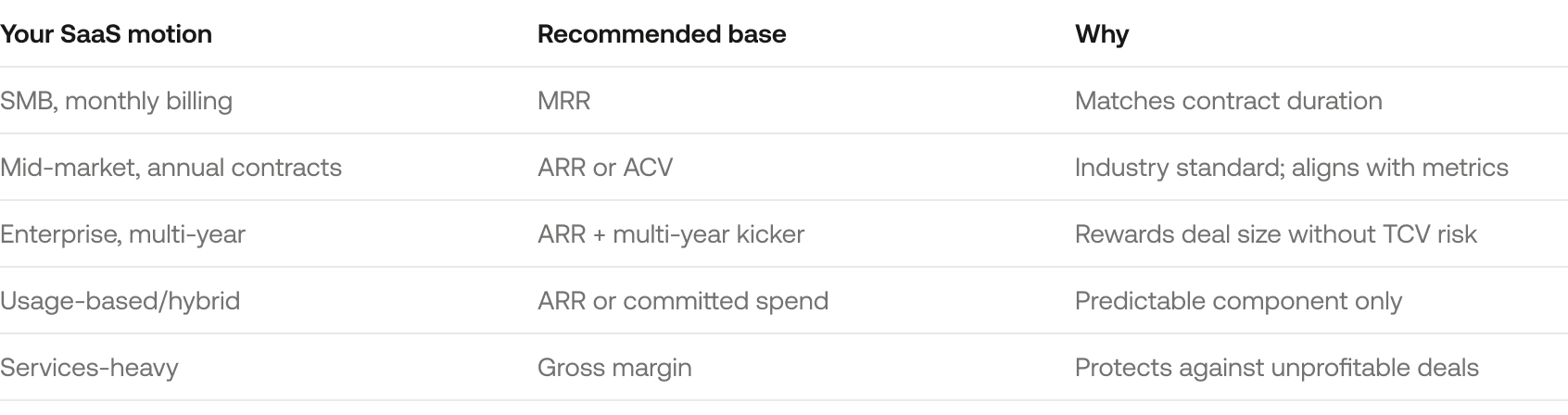
Decision matrix
The right base connects directly to how you recognize revenue. If your billing system and rev rec are already aligned, commissions become a natural downstream output. If they're not, you're building on a broken foundation.
Step 2: Set your commission rate
There's no universal "right" rate. Anyone who tells you "SaaS commissions are 10%" is skipping the context that makes that number meaningful or meaningless.
The reverse-engineering method
Most SaaS companies work backward from OTE. This is the honest way to set rates:
That 10% only works because of the specific relationship between OTE and quota. Change either number and the rate changes too.
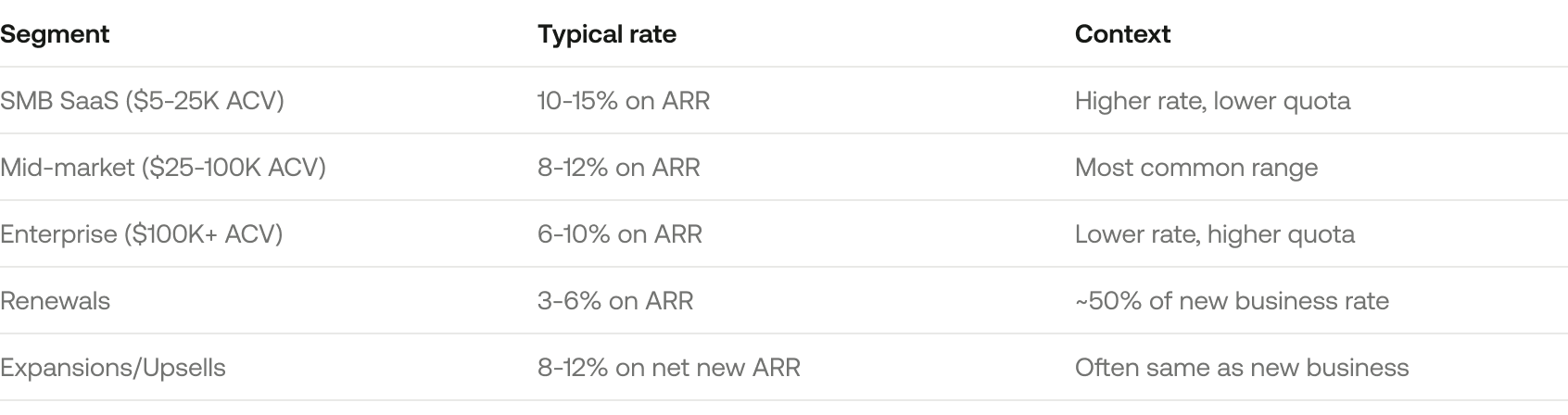
Benchmark data by segment
Why "industry standard" is a dangerous phrase
10% on a $1M quota equals $100K variable comp. 10% on a $500K quota equals $50K variable comp. Same rate, completely different economics. Same rate, completely different caliber of rep you'll attract.
Always start with OTE and quota, then derive the rate. Never set the rate first and hope it works.
Step 3: Apply attainment multipliers
Flat commission rates are rare in scaling SaaS companies. Most plans include accelerators that reward overperformance and sometimes decelerators that reduce payouts for underperformance.
How accelerators work
Here's a typical tiered structure:
- 0-79% of quota: 8% commission rate
- 80-99% of quota: 10% commission rate
- 100-119% of quota: 12% commission rate
- 120%+: 15% commission rate
And here's the actual calculation for a rep who closes $900K ARR against a $750K quota (120% attainment):
Tier 1 (first $592.5K, up to 79%): $592.5K × 8% = $47,400
Wait. That doesn't look right, does it? This is actually a common source of confusion. Some companies apply tiers marginally (like income tax brackets, shown above). Others apply the highest achieved rate to the entire amount. Your plan document needs to specify which method you use. Ambiguity here is where disputes start.
Linear vs. step accelerators
Linear accelerators increase the rate smoothly. For every 10% above quota, add 0.5% to the commission rate. Simple, predictable, no cliff effects.
Step accelerators jump at thresholds. They're easier to communicate but can create sandbagging behavior. A rep at 118% attainment might hold a deal to hit the 120% threshold next quarter.
One important rule: accelerators should start paying elevated rates at 100% of quota or higher. Paying elevated rates below quota rewards underperformance.
Step 4: Handle SaaS-specific edge cases
Here's where spreadsheet-based commission plans actually collapse. These situations happen constantly in B2B SaaS, and each one requires clear policy and precise math.
Multi-year deals
A rep signs a $360K, 3-year deal. How much commission do you pay?
Option 1: First-year ARR only. Pay on $120K ARR. Commission: $120K x 10% = $12K. This matches revenue recognition. It's manageable cash impact. But the rep may feel underpaid relative to the deal's total value.
Option 2: TCV with deferred vesting. Pay on $360K TCV but vest over 3 years. Year 1: 65% ($23.4K). Year 2: 25% ($9K). Year 3: 10% ($3.6K). This rewards multi-year commitment and creates retention incentive, but it's complex to administer.
Option 3: ARR + multi-year kicker. Pay $12K on ARR plus a $4K bonus for the 3-year term. Simple. Rewards longer terms without creating TCV risk.
For companies between $3-10M ARR, Option 1 is simplest and matches your revenue recognition. Add a multi-year kicker if you specifically need to incentivize longer terms.
Renewals
The spectrum runs from $0 (CS owns retention, no sales commission) to full rate (treat renewals like new business). Most companies land somewhere in between.
Here's a decision framework:
If your renewal rate is above 90% and reps aren't involved in the renewal process, pay $0. If reps own renewals but the effort is low, pay 50% of the new business rate. If expansion is core to your growth strategy, pay full rate on net new ARR only (not on the flat renewal portion). If you run a true land-and-expand motion where the initial deal is deliberately small, consider full rate on everything.
Worked example:
Customer renews at $100K (same as last year):
- Zero-commission approach: $0
- Half-rate approach: $100K × 5% = $5K
- Expansion-only approach: $0 (no growth)
Customer renews + expands to $150K (+$50K net new):
- Zero-commission: $0
- Half-rate: $150K × 5% = $7.5K
- Expansion-only: $50K × 10% = $5K
Clawbacks
Rep earns $10K commission on a $100K ARR deal. Customer churns after 4 months. Do you claw back?
Common policies include: no clawback period (rep keeps it, typical for companies with less than 10% churn), 12-month clawback (prorated based on months active), or a 6-month cliff (no clawback after 6 months of customer retention).
Clawback calculation:
Original commission: $10,000
Customer churns after 4 months (33% of 12-month period)
Practical considerations: clawbacks must be documented in writing and comply with state labor laws. Many companies deduct clawbacks from future commission checks rather than demanding repayment. An alternative approach is to skip clawbacks entirely but reduce base commission rates to account for expected churn.
Proration
Rep joins mid-quarter: Prorate the quota. Adjusted Quota = Full Quarter Quota × (Days Worked / Days in Quarter). A rep starting 30 days into a 90-day quarter gets two-thirds of the full quota.
Deal closes on the last day of the quarter: Use close date (contract signature), not contract start date. Align with your booking recognition policy and document it clearly.
Splits
When multiple people work a deal, you need predefined rules:
AE + SDR split: 80/20 or 90/10
Total commission pool: $12,000
AE: 80% = $9,600
SDR: 20% = $2,400
Overlay specialists (solutions architects, security engineers) typically receive 10-20% of the AE's commission. Territory reassignments mid-cycle need a written policy specifying how credit splits based on deal stage at handoff.
Define split rules upfront in your comp plan document. Disputes over splits are one of the top sources of sales team friction. Every single time.
Discount approval and deal margin
Rep discounts a $100K deal to $70K. Pay commission on actual contract value ($70K), not list price. Some companies add a minimum margin threshold: if deal gross margin falls below 60%, the commission rate drops to 50% of standard. This is how you handle complex pricing without creating unprofitable deals.
Step 5: Choose your payout timing
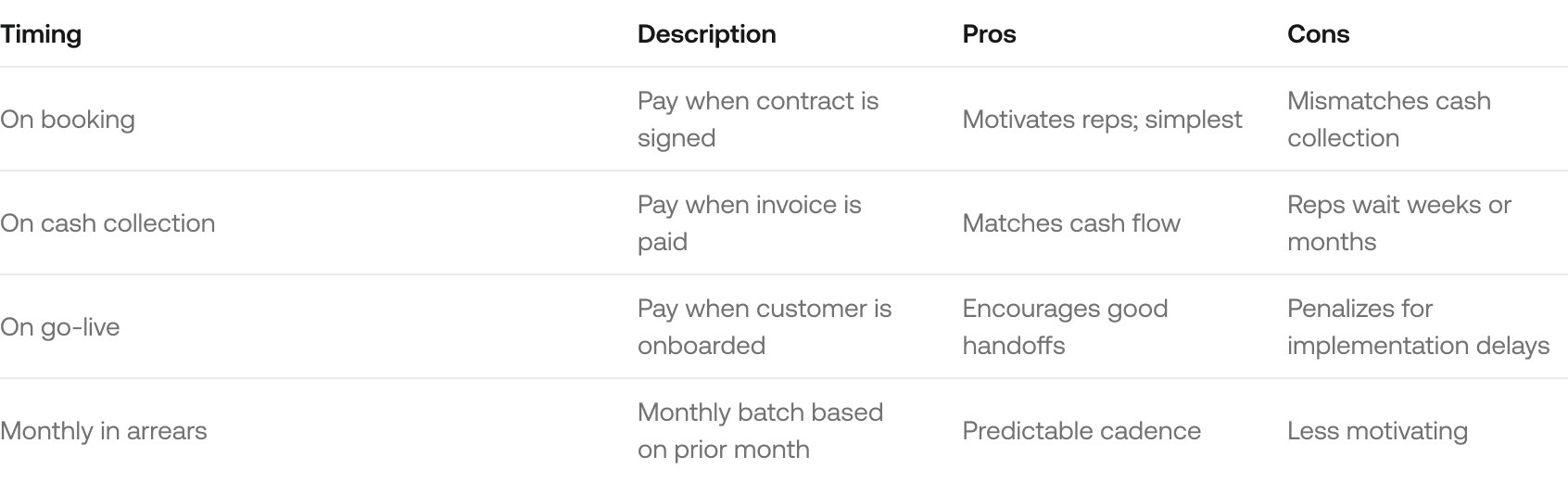
When you pay matters as much as how much you pay.
For $3-10M ARR SaaS companies, monthly on bookings is the most common approach. Pay all deals closed in the prior month, regardless of collection. It's simplest to administer, keeps reps motivated, and churn risk at this stage is typically manageable.
If cash flow is a concern, add a collections modifier: reduce commission by 10-20% if an invoice goes more than 60 days past due. This is lighter than full cash-collection gating and doesn't require you to track every invoice payment against every commission payout.
The gap between when you sign a contract and when you actually collect cash is a problem that compounds as you grow. If that gap between your signed contract and your first invoice is already causing problems, fixing it upstream will make commission timing dramatically simpler.
Complete worked example
Let's put it all together.
Sarah is an AE at a mid-market SaaS company. Her OTE is $150K ($75K base, $75K variable). Her annual quota is $750K ARR. Her company pays 10% on new business ARR, 5% on renewal ARR, and 10% on expansion ARR. Accelerators kick in at 120% attainment.
Sarah's Q1 activity:
Closed a $200K ARR new business deal (3-year term)
Renewed an existing customer for $100K ARR (flat renewal)
Expanded another customer from $50K to $80K (+$30K net new ARR)
- New business + expansion ARR toward quota: $230K
- Q1 quota (25% of annual): $187,500
- Attainment: 123%
Sarah earned $28K in Q1 on $230K closed ARR. That's a 12.2% effective rate because expansions and renewals diluted her blended rate. This is normal in land-and-expand SaaS businesses. Her 123% attainment would trigger accelerators if her company uses a quarterly measurement period, but the specifics depend on whether accelerators apply to individual deals or cumulative performance.
Common calculation mistakes to avoid
Mistake 1: Paying on TCV without vesting. This creates massive cash flow mismatches. Pay on ARR or use deferred vesting schedules.
Mistake 2: Not defining "close date" vs. "start date." This creates end-of-quarter disputes. Use contract signature date as trigger, not go-live date. Document it.
Mistake 3: Ignoring partial-year proration. This overpays reps who join late in the year. Prorate quota for anyone starting mid-period.
Mistake 4: Setting accelerators that pay out below 100% quota. This rewards underperformance. Accelerators should start at 100%+ attainment only.
Mistake 5: No written clawback policy. This creates legal risk and rep resentment. Document clawback rules in offer letters and comp plan documents.
Mistake 6: Calculating commissions on revenue you haven't recognized. This creates finance/sales misalignment and overstated expenses. Align your commission base with how you actually recognize revenue.
Mistake 7: Manually joining data from 3+ systems every month. This is error-prone, time-consuming, and not going to survive your next growth phase. If you're stitching together Salesforce exports, billing system data, and contract spreadsheets, you're one mistake away from a costly dispute.
When to move beyond spreadsheets
Spreadsheet-based commission calculations work until they don't. Here are the warning signs you've hit the breaking point:
You have more than 5 sales reps with different quotas. Your plan includes accelerators, clawbacks, or splits. You're spending more than 10 hours per month reconciling disputes. You have to manually join data from Salesforce, your billing system, and your contract database. Reps don't trust the numbers and constantly ask for "show me the math." Your finance team dreads month-end close because commission calculations are part of the bottleneck.
If three or more of those describe your situation, you've outgrown spreadsheets.
The automation spectrum
Level 1: Formula-enhanced spreadsheets. VLOOKUP and INDEX-MATCH to pull data from Salesforce exports. Free and familiar, but still manual, error-prone, and not auditable.
Level 2: Commission-specific software. Tools like CaptivateIQ, Spiff, or QuotaPath. Purpose-built for complex plans. But they don't connect to your contract or billing data natively. You're still exporting, transforming, and importing. The source of truth lives somewhere else.
Level 3: Connected revenue infrastructure. Commissions are just one output of your revenue data. When contracts, billing, revenue recognition, and commissions live in one connected system, the commission calculation automatically updates when a contract changes. No manual data transfer. No reconciliation. The contract is the source of truth, and commission payouts propagate from it.
This is how it should work: a rep closes a deal, the contract goes in, billing schedules generate, revenue recognition posts, and commissions calculate. Together. In one place.
What to look for in a commission system
Must-haves: automatic data sync from CRM and billing, full audit trail, rep self-service portal (so they can see their own math), flexible plan builder that handles your edge cases without custom code, and integration with payroll.
Nice-to-haves: scenario modeling to test plan changes before rolling them out, clawback automation, and multi-currency support.
How many systems does it take to calculate one rep's commission? If the answer is more than one, you're paying a stack tax in reconciliation time, error rates, and rep trust.
FAQ: How to calculate SaaS commissions
Should SaaS commissions be based on ARR or ACV?
For multi-year contracts, use ARR (one year's recurring value) to match how you recognize revenue and how investors value your business. ACV is similar but includes normalized one-time fees. Avoid TCV unless you have a deferred payout structure that vests over the contract term.
What is a typical commission rate for B2B SaaS sales?
8-12% on ARR is most common for mid-market SaaS, but the "right" rate depends on your OTE structure and quota. Work backward: Rate = Target Variable Comp / Quota. A rep with $75K variable comp and $750K quota earns 10%.
Do you pay commission on renewals?
It varies by motion. Many companies pay 0% if renewal rates are high and CS owns retention. Others pay 50% of the new business rate (e.g., 5% instead of 10%) if AEs are involved. Pay full rate on net new expansion ARR if you have a land-and-expand motion.
How do you handle clawbacks when a customer churns?
Common policies: no clawback if customer stays beyond 6-12 months, prorate clawback based on months active within the clawback window, or skip clawbacks entirely but reduce commission rates to account for expected churn. Always document your policy in writing and check state labor laws.
When should you pay commissions, on booking or cash collection?
On booking is most common for B2B SaaS and keeps reps motivated. Pay monthly, batching all deals closed in the prior month. If cash flow is a concern, add a collections modifier for late payments rather than gating all payouts on collection.
How do you calculate commission on multi-year deals?
Three options: pay on first-year ARR only (simplest, matches rev rec), pay on TCV with deferred vesting (complex but rewards long terms), or pay on ARR plus a multi-year contract kicker bonus. For most $3-10M ARR companies, option one with an optional kicker is the right balance.
At what point should you stop using spreadsheets for commissions?
When you have more than 5 reps, multiple plan components (accelerators, splits, clawbacks), or spend more than 10 hours per month reconciling disputes. At that point, commission software or a unified revenue infrastructure platform is worth the investment. The spreadsheet breaking point typically hits around $5M ARR.
The path forward
Calculating SaaS commissions accurately requires more than a simple percentage. You need the right revenue base, competitive rates derived from OTE and quota, clear policies for edge cases, and a payout timing that balances motivation with cash flow.
For early-stage SaaS companies, spreadsheet calculations work. But most $3-10M ARR companies hit the wall when they cross 5-10 reps or add plan complexity like accelerators and splits. At that point, manual calculations create disputes, errors, and RevOps burnout.
The honest truth: commissions aren't an isolated problem. They're a symptom of disconnected revenue data. When your contracts, billing, and rev rec live in separate systems, commissions become a reconciliation nightmare.
Measure connects contracts, billing, revenue recognition, and commissions in one system. Commission payouts calculate automatically from your contract data. Full audit trails. Zero manual exports. Reps can see their own math.
Book a demo to see how it works with your specific commission plan.
See it in action.
Billing and revenue automation that handles contracts, invoicing, revenue recognition, and commissions in one connected system. Book a demo to see how Measure works.