Consumption billing: what it is and why it matters
Consumption billing charges customers based on actual usage. Here's how it works, the real trade-offs for finance teams, and what it means for rev rec and commissions.
Consumption billing charges customers based on what they actually use. Not a flat monthly fee. Not a per-seat count. The actual, measured quantity of whatever value your product delivers.
If you're a finance or RevOps leader at a growing SaaS company, you're probably reading this because someone on your team just proposed usage-based pricing. Or you're already running it and the billing complexity is starting to bite. Either way, you need the full picture. Here it is.
What is consumption billing?
The core definition
Consumption billing is a pricing model where customers are charged based on the quantity they actually consume, measured in defined units, rather than paying a fixed fee for access.
Think: per API call, per GB of data processed, per document generated, per AI inference run, per active user (not licensed seat). The customer's bill goes up when they use more. It goes down when they use less.
How it differs from subscription and seat-based billing
In a traditional subscription model, the customer pays a fixed amount each period regardless of how much they use. Seat-based billing ties cost to the number of licensed users. Both create predictable invoices.
Consumption billing breaks that pattern. The invoice amount varies every period based on actual usage. That single difference cascades into how you recognize revenue, calculate commissions, forecast growth, and build invoices.
Common names for the same idea
The terminology is a mess, so let's clear it up. Consumption billing, usage-based pricing, metered billing, and pay-as-you-go all describe essentially the same model. The terms vary by vendor and industry, but the mechanics are the same: measure usage, apply a rate, generate a bill.
Throughout this article, we'll use "consumption billing" as the primary term, but everything here applies to usage-based billing as well.
How consumption billing works: the three-layer model
Every consumption billing setup, whether simple or complex, runs on three layers. If any layer breaks, the whole system breaks.
Layer 1. Metering: tracking what gets used
Metering is the instrumentation layer. Your product captures usage events with three pieces of data: who (the customer or tenant ID), what (the billable unit or event), and when (the timestamp).
This sounds straightforward. It isn't. Metering failures are the number-one source of billing disputes in consumption models. A missed event means you undercharge. A duplicate event means you overcharge and get an angry email from procurement. Accurate metering is the foundation. Everything downstream depends on it.
Layer 2. Rating: turning usage into a dollar amount
Rating is the logic layer. It takes raw usage events and applies the pricing rules from that customer's contract. That might mean a flat per-unit rate, a tiered structure, volume discount thresholds, or credit deductions.
Here's where complexity compounds. A single customer can have multiple concurrent rating rules based on their contract terms. One SKU might be tiered. Another might be flat-rate with a volume discount kicking in at a certain threshold. Your rating engine needs to handle all of this without manual intervention.
Layer 3. Invoicing: presenting it to the customer
Invoicing aggregates rated events over the billing period, applies any minimums or caps from the contract, and generates a line-item invoice the customer can actually understand.
Transparent invoicing is a trust driver. If a customer can't reconcile their invoice against their own usage data, they'll dispute it. And disputes at scale eat your finance team's bandwidth fast.
The main consumption billing structures
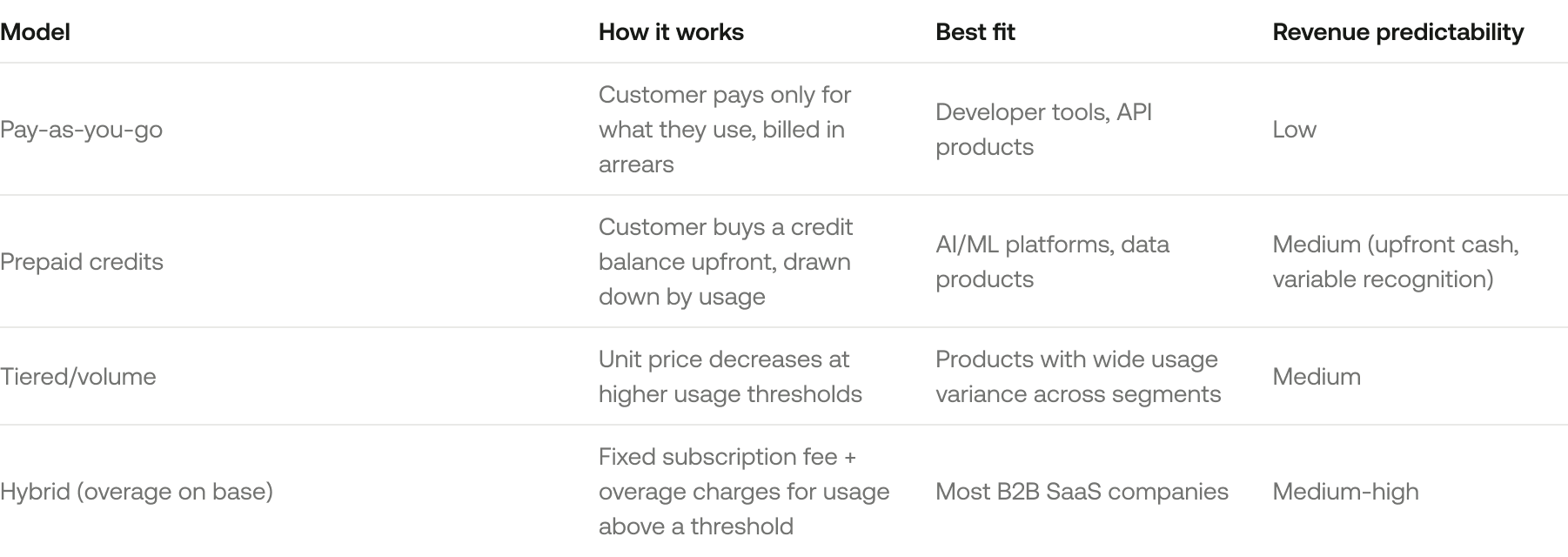
Not all consumption billing looks the same. Here are the four structures you'll encounter in B2B SaaS:
Pay-as-you-go
Pure PAYG is actually rare in B2B SaaS. Enterprise procurement teams dislike unpredictable costs, and your finance team will dislike unpredictable revenue. It works best for developer tools with self-serve adoption and low average contract values.
Prepaid credits
Popular with AI and API companies. The customer purchases a credit balance. Usage draws down that balance. This gives you upfront cash, but those credits sit as deferred revenue (a liability on your balance sheet) until the customer consumes them. If you're tracking credit balances in spreadsheets, that stops working around 40 to 50 active accounts.
Tiered and volume pricing
Tiered pricing is a pricing structure within consumption billing. It's not a separate model. The unit price changes at defined thresholds. This gives customers cost predictability at scale while still aligning price to usage.
Hybrid: overage on a base subscription
This is the most common structure in B2B SaaS because it preserves a revenue floor while allowing expansion. The customer pays a fixed subscription that includes a usage allotment. Usage above that allotment generates overage charges. If you're evaluating consumption billing for the first time, hybrid is likely where you'll land.
Why B2B SaaS companies are moving to consumption billing
Alignment with value delivery
When your price tracks usage, customers pay in proportion to the value they receive. This reduces procurement friction and makes renewals easier. Nobody argues about the price of something when they can see exactly what they got for it.
Lower barrier to entry accelerates adoption
Consumption billing lets customers start small. No big upfront commitment. No negotiating seat counts before they've evaluated the product. This matters for product-led motions where you want fast adoption.
Expansion revenue without a sales motion
This is the finance-relevant point. Net revenue retention improves when customers can grow their spend without a sales-assisted upgrade. In a seat-based model, expansion requires a contract amendment. In a consumption model, a customer who doubles their API calls doubles their bill. That expansion shows up in your NRR metrics automatically.
Research from OpenView consistently shows that companies with usage-based pricing report higher net dollar retention than their subscription-only peers.
It fits how AI and API products are actually used
AI inference costs, token consumption, and API call volumes are inherently variable. Forcing these into a flat subscription creates misalignment. One customer runs 100 inferences a month. Another runs 100,000. Charging both the same price doesn't work. Consumption billing is a natural fit for these products because usage patterns vary dramatically across customers.
The real trade-offs (what most guides skip)
Here's where we get honest. Consumption billing creates genuine operational complexity for finance and RevOps teams. If you're evaluating this model, you need to know what you're signing up for.
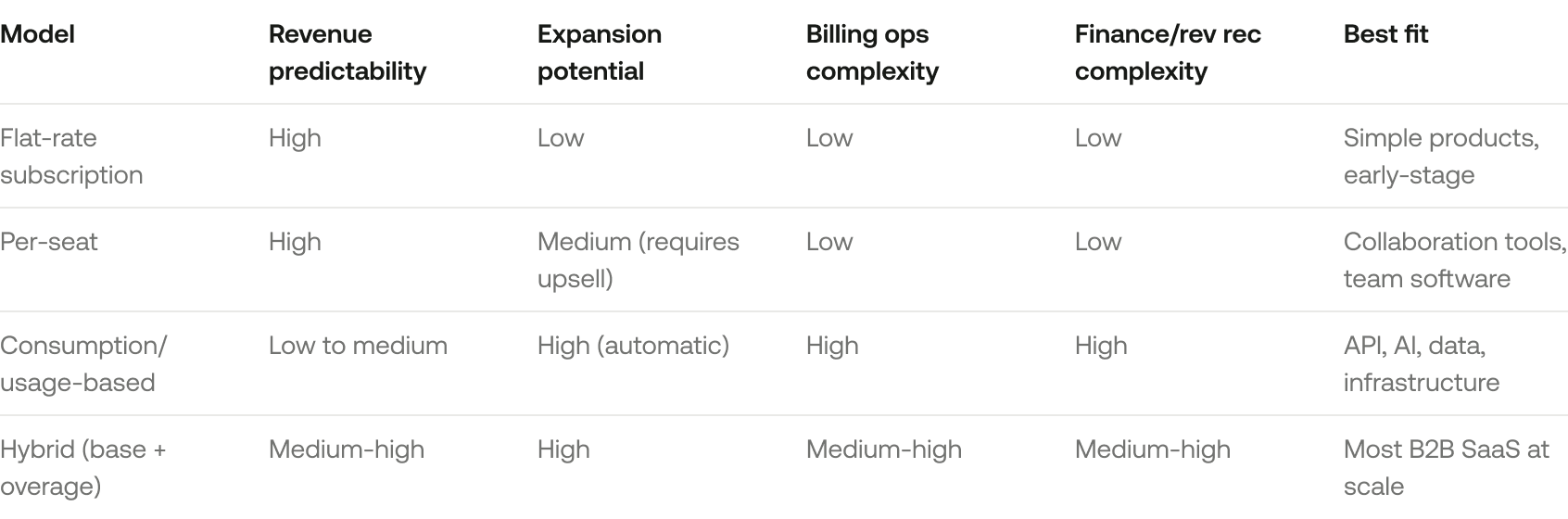
Revenue predictability takes a hit
Monthly ARR calculations get murky. You can't just multiply contracted seats by price. You need to model usage cohorts, track trailing usage trends, and build forecasts on consumption data rather than contract values alone. Your board deck gets harder to build.
Billing complexity goes up significantly
A seat-based invoice has one to three line items. A consumption invoice might have 50. Error rates rise. Customer service burden increases. Your billing platform needs to handle variable-rate SKUs, usage ingestion, credit balance tracking, and contract-level minimums. If you're stitching this together with Stripe plus manual invoicing, you'll feel the pain quickly.
Revenue recognition gets harder
Finance note: Under ASC 606, consumption revenue is recognized as the performance obligation is satisfied. That means as usage occurs. Not when the contract is signed. Not when the invoice is sent.
If a customer has prepaid credits, those sit as deferred revenue until consumed. Or until they expire, at which point you recognize them as breakage. Variable consideration guidance applies to usage estimates in many cases. Your auditor will have opinions. Manual spreadsheet tracking of consumption rev rec breaks fast.
Commissions and quota relief become more complex
How do you pay quota credit on a deal when the customer's actual spend might be 30% above or below the contracted estimate? Most commission plans aren't built for this. RevOps ends up rebuilding commission calculations in Excel every month, reconciling contract value against actual usage against payout.
Customers can spend less than you planned
Unlike seats, there's no renewal event to manage. A customer can simply stop using the product and their bill drops to zero without any formal churn. This requires proactive usage monitoring and customer health scoring based on consumption trends, not just contract dates.
What consumption billing means for your finance stack
This is where the definition meets your daily operations.
Your billing system needs to handle variable-rate invoicing. That means usage ingestion, a rating engine, credit balance tracking, and contract-level minimums and caps. If your billing implementation can't support these natively, you'll build workarounds. Workarounds become technical debt. Technical debt becomes month-end fire drills.
Revenue recognition under ASC 606 changes. Consumption revenue is recognized at delivery. Credits are recognized over the expected usage period or at expiration. You need a system that tracks both in real time. Not a spreadsheet updated once a month.
Commissions need contract value, usage estimates, and actual usage. Without a system that connects these three data sources, your RevOps team is the connection. And they're doing it manually.
Forecasting requires usage data, not just contract data. Your pipeline needs to feed in estimated usage. Finance needs usage trends by cohort, not just bookings. The forecasting model you built for subscription billing doesn't transfer cleanly.
If your billing model is getting more complex, your finance stack needs to keep up. See how Measure connects consumption billing to rev rec, commissions, and reporting in one system. See how it works.
Consumption billing vs. other pricing models
When consumption billing is (and isn't) the right choice
Signs it's the right fit
Your product has a clearly measurable value unit. API calls, documents processed, data volume, AI inferences. Usage varies significantly across customers. You want product-led expansion without sales overhead. And your customers are asking for it. If procurement is pushing back on seat counts that don't map to actual usage, that's a signal.
Signs you're not ready for it yet
Your metering infrastructure doesn't exist. Your billing system is Stripe plus manual invoicing in QuickBooks. Your rev rec is still done in spreadsheets. Your sales comp plan hasn't been updated to handle variable contract value. These aren't permanent blockers. They're prerequisites. Address them before you flip the switch on consumption pricing, or you'll create more problems than you solve.
If you're somewhere in between, evaluating a migration from your current billing setup, start by mapping the operational requirements before committing to a pricing model change.
Glossary: key terms in consumption billing
Metering. The process of capturing, counting, and recording usage events in real time.
Rating engine. The system that applies pricing rules to raw usage data to calculate a dollar amount.
Billing period. The time interval over which usage is aggregated for invoicing (monthly, quarterly, or custom).
Deferred revenue (credits). Prepaid credits that sit as a liability on your balance sheet until consumed or expired.
Overage. Usage that exceeds a contracted allotment, billed at a defined per-unit rate.
Minimum commitment. A contractual floor the customer pays regardless of actual usage.
Hybrid billing. A model combining a fixed subscription fee with variable consumption charges.
ARR in consumption context. Annualized recurring revenue becomes harder to calculate. Many companies use trailing 12-month usage or annualized trailing 3-month usage as a proxy.
Usage cohort. A group of customers segmented by usage behavior, used for forecasting and retention analysis.
Frequently asked questions
Is consumption billing the same as usage-based billing?
Yes, functionally. The terms are interchangeable in most B2B SaaS contexts. "Consumption billing" tends to emphasize the billing mechanics. "Usage-based pricing" tends to emphasize the pricing strategy. The underlying model is the same: measure what the customer uses, apply a rate, generate an invoice.
Can you combine consumption billing with a subscription?
Absolutely. This hybrid model is actually the most common approach in B2B SaaS. The customer pays a fixed base fee (often including a usage allotment) plus variable charges for consumption above that threshold. It gives you a revenue floor while preserving the expansion benefits of usage-based pricing.
How do you recognize revenue from consumption billing under ASC 606?
Consumption revenue is recognized as the performance obligation is satisfied, which means as usage occurs. Prepaid credits are recorded as deferred revenue (a liability) and recognized as the customer consumes them, or as breakage if they expire unused. Variable consideration guidance under ASC 606 may also apply to usage estimates in contracts with minimums or commitments. Consult your auditor for your specific contract structures.
What's the difference between tiered pricing and consumption billing?
Tiered pricing is a pricing structure within consumption billing, not a separate model. Consumption billing is the overarching approach of charging based on usage. Tiered pricing defines how the per-unit rate changes at different volume thresholds. You can run consumption billing with flat per-unit rates, tiered rates, volume discounts, or credit-based deductions.
Consumption billing isn't inherently better or worse than subscription pricing. It's a fundamentally different operational model that affects every part of your revenue infrastructure, from how you build invoices to how you recognize revenue to how you pay your sales team.
If you're evaluating consumption billing or already running it and feeling the operational weight, Measure connects contracts, billing, rev rec, and commissions in one connected system. No spreadsheet reconciliation. No month-end fire drills. Book a demo to see how it works for usage-based models.
See it in action.
Billing and revenue automation that handles contracts, invoicing, revenue recognition, and commissions in one connected system. Book a demo to see how Measure works.